


Gloria Steinem died at her home in New York City on Wednesday at 92, and her foundation posted the announcement on Instagram without giving a cause. She was working into her final year, with an International Women’s Day event at the New York Stock Exchange in March and a public conversation at 92Y on February 2.
The obituaries are going to spend today on the biography, and they should, because the biography is remarkable. Toledo. India on a Chester Bowles fellowship. The 1963 Playboy Club piece. Ms. magazine in 1971. Fifty years on the road. The aviator glasses.
I want to write about something narrower, because the biographies will not, and because it is what her death actually costs us.
A short piece I wrote earlier this week was about a movie
The essay went up on Monday. It looked at 9 to 5, the 1980 comedy, and asked what a viewer today could and could not understand about the workplace it shows. Franklin Hart puts his hands on Doralee. He spreads a rumor about her. She has no way to correct the story, and the other women turn on her.
The obvious question, from anyone under about fifty, is why she doesn’t report him.
That question sounds reasonable because a person asking it has lived their entire life inside a category, one that did not exist when the movie was made. Meritor Savings Bank v. Vinson, which established that a hostile work environment was sex discrimination under Title VII, was decided in 1986, six years after the film. The phrase “sexual harassment” was about five years old when the movie was shot. The EEOC issued its guidelines that same year.
I wrote that a young viewer could look up every one of those facts in ninety seconds and still not understand why Doralee doesn’t act. Because the presence of a category is not a fact you retrieve. It is the shape of the room you live in.
What that essay did not say, because it was about something else, is where the category came from.
She put it there
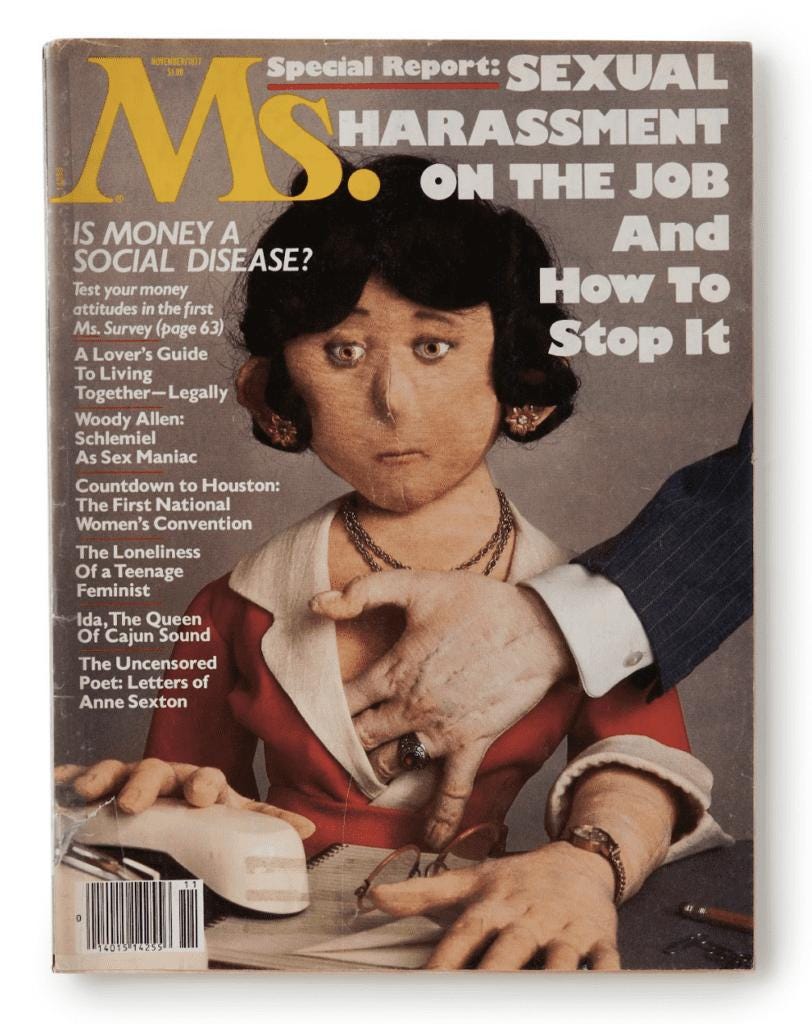
Ms. magazine, in the 1970s, ran the first major magazine cover on sexual harassment in the workplace. It featured a doll being fondled by a man. Katherine Spillar, an executive editor of Ms., recalled to CBS that the cover got the issue pulled off newsstands.
That is what building a category looks like from the inside. There was no phrase for the thing. Somebody had to name it, in print, in a magazine that had to fight to exist, on a cover that got the issue banned in some places, and then somebody had to argue for it in a courtroom, and then somebody had to convince a Supreme Court, and none of that would have moved without the language, and the language did not exist until she and the people around her put it there.
The reason a 25-year-old in 2026 can look at Doralee and think she had options is that Gloria Steinem and the movement she was the most visible face of successfully installed the category into ordinary American life. It became so ordinary that it is now invisible.
Invisible is the specific problem. A right that has become invisible is a right with no constituency, because nobody defends what they cannot see.
What is happening while we are writing obituaries
The Supreme Court and lower federal courts have been busy for eighteen months. Title IX enforcement narrowed. Consent decrees regarding sexual harassment at named federal agencies quietly closed. EEOC guidance rewritten. The Justice Department’s Civil Rights Division functionally hollowed out. The Department of Education Office for Civil Rights, which processes Title IX complaints, ran down to roughly a third of the staff it had in January 2025.
I am not writing about that today because a piece on the day of her death is not the place for the tracker. I mention it only to say what a category losing its constituency actually looks like on the ground. It looks like nothing at all, until a specific person needs the protection and finds it missing, and by then the person who could have organized the response is gone or was never trained, because the categories that felt permanent turned out to require continuous defense by people who understood what they had cost to install.
Two things she said, and one thing she was
She said, more than once, that the truth would set you free but first it would piss you off. That line got put on tote bags, which is a fate that happens to lines that survive, and it survived because it was correct.
She also said that a movement was people, and that people did not scale. Movements did not automate. Every generation had to do the work again.
That was true and it was a warning, and it was aimed at exactly the situation we are in now.
The thing she was, which is harder to name, was somebody who understood that a movement’s success is measured by how invisible its language becomes. She wanted the words to disappear into the water because that meant they had won. She also understood, and said clearly, that once they disappeared, the work of protecting them became harder, not easier, because you cannot rally people around a thing they no longer notice.
That is the actual test her death leaves us with. Whether the categories she and her generation installed hold, now that they belong to a country that grew up assuming them, in a moment when they are being quietly removed by people who understand exactly what removal costs.
Now
A young person watching 9 to 5 tonight can look up sexual harassment. Title VII. Meritor. Every fact in that whole apparatus. Ninety seconds each.
The apparatus is there because she put it there.
The apparatus is being taken apart now, in ordinary agency actions and executive orders and rewritten guidance, none of which anyone will register as historic while it is happening, and all of which are difficult to reverse.
If you are looking for something to do today besides mourn her, the useful thing is to notice which of the things you take for granted are the things she built, and then to notice which ones are being unbuilt, and then to act as if that matters. Which was what she did for sixty years, and which is why the question of why Doralee didn’t report him is available to be asked at all.
She died at home, at 92, working to the end. May her memory be a blessing, and may her method be a curriculum.
Thank you for this thoughtful and challenging tribute. I graduated HS in ‘75 and am horrified to see acceptance of sexual harassment creeping into the younger generation’s attitudes.
Well thought out and well written. Thank you.