


In Argentina, Uruguay, Paraguay, and southern Brazil, mate is served by one person to everyone. The server is called the cebador. There is a gourd, a metal straw called a bombilla, and a circle of people, and it goes around in order, and everyone drinks from the same straw.
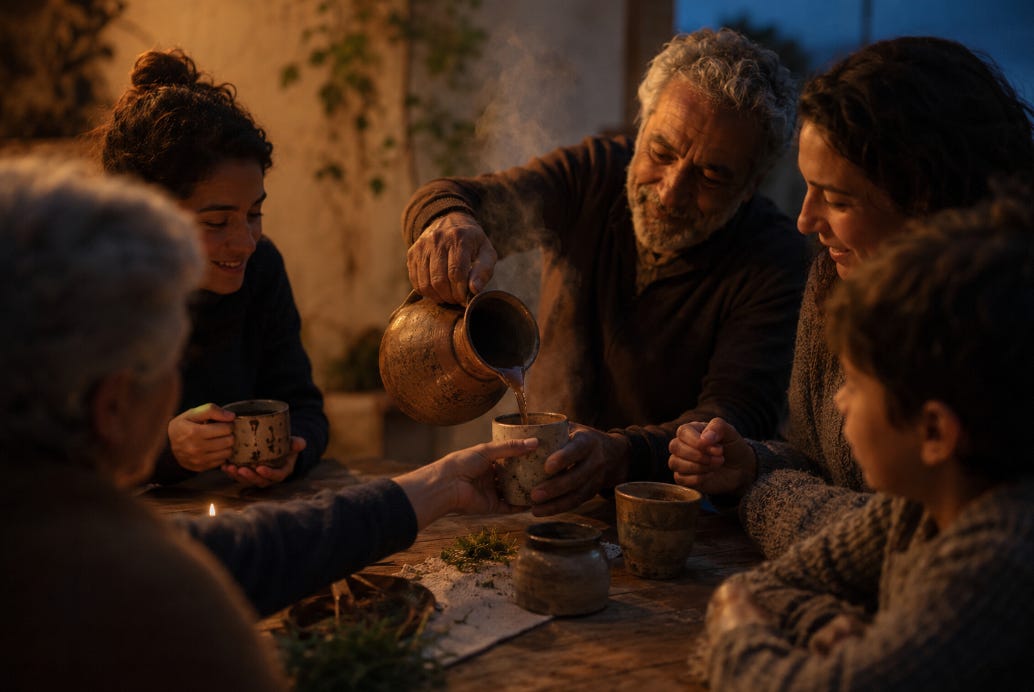
The cebador drinks first.
Not as a privilege. The first pour is the harshest, gritty with dust off the dry leaves, and handing it to a guest would be an insult. So the person doing the work takes it themselves, every time, before anyone else is served.
Nobody wrote that down. It is not enforced by anything. Somebody decided the host should absorb the bad cup, and then everyone agreed, and it has been that way for longer than anyone can trace.
Three times, from the same leaves
In an Ethiopian household the ceremony is called buna and it runs one to three hours.
Green beans are roasted in a pan over an open flame, and the pan is walked around the room so everyone can lean in and take the smoke. The beans are pounded by hand in a wooden mortar called a mukecha. They are brewed in a long-necked clay pot called a jebena, often shaped by an older woman in the same community and fired in an open kiln. The coffee is poured from a hand span or more above a row of small cups, in one unbroken stream.
Frankincense burns. Fresh grass is spread across the floor.
Then it is done twice more, with the same grounds and fresh water, and each round has a name. Abol is the first and strongest. Tona is the second, by which point the conversation has loosened. Baraka is the third and lightest, and baraka means blessing.
Leaving before baraka is not a minor rudeness. It is understood as declining the blessing.
The everyday Amharic phrase for all of this is buna tetu. It translates as drink coffee. What it means, in ordinary use, is let us sit down and talk.
In the Sahara they do the same thing with tea. Three glasses, one set of leaves, and a saying quoted across the Maghreb. The first is bitter as life. The second is strong as love. The third is gentle as death.
You will find that line in several arrangements depending on who is telling it, which is what happens to a good sentence carried by mouth across a desert for two centuries. The order shifts. The structure never does.
Both traditions are looking at the same dull physical fact, which is that the second and third steepings are weaker than the first. Neither decided it was a defect. They gave the weakening a shape and put a name on each stage of it, and now a pot of coffee has a beginning, a middle, and a blessing.
The pour
Watch the tea go into the glass in a Tuareg camp. The pot comes up high, sometimes a foot or two, and the stream falls a long way to build a head of foam, and there is a proverb that tea without foam is like a Tuareg without a turban.
In Morocco it comes from twelve inches or more, off a silver tray. In Ethiopia the jebena is held well above the cups and the stream is not broken between them.
In Malaysia the tea is thrown. Teh tarik means pulled tea, and it is made by pouring a strong brew of black tea and condensed milk back and forth between two containers with the arms flung wide, which cools it, gives it a froth, and is also indisputably a performance. Malaysia nominated it to UNESCO as intangible cultural heritage.
There are technical justifications available for all of it. Aeration, cooling, a better head. None of them explain the height, because you can aerate tea with a spoon.
The height is because it is worth watching. Somebody is going to some trouble, visibly, in front of you.
The rules are mostly kindnesses
Look closely at the etiquette in any of these and most of it turns out to be an instruction for taking care of somebody.
In mate, you do not say thank you until you are finished, because gracias is the signal that you want no more. It is not that gratitude is unwelcome. The circle needed one unambiguous way to say I have had enough, that word got the job, and now nobody ever has to ask a guest an awkward question.
In Morocco the tea is traditionally made by the head of the household, or in his absence his eldest son. It is not handed to whoever is nearest.
In Ethiopia the coffee is often carried to the guests by the youngest child in the house, who serves the eldest guest first.
Consider what that one assignment accomplishes. A child is given a job of real consequence in a room full of adults. The oldest person present is honored in front of everyone. And the two people furthest apart in years are the two the ritual puts into direct contact.
Nobody designed that in a meeting. It settled, over generations, into the shape that worked.
Where it came from, which is not where you would guess
None of this is ancient in the way it feels ancient, and none of it began where you associate it with.
Coffee moved out of Ethiopia through Yemen and the Arabian ports. Tea moved out of China. The mint tea of the Sahara is Chinese gunpowder green, and it arrived in North Africa as freight, spreading outward from Morocco to Algeria, Tunisia, Libya, Egypt, and to the Berber and Tuareg. We borrow relentlessly, and that is most of how culture works.
What does not travel in the crate is everything else.
By the reign of Sultan Suleiman, who took the throne in 1792, the Moroccan court had an official whose title was mūl atay, master of tea. In the 1840s the British explorer James Richardson recorded a full Moroccan tea ceremony and noted that tea was drunk widely and all day long.
An imported commodity acquired a dedicated position at court. Then a ceremony. Then a proverb about life, love, and death, and a rule about foam. None of that was in the shipment.
It is not decoration, and it is older than us
Here is the part I had wrong when I started thinking about this, and the correction is better than the error.
The tempting story is that the ceremony is pure surplus. Beautiful, useless, a gift of time with no function, and therefore proof of something noble in us.
That is not what the research says, and the first evidence does not come from anthropology at all. It comes from bats.
The common vampire bat feeds on blood and nothing else. It goes out once a night and takes about fifteen milliliters from a bite it opens with its incisors, and if it misses two or three nights in a row it dies. That is the entire margin.
So a bat that fed comes home to the roost, finds one that did not, and regurgitates part of its meal into the other one’s mouth.
Gerald Wilkinson published this in Nature in 1984 and people have argued about it ever since, mostly over whether it is generosity or just extortion by a hungry relative. The arguing produced better data. In controlled trials, the best predictor of whether a bat gives food turned out to be whether it had received food from that same individual before, and that predicts donations about eight and a half times more strongly than how closely the two are related. Donors initiated the sharing more often than the hungry bats requested it.
They are not feeding their families. They are settling accounts with their friends.
The part that stopped me is how the friendships start. Researchers put previously unfamiliar wild-caught bats together and watched what happened over fifteen months. The bats did not begin by sharing food. They began by grooming each other, at low cost, for a long time, and only after the grooming had gone back and forth did the first regurgitation pass between them.
They build the relationship first. The meal comes later, and once it starts it holds the thing together.
Give a bat a dose of oxytocin and it grooms more and shares more food. Take blood from wild chimpanzees after they have shared food and their oxytocin is elevated, in pairs that are related and pairs that are not.
Which brings us back to our own species and to a word for the subject, commensality. Robin Dunbar at Oxford has spent years on it, and his 2017 paper, titled Breaking Bread, reports that eating together triggers the human endorphin system, the same one activated by laughter and music and physical touch, at a rate that eating alone does not reproduce. People who share meals more often report greater life satisfaction, higher trust, stronger engagement with their communities, and more friends.
So the ritual is not an ornament laid over the useful thing. It is the useful thing, and it did not start with us. The bonding is not a pleasant side effect of the tea. The tea is the occasion for the bonding, and we have been running equipment older than our species without needing to know how it worked.
We did not build these ceremonies because we had time to spare. We built them, over and over, in every climate, out of whatever arrived in the cargo, because groups that ate and drank together held together, and groups that did not, did not.
The three hours are not generosity. They are the dosage.
What it appears to be doing to us
None of this stayed in the lab.
A nationally representative study of eight and a half thousand adolescents found that the more often they ate with their families, the fewer depressive symptoms they reported, the fewer emotional difficulties, and the better their overall wellbeing, with the effect running stronger in girls. A study of roughly nine thousand older adults in China found lower rates of depression among people who shared meals. When researchers checked the parents rather than the teenagers, they found it there too.
In 2025 the World Happiness Report devoted a chapter to it and built the first global dataset on social eating, drawn from the Gallup World Poll. Countries where people share more meals have higher levels of social support, more positive reciprocity, and less loneliness.
Almost all of that is association rather than proof, and the report says so in its own text, noting vast gaps in our understanding of the causal direction. It is possible that people who are already doing well are simply the ones who show up to dinner.
What keeps this from being merely a pleasant correlation is the machinery underneath it. Give a vampire bat a dose of oxytocin and its sharing measurably increases. That is an intervention with an effect, not a survey. We have a plausible biological mechanism at one end and a large, consistent, cross-cultural association at the other, and the thing joining them is the oldest social technology on the planet.
So no, it is not mysticism, and it is not sentimentality either. It is one of the most reliable findings in the wellbeing literature, it costs nothing, it requires no professional, and there is no version of it with a downside.
And if you are eating alone tonight, this is not an accusation. Plenty of us do, for reasons that have nothing to do with choice. It is an invitation, and the threshold is lower than you would think. One other person. Twenty minutes. No screens.
The one you already have
You have one of these. Almost everybody does, and it is usually so ordinary that it has never occurred to you to give it a name.
The coffee that has to happen before anyone in the house is allowed to speak. The particular mug, which is not better than the other mugs. The Sunday dinner nobody formally agreed to attend and nobody misses. The bottle opened only for certain news. The way somebody in your family cuts the bread, which is how their mother did it.
None of it is efficient. All of it is effort nobody is obliged to make.
That is the point and it always was. Anyone can hand you a cup. Taking three hours over it, or pouring from a foolish height, or drinking the gritty one yourself so a guest does not have to, communicates something that speed cannot, which is that you were worth the trouble.
Eight billion of us, across every climate and language and century, working with whatever plant happened to reach us.
We all landed in the same place.
If you want somebody to know they are safe with you, hand them something warm, and then sit down, and do not be in a hurry.
I know - Spike the country's water supply with oxytocin giving an extra helping or two to Washington DC and all the red states.
Another excellemt story, thank you.