


If you have the sense that the food supply is falling apart, the recall numbers do not support you, and I want to start there because it is the thing an honest piece has to deal with first.
The Food and Drug Administration and the Department of Agriculture have reported roughly 160 food recalls so far this year. Last year the figure was 320. In 2018 it was close to 400. Fact-checkers have already gone after the recalls-are-surging framing and they were right to.
So the number is down by half.
Now hold that next to a second number from the same agencies.
The pounds of meat, poultry, and egg products recalled in the first half of this year came to 37.18 million. The ten-year average for a full year is about 23.2 million. Six months of 2026 produced more recalled poundage than any first half in a decade, by a wide margin.
Fewer recalls. Much larger ones.
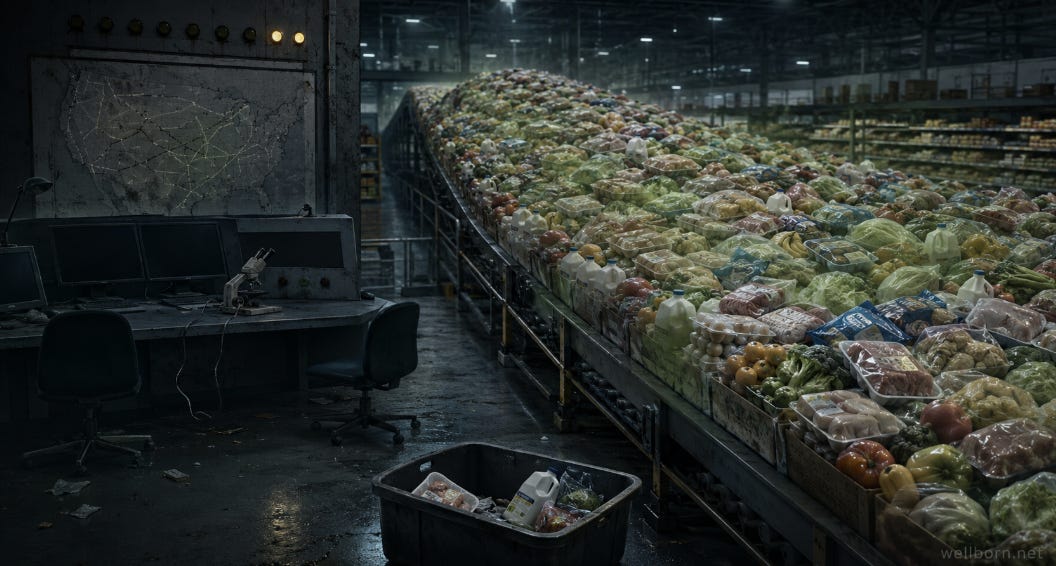
There is one obvious explanation for that combination and it is not a happy one. You do not get fewer, bigger recalls when a system is catching problems early. You get fewer, bigger recalls when problems are running longer before anyone notices.
What a recall actually requires
Almost nobody understands how a recall happens, which is why the count gets misread in both directions.
Three things have to occur. Somebody has to inspect, or test, or otherwise find the contamination. Somebody has to connect the person who got sick in Ohio with the person who got sick in Georgia and establish that it is one outbreak and not two coincidences. And somebody has to trace the product back through the supply chain to the lot and the plant.
Inspection is FDA and USDA. Pattern detection is the CDC, which inspects nothing and exists to connect dots. Traceability is a records requirement on the companies.
Remove any one of the three and there is no recall. Not a delayed recall. No recall, because nobody knows there is anything to recall.
All three have been cut, and I mean that specifically rather than rhetorically.
The surveillance
The CDC used to track eight foodborne pathogens through its active surveillance network. It now tracks two: Salmonella and Shiga toxin-producing E. coli.
The six that were dropped are Campylobacter, Shigella, Vibrio, Yersinia, Cyclospora, and Listeria.
Listeria is the one to hold on to. In 2024 a Listeria outbreak traced to Boar’s Head deli meat sickened at least 61 people and killed ten. It is among the deadliest organisms in the food supply, it grows at refrigerator temperature, and it is now no longer part of the surveillance system that would identify the next one.
The agency did not announce that it was becoming less able to find outbreaks. It reduced what it counts.
The inspection
The staffing numbers are from the Office of Personnel Management and they are not ambiguous.
The FDA lost 3,859 employees in fiscal 2025 and another 473 in fiscal 2026. The CDC lost 2,499 and then 390. The USDA lost 19,984 and then 2,269, with the Food Safety and Inspection Service down 913 across the two years.
The FDA is responsible for about eighty percent of the American food supply, meaning everything except meat and poultry. In 2024 it employed 443 food safety inspectors to cover 36,600 registered food facilities. The agency’s own internal estimate of what it needs is roughly 1,500.
The proposed fiscal 2026 budget would cut Human Foods Program staffing by a further 7.6 percent, and Field Laboratory Operations, which is the capacity that physically tests samples, by 54.4 percent.
And most inspection is not federal anyway. States conduct about ninety percent of produce inspections and seventy-five percent of manufactured food inspections, under federal grants. Those state programs were told to expect funding cuts approaching sixty percent.
ProPublica found that foreign inspections fell by nearly half in one month of 2025 and stayed about thirty percent below prior years through the summer.
The traceability
This is the least visible of the three and possibly the most consequential.
The Food Safety Modernization Act’s Food Traceability Rule requires companies handling high-risk foods to keep records detailed enough that investigators can follow a contaminated lot back to its source quickly. It is the difference between knowing that romaine is making people sick and knowing which farm, which day, which shipment.
The fiscal 2026 appropriations bill restricted the FDA from enforcing that rule until 2028.
The same bill limited enforcement of the Produce Safety Rule and the Pre-Harvest Agricultural Water Rule for certain crops, and restricted the FDA from issuing new Listeria guidelines for low-risk ready-to-eat foods.
In March 2025 the USDA terminated both of its standing food safety advisory committees, the panels that had provided independent scientific guidance on Listeria control, Cronobacter in infant formula, and inspection standards. And the agency withdrew a proposed framework that would have set enforceable Salmonella limits in raw poultry.
Where this came from
The lazy version of this argument is that somebody sat in a room and decided Americans should get sick.
Nobody did that. What happened is worse and more ordinary.
Project 2025 does not contain a chapter on making food less safe. What it contains, and what this administration implemented immediately, is a machine for eliminating regulation as a category.
On January 31, 2025, an executive order established a ten-for-one rule: for every new regulation or guidance document, agencies were to identify at least ten existing ones for repeal. In February a further order directed agencies and the budget office to hunt for rescissions. In April a presidential memorandum instructed agencies to repeal regulations they deemed unlawful without going through notice-and-comment rulemaking, which is the process by which the public gets to object.
In December the White House announced the results. Federal agencies had finalized 646 deregulatory actions against 5 regulatory ones. A ratio of about 129 to 1. The administration called it the best deregulation year in history.
Food safety rules are regulations. They were fed into that machine along with everything else, at a ratio of ten repealed for one issued, by people working against a quota, and nothing in the process required anyone to ask what any particular rule was for.
The Listeria guidance was not targeted. It was processed.
That is the finding, and it should be more alarming than a conspiracy, because a conspiracy has people in it who could be persuaded. A quota has nobody.
What it looks like from your kitchen
You will not experience any of this as policy.
You will experience it as a bag of frozen blueberries that turns out to be a problem, six weeks after you ate them. As a jar of something recalled in nine states. As eggs, a million and a half dozen of them, pulled after about a hundred people were already sick.
And most of the time you will experience nothing at all, because the great majority of foodborne illness is never linked to anything. The CDC’s standing estimate is 48 million illnesses, 128,000 hospitalizations, and 3,000 deaths a year in the United States, and only a small fraction of that ever gets attached to a product, a plant, or a recall notice.
That fraction is the part we can see. It is the part that was being slowly enlarged for fifteen years by traceability rules and surveillance networks and inspector headcount.
It is now being reduced.
The recall count will keep going down. Somebody will put that in a press release.
The one thing to remember
A recall is not evidence that the food supply failed. A recall is evidence that the food supply failed and somebody caught it.
We are going to have fewer of them.