


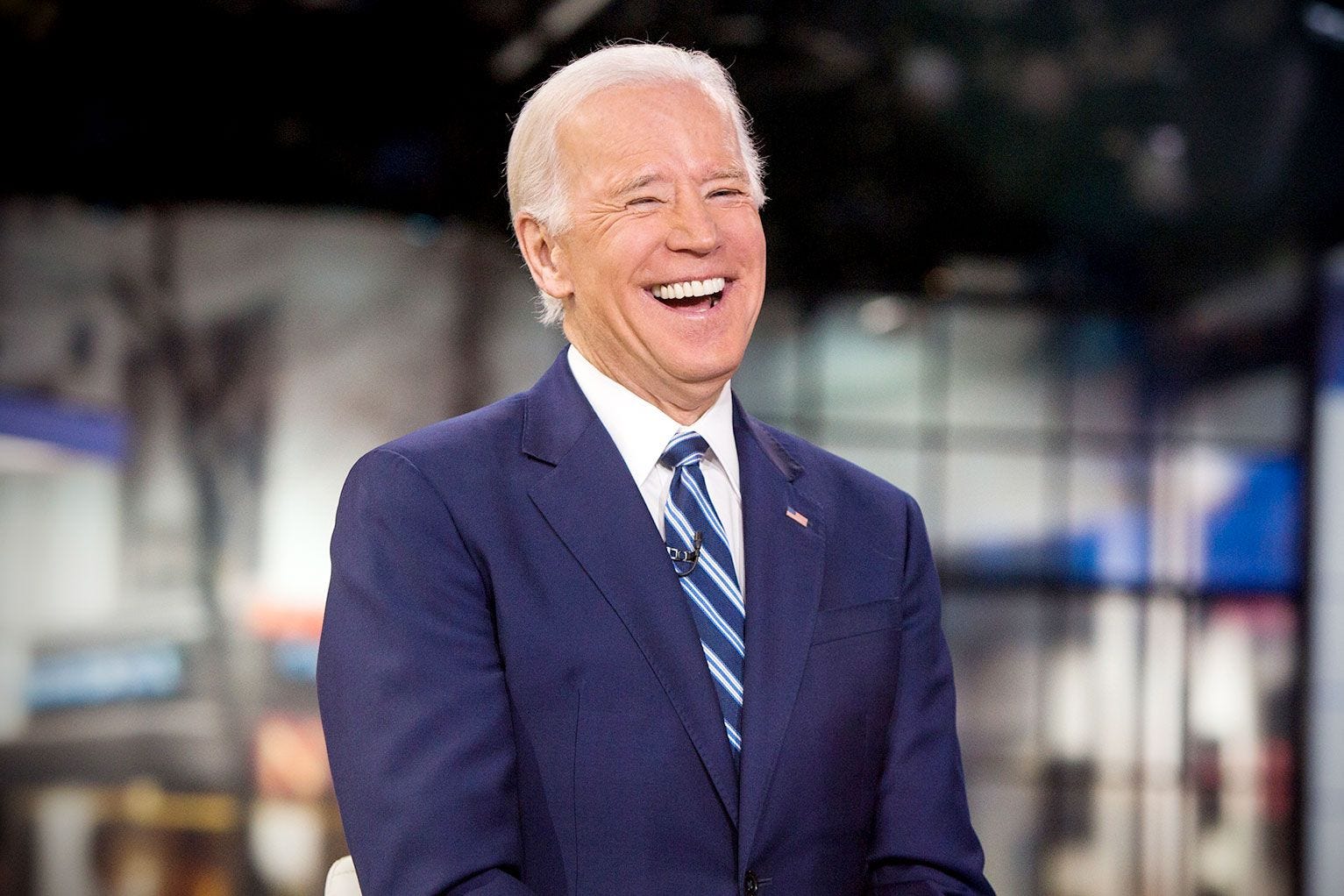
Joseph R. Biden Jr. left the presidency at noon on January 20, 2025.
As of today that is five hundred and forty-nine days. Eighteen months. A span long enough to conceive and deliver two children, complete a master’s degree, or serve out a sentence for a class D felony. Long enough that a child who started kindergarten under this administration is now finishing first grade, having never in her educational life attended a school in a country governed by Joe Biden.
His name came up yesterday in the Senate Appropriations Committee, in sworn testimony, from the Secretary of War.
Pete Hegseth appeared to defend an emergency funding request for the war with Iran. Asked why the request bundled in money for the National Guard and for strikes on suspected drug boats, he explained that the Biden administration had underfunded the Pentagon. He described the previous administration’s failure to develop hypersonics as staggering. He said he did not know what his predecessor, Lloyd Austin, had done.
Senator Patty Murray, the ranking Democrat on that committee, put it plainly afterward. Blaming Biden, she said, is the go-to when they do not have a good answer. And then the sentence that ends the argument: Biden did not get us into this war.
He did not. He was five hundred and thirty-two days into private life when the strikes began.
The Ledger
Blaming your predecessor is not a scandal. It is ordinary politics, and every administration does it, and sometimes it is entirely fair. A president does inherit an economy, a set of wars, a budget written before he arrived. Reasonable people can argue about how long the inheritance defense remains legitimate.
What is happening now is not that argument. It is something closer to a reflex, and it has become detached from any relationship to the question being asked.
The clearest specimen came in April, when Representative Jill Tokuda asked Hegseth a hypothetical about his own future conduct: if the president ordered him to deploy troops to polling places this fall, in violation of federal law, would he carry out the order?
Hegseth answered that in 2024, Joe Biden deployed troops to polling locations in fifteen states.
That is not an evasion of the question. An evasion at least acknowledges that a question was asked. This is a man being asked what he would do and responding with what a private citizen did two years ago, a claim that is itself false. Tokuda’s reply belongs in a museum: “You seem to really like Joe Biden.”
He was undeterred. The following day, before the Senate Armed Services Committee, he said Biden’s name six more times.
In the same stretch of testimony he claimed Biden had given Ukraine hundreds of billions of dollars in American weapons. A New York Times analysis of Pentagon records put the actual figure at $33.8 billion under the Presidential Drawdown Authority, meaning the exaggeration was off by roughly an order of magnitude, in sworn testimony, about a number his own department maintains.
The pattern is not confined to the Pentagon. Senator Markwayne Mullin, now Secretary of Homeland Security, spent his time in an Armed Services hearing lecturing Democrats about their failure to hold the Biden administration accountable, delivering the line “history is history” as though it settled something, in a hearing convened to examine the current administration’s budget. Treasury Secretary Scott Bessent has spent eighteen months attributing an economy he now presides over to the man who left it. CNN, surveying the cabinet’s collective performance before Congress, concluded that the general strategy appears to be attacking lawmakers in order to avoid answering even straightforward questions.
The Test Fox News Already Wrote
Here is where the argument stops being partisan, because the standard was set by the people now benefiting from its abandonment.
Barack Obama blamed George W. Bush. He did it often, and by any fair reading he had more cause than most, having taken office during the worst financial collapse since the Depression. Conservatives objected immediately and loudly.
Jeb Bush complained about it in April 2009, when Obama had been president for ten weeks. “It is time for him to move on,” he said.
In January 2010, at the one-year mark, Fox News published a piece under the headline “’Blame Bush’ Strategy Wears Thin as Obama Enters Second Year.” The network ran variations on that theme for years afterward: lists of things Obama could not blame on Bush, segments on the president as “the blamer,” commentary quoting Michael Barone’s observation that presidents who blame their predecessors do not fare well with voters, because voters sense a president bears responsibility for the country’s condition after he has been in office a while.
That was the conservative position, argued at length, in prime time, on the record.
One year was declared too long.
We are at five hundred and forty-nine days. That is one hundred and eighty-four days past the point at which this argument was pronounced exhausted, and the officials making it are making it on the same network that pronounced it.
It is worth noting, in fairness, that the tactic has occasionally worked. Franklin Roosevelt blamed Herbert Hoover for the Depression for years, and it was politically effective, in part because the Depression had in fact begun under Hoover and in part because Roosevelt was simultaneously doing a great many things and asking to be judged on them. The inheritance defense holds up when it is paired with visible ownership of everything else. It collapses when it is the only thing on offer.
What It Actually Reveals
Set aside the hypocrisy, which is real but ordinary, and look at the structure, which is not.
A war is the clearest case. You cannot inherit a war you started. The strikes on Iran were ordered by this president, under this Secretary of War, five hundred days after the previous administration ended. There is no version of events in which the decision belongs to anyone else. And yet when the funding for that war comes before the Senate, the explanation offered for the state of the military prosecuting it is that the last guy underfunded it.
Follow that logic to its end and you arrive somewhere genuinely strange. The war is theirs. The military fighting it is not. The economy is not. The prices are not. The enforcement agency killing citizens is not. The oversight offices are not. Nothing that has gone wrong under this administration was authored by this administration, and everything that has gone right was.
That is not a defense. It is a description of a government that has never once accepted authorship of anything.
And it is the same move, exactly, that this administration makes everywhere else. The border czar was asked about two American citizens killed by federal agents and said that a lot of what happened, he did not think, were mistakes. The Justice Department left the most consequential documents in its possession out of a public release and called it a coding error. The disclosure schedule slows down and nobody announces it. In every case the mechanism is identical: locate the responsibility somewhere outside the room, preferably in the past, preferably with someone who cannot answer.
Blame directed at a predecessor is the most convenient form of this, because a predecessor is permanently unavailable for rebuttal, permanently unable to be voted out again, and permanently useful. Joe Biden will be blamed for the 2028 economy. He will be blamed after he is dead. There is no expiration date on a defense that requires nothing of the person making it.
An administration that has never done anything wrong has also, by its own logic, never done much of anything. If nothing that happens on your watch is yours, you are not governing. You are commentating on a government you claim not to run, from inside the building, holding the pen.
Do Americans See Through It
Yes. The polling on this is not close, and it has been moving in one direction for a year and a half.
Quinnipiac, in December: fifty-seven percent said Trump was more responsible for the economy, against thirty-four percent for Biden. The Harvard CAPS/Harris survey in the spring: sixty-two to thirty-eight. A Wall Street Journal/YouGov poll had it fifty-five to twenty-three. A Strength in Numbers/Verasight poll in May found fifty-eight percent saying Trump had made the economy worse, and noted the underlying dynamic bluntly: once the public decides who is responsible for an economic crisis, it tends not to change its mind.
Trump’s approval on the economy fell to forty percent in March, down from forty-nine a year earlier. Only thirty-two percent said the economy was on the right track. Gallup found forty-seven percent calling conditions poor and seventy-three percent saying they were getting worse.
But the number that matters most is buried in the Wall Street Journal poll, and it is the one the cabinet should be reading.
Among people who voted for Donald Trump in 2024, forty-six percent said he is responsible for the current economy. Thirty-four percent said Biden.
His own voters. By a twelve-point margin.
That is what happens when a defense outlives its plausibility. It does not merely stop working. It starts working in reverse, because a man insisting at great length that nothing is his fault is describing, with each repetition, a man who is not in charge of anything.
They have been in power for five hundred and forty-nine days.
At some point, and the public appears to have located it, the inheritance becomes the estate.
"Underfunded the Pentagon."Correct. But then, no one was scrambling to win a fight the president started and burned through a wars-worth of munitions in two months. . . Dumbass