


On January 26, 2026, David Streever sat down and wrote an email.
He was a former journalist, now working in tech, living in Rochester, New York. He had just watched videos of federal immigration officers fatally shooting two U.S. citizen bystanders in Minneapolis, Renee Nicole Good and Alex Pretti, and then watched administration officials characterize both of them as domestic terrorists. He was, by his own description, watching the country slip into fascism in real time. He felt he needed to be on the record.
So he wrote to Todd Lyons, then the acting director of U.S. Immigration and Customs Enforcement, at Lyons’ government email address. The email was three paragraphs. It called Lyons a monstrous human being. It compared him to Reinhard Heydrich, the Nazi architect of the Holocaust. It predicted that Lyons’ own conscience would torment him for the rest of his life. The subject line was “What’s next.”
That is the entirety of what David Streever did.
Five months later, the United States government came to his house.
On June 23, two agents from Homeland Security Investigations, a division of the Department of Homeland Security, arrived at Streever’s home in Rochester while he was in Finland on vacation with his 7-year-old daughter. They waited on his front porch, walking past children’s toys on the steps, and rang the doorbell repeatedly. His doorbell camera captured the footage. Nobody answered because nobody was home.
Then his wife arrived.
The Reverend Hilary Streever, 43, an Episcopal priest, pulled up to her own home still wearing her clergy collar, with the couple’s 2-year-old son. She found two federal agents standing on her porch. They told her they were looking for her husband. They said it was about an email he may or may not have sent to Todd Lyons. She told them her husband was overseas and would be back Friday. They handed her a document and asked her to have him sign it.
The document was printed on official federal stationery from ICE and DHS. At the top, in underlined capital letters, it read: “WARNING NOTICE.” Beneath that, also in capital letters: “YOU MAY BE IN VIOLATION OF FEDERAL LAW.” It cited federal statutes criminalizing threats against federal officials. It stated that ICE’s Office of Professional Responsibility had identified an email to Lyons that may violate federal law, and it instructed Streever to “promptly remove and/or discontinue the aforementioned behavior.” It warned that the notice would be “taken into consideration” if he continued to be involved in “criminal activities.”
The agents left. Hilary Streever called her husband in Finland and told him what had happened.
The agents did not wait until Friday.
That night, while Streever and his daughter were sleeping off jet lag at a hotel in New York City before the last leg of their trip home, a federal agent appeared at the hotel front desk asking for him. The agent left a business card with a clerk, who called Streever’s room to inform him that a federal agent had come looking for him. That same night, two agents called Streever’s phone repeatedly, leaving voicemails identifying themselves only as “Homeland Security Investigations.”
Hilary Streever had not told the agents which hotel her husband was staying at. The government found him anyway.
On the train home to Rochester, Streever told his daughter what was happening. The 7-year-old broke down in tears, frightened for her father’s safety.
Take the full weight of what is described above.
A private citizen wrote a critical email to a government official. He used angry language. He made a historical comparison that the official presumably found offensive. He expressed his moral outrage at a government agency’s conduct in a way that was, without any reasonable dispute, political speech directed at a public official performing a public function. He sent it to a government email address, which is precisely the channel that exists for citizens to petition and criticize their government.
He did not threaten violence. He did not provide any operational information that could endanger anyone. He did not call for anyone to harm Lyons or any other federal officer. He said a man would live with a guilty conscience. He invoked the name of a Nazi official as a historical analogy for state violence, which is a rhetorical device with a long and protected tradition in American political discourse.
The Foundation for Individual Rights and Expression, which filed a federal lawsuit on Streever’s behalf on July 6, put the legal point plainly: if the government believed the email was a genuine credible threat to Lyons’ safety, it would not have waited five months to act. The five-month gap is not a bureaucratic delay. It is proof that no one inside the Department of Homeland Security actually believed David Streever posed a physical danger to anyone. What they believed, or what they were directed to act as though they believed, is that he had said something they wanted him to stop saying.
The “WARNING NOTICE” form is not a law enforcement tool. It is a silence tool. It is a piece of official federal stationery, bearing the seals of ICE and DHS, printed in capital letters, hand-delivered by federal agents to a man’s home and to his hotel room, designed to make him understand that the government is watching him, that it has identified his speech as potentially criminal, and that further speech may have further consequences. It is designed to make him calculate, before the next time he is tempted to write an email or post on social media or speak at a city council meeting, whether the calculation is worth it.
It worked, for a time. Streever’s lawsuit states that the agents’ actions caused him to self-censor. A man who felt compelled, in January, to put himself on the record against what he was watching, went quiet after federal agents tracked him across an international trip and showed up at his hotel.
That is the entire point of the exercise.
The DHS response to press inquiries has been consistent and telling. The department says it investigates all credible threats toward its employees and officers. It says doxxing federal law enforcement officers is a federal crime. It says anyone who threatens its officers will face consequences.
None of that is responsive to what David Streever actually did, because what David Streever actually did does not fit any of those descriptions. He did not doxx anyone. He did not threaten violence. He wrote a scathing, angry, historically-informed piece of political criticism to a government official’s government email address. The department’s refusal to engage with the specific content of the email, its insistence on describing the situation in terms of threats and doxxing that do not apply, is not a mischaracterization. It is a deliberate rhetorical strategy: define the category broadly enough to sweep in protected speech, then act as though the sweep is justified, and let the warning notices do the rest.
This is also not an isolated incident. The same day agents visited Streever’s home, they presented the same warning notice to a Syracuse poll worker who had posted criticism of an ICE officer on her Instagram account. NewsNation reported that DHS has been issuing these notices to Americans who criticize federal immigration enforcement operations on social media or in emails. The department would not confirm how many notices have been issued or how long the program has been operating. It does not want you to know the scope of what it is doing, because the scope is the point. The notices only function as a deterrent if enough people receive them or hear about them that every critic of ICE has to wonder whether they might be next.
This is a federal intimidation program. It is being run out of the Department of Homeland Security. It is targeting American citizens for the content of their political speech. And it is operating in a country whose founding document’s very first amendment prohibits the government from doing exactly this.
There is a phrase that gets used carefully, and sometimes recklessly, in political discourse: chilling effect. It is a legal term of art describing what happens when government action, even action that stops short of an outright prohibition, causes people to refrain from speech they would otherwise engage in out of fear of punishment. Courts have recognized the chilling effect as a First Amendment harm for decades, because the architects of the First Amendment understood that a government does not need to put people in prison to silence them. It only needs to make speaking feel dangerous enough that people decide the risk is not worth it.
The warning notice program is a chilling effect delivery mechanism. It is engineered, with official letterhead and federal agents and five-months-later hotel visits, to produce exactly that outcome in exactly the people it targets and in everyone who hears about what happened to them. The lawsuit FIRE filed on Streever’s behalf asks the court not only to find that his email was protected speech but to declare the warning notice program itself unconstitutional, to bar the government from using these instruments against critics who have engaged in protected expression.
The lawsuit names Homeland Security Secretary Markwayne Mullin as a defendant. It names three specific federal agents. It asks for a permanent injunction.
It is worth being precise about what kind of country does this.
Countries that are governed by the rule of law do not send federal agents to citizens’ homes five months after those citizens write angry emails to government officials. They do not track people across international travel to deliver warning notices at hotel desks. They do not hand documents to priests in clergy collars telling them their spouses may be in violation of federal law for engaging in political speech. They do not make 7-year-old children cry on train rides home because a child has learned that her government came looking for her father while he was on vacation with her.
Countries that do those things are not governed by the rule of law. They are governed by the principle that power protects itself from criticism by making criticism feel like a crime, even when it is not one, even when everyone involved knows it is not one, even when the five-month gap between the email and the visit proves that no one with any actual legal authority believed for a moment that a prosecution would survive contact with the First Amendment.
The government is not confused about what David Streever did. It knows his email was protected speech. It sent agents to his home anyway.
That is the clarifying fact. Not the legal argument, not the constitutional doctrine, not the text of the warning notice. The clarifying fact is that the people who designed this program and the people who carried it out know they cannot prosecute David Streever for his email, and they sent agents to his house regardless, because prosecution was never the point. The point was the knock on the door. The point was the official letterhead. The point was the hotel. The point was making a man explain to his daughter, on a train, why the government came looking for him.
They know what they are doing. They are doing it on purpose. And they are doing it to as many people as they can reach before someone makes them stop.
This is not a warning sign that authoritarianism is approaching. This is authoritarianism, already here, already operating, hand-delivering its intentions to front porches across the country and calling them notices.
The First Amendment exists because the people who wrote it had just fought a revolution against a government that treated dissent as sedition. They understood, from direct experience, that the first move of any government consolidating illegitimate power is to make its critics afraid to speak. They wrote it down. They made it the first thing.
David Streever is suing. He should. And every American who has ever written an angry email to a government official, every person who has ever posted a criticism of federal enforcement on social media, every citizen who has ever signed a petition or attended a protest or put a bumper sticker on a car, should understand that what happened to him is a test of what this government believes it can get away with.
The doorbell camera footage exists. The warning notice exists. The hotel business card exists. The tears on the train exist.
The government is on record.
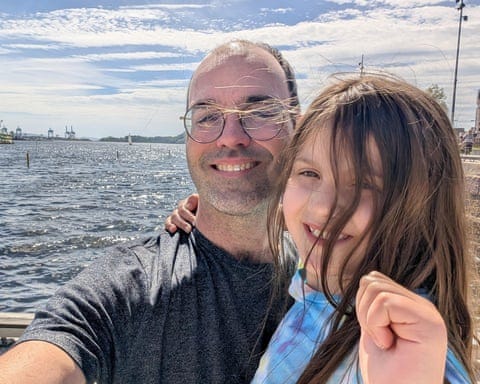
Photograph: David Streever/AP
would a defense of being in a "first amendment zone" aka his home be applicable when the supposed offense took place? since this is the government's acceptable protocol for in-person protests at ICE detention facilities, a remote protest occurring from the home via electronic communication should be well within the same parameters 🍸
I had no idea that government monsters have such sensitive widdle feewings. David Streever hit a nerve.