


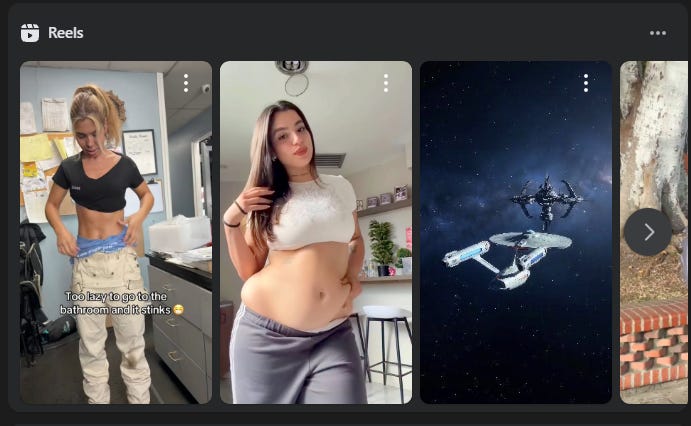
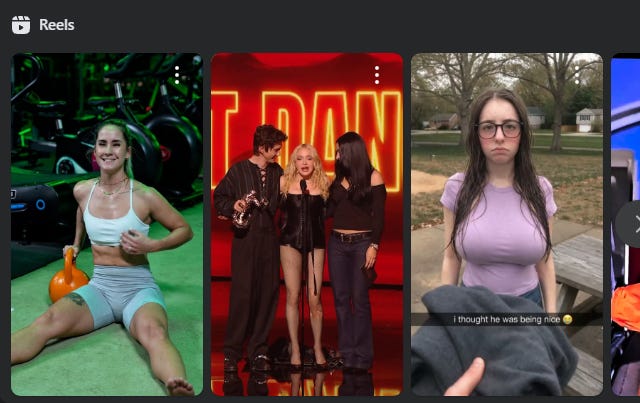
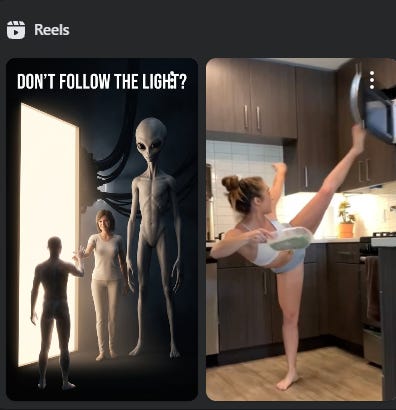
I am a 58-year-old happily married man. I do not go looking for thirst traps. Facebook lays them out for me anyway. In the Reels, it inserts them into my feed no matter how many times I tell it to stop, and the trick is always the same: the preview frame is a suggestive pose, the body angled, the clothing minimal, sometimes on someone who does not look old enough to be on the platform, and the actual video, if you tap it, turns out to be a woman explaining how to repot a fern.

The thumbnail is the product. The fern is the alibi. My feed used to be the people I know and the groups I chose. It is now strangers, ads for products that do not exist, memes engineered to be wrong in ways that are hard to argue with, and Reels. I still use it because there are people I want to keep, and because somebody should watch this thing rot in real time and take notes. These are the notes.
I had five questions. What does Facebook actually collect? What is it for, since helping people connect plainly is not it anymore? Why is a company that does this worth more than a trillion dollars? Why has nobody regulated it. And whether the $17 billion it agreed to pay last month for what it did to children changed anything I can see. The answers are all on the public record, most of them in Meta’s own filings and blog posts, and they fit together better than I expected.
What it collects
Start with the Pixel, because that is the part people do not know they are carrying. The Meta Pixel is a small piece of code that websites embed to report back to Meta what visitors do: which pages, which products, what went in the cart, what got bought. Researchers who studied it in 2025 counted it on roughly 5.8 million websites, including about 17,000 of the top 100,000 sites reachable from the United States. In 2022 The Markup found it on a third of the country’s top hospitals’ sites, transmitting appointment details and doctors’ names. It sends this back whether or not you are logged in, whether or not you have a Facebook account at all. Meta has always said that if you do have an account, you can disconnect that activity from it.

Last summer, a team of European researchers found something the disclosure did not cover. Meta’s Facebook and Instagram apps on Android were quietly listening on a set of local network ports. When you visited a Pixel-bearing website in a browser on the same phone, the Pixel’s script used a WebRTC trick to pass your browser’s tracking cookie to the app through those ports, and the app matched it to your logged-in identity. The technique worked in incognito mode. It worked after you cleared cookies. It worked when you were logged out of Facebook in the browser, because the app was still logged in, and the app was the one listening. It defeated the isolation Android builds between applications, which is the whole point of that isolation. The researchers published on a Monday in early June 2025, and Meta’s Pixel stopped sending to localhost by 7:45 that morning, Central European time, which is the speed at which a company moves when it already knows where the switch is. A member of Congress wrote a letter. That was the consequence.

Then, this June, Meta announced on its own newsroom that it would begin using “activity from other businesses,” meaning the Pixel data and its server-side cousin, to personalize “the content you see in your Feed and AI responses,” in addition to the ads. In the same post it said the old setting, the one that let you “disconnect activity that businesses share with us from your account,” was being replaced with a new one that lets you “manage how we use this activity data.” Taken together, the two sentences say that the switch that used to stop the linking now decides what the linking is for, and the linking itself is no longer optional. That took effect in July, for U.S. users, about six weeks before the child-safety settlement was announced. Last fall the company also said it would start using people’s conversations with its AI assistant to shape what they see. So the inventory, in the company’s own words, is: what you do on its apps, what you do on 5.8 million other people’s websites, what you buy, where your phone is, who is in your contacts, what you told the chatbot, and, for a year until someone caught it, what you did in a private browser window on a phone that had the app installed. That is what it collects. What it is for is the next question.
What it is for
Meta’s second-quarter results this year: $60.8 billion in revenue, of which $59.36 billion, 97.6 percent, was advertising. The rest is mostly the headsets. Net income for the quarter was $15.8 billion, about $174 million a day. The company reported 3.6 billion people using at least one of its apps daily, which works out to roughly $17 in revenue per person per quarter worldwide and several times that in North America. Two other numbers explain the feed I described. Ad impressions were up 14 percent from a year earlier, and the average price per ad was up 12 percent. The company is showing each of us more ads and charging more for each one, in the same quarter, and both numbers are still rising. A feed that used to be friends and groups is a feed with a fixed amount of ad inventory. A feed that is mostly recommended strangers and Reels has as much inventory as you can be induced to scroll.
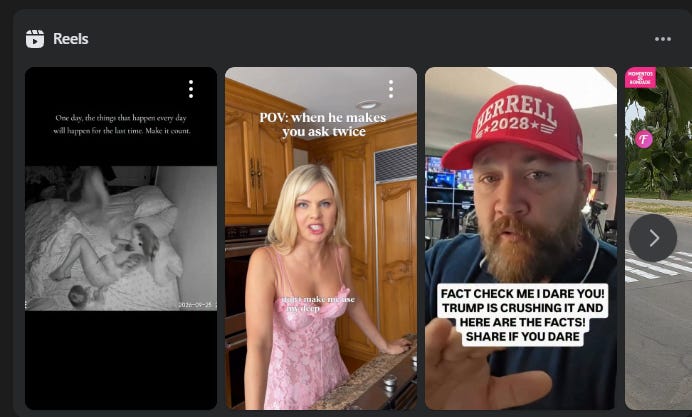
That shift was announced, not discovered. In July 2022 Mark Zuckerberg told investors that about 15 percent of what people saw in the Facebook feed came from accounts they did not follow, recommended by the company’s systems, and that he expected that share to more than double by the end of 2023. It did. In early 2024 Meta stopped reporting how many people use Facebook at all, folding it into a “family daily active people” number that includes Instagram and WhatsApp, so the one metric that would show whether Facebook the social network is growing or shrinking is no longer published. And in March 2025 the company introduced a “Friends” tab, which Zuckerberg described as a throwback to “OG Facebook”: a separate feed showing only posts from people you actually know. It is behind a menu. The default feed, the one that opens when you open the app, is the other thing. The company built a tab for the product it used to be and put it where you have to go looking for it, which tells you exactly what the company thinks the product is now.

This is the answer to why a married 58-year-old gets thirst traps. The system does not model who I am in any sense a person would recognize. It models what stops a thumb, in the half second before the thumb decides, across billions of thumbs, and a suggestive still frame stops thumbs. Whether the video underneath is a fern is irrelevant to the frame’s job. The frame’s job is the half second, and the ad next to it is the revenue.
The evidence that the same machine does this to children is not anecdotal, and it is worse than mine. In 2024, the Wall Street Journal and a Northeastern University computer scientist, Laura Edelson, set up fresh Instagram accounts registered as 13-year-olds and watched what Reels served them. Within minutes of the accounts pausing on sexualized content, the recommendations followed. Within twenty minutes the Reels page was, in the Journal’s description, full of creators showing sexual content, some promising nude images in the comments. The same test on TikTok and Snapchat produced nothing comparable. Meta called it “an artificial experiment that does not match the reality of how teens use Instagram.” A year later, after Meta had launched Teen Accounts as the fix, two advocacy groups ran the test again and found teen accounts still being recommended sexual material, eating-disorder content, and drug references; a Washington Post columnist reproduced it. Meta’s response was that this amounted to “less than 0.3 percent” of what the accounts would have seen, which is an interesting defense to offer about a thirteen-year-old.

In August 2025, Reuters obtained Meta’s internal standards for its AI chatbots and reported that the document permitted the bots to engage a child in conversations described as romantic or sensual. Meta said the passages were erroneous and removed them after Reuters asked. And in March of this year a New Mexico jury, after a seven-week trial that included undercover investigators posing as children on Meta’s platforms and documenting the solicitations that followed, found that the company had knowingly harmed children’s mental health, concealed what it knew about child sexual exploitation on its platforms, and engaged in unconscionable trade practices. That is a civil verdict, on a state consumer-protection statute, and Meta says it will appeal. It is also twelve people who sat through the evidence for seven weeks. When my feed shows me a thumbnail of someone who looks sixteen in a pose chosen to stop my thumb, the machine choosing it is the one those twelve people heard about.

The moderation, which is the same machine from the other side
Here is the part that made me start writing. While the feed does the above, the moderation system suspends people for a bikini photo or a Trump quote. This looks like hypocrisy and is better understood as consistency, because both behaviors come from the same optimization. On January 7, 2025, Meta published a post titled “More Speech and Fewer Mistakes.” It ended third-party fact-checking in the United States, loosened the rules on immigration and gender, moved its trust-and-safety teams to Texas, and said the old system made too many mistakes and removed too much. Six months later, in June and July, tens of thousands of Facebook and Instagram users found their accounts suspended for “child sexual exploitation, abuse and nudity.” A woman in Australia was flagged for a video that included a brief shot of her holding her own daughter. A teacher lost her account. Appeals came back rejected within fifteen minutes, faster than any human reads an appeal. A petition passed thirty thousand signatures. Meta acknowledged “a technical problem” affecting Facebook Groups and denied the platforms were more widely affected, and accounts came back when a news organization called.
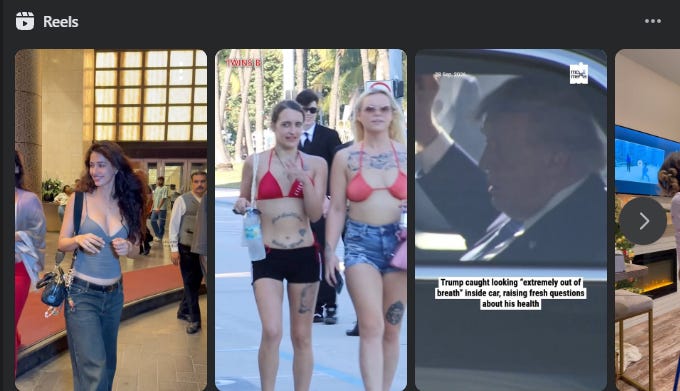
The two facts sit together comfortably once you stop assuming the system is trying to judge content. It is trying to manage risk to the company at the lowest possible cost. A human being’s bikini photo is a liability with no revenue attached, and an automated classifier that removes it costs almost nothing when it is wrong, because the person it was wrong about has no recourse except a reporter. A Reels thumbnail that stops thumbs is inventory, and a classifier that removed it would cost money every time it was right. Nobody at Meta has to intend that outcome for the incentives to produce it. The fact-checkers were the one part of the system paid to be right rather than cheap, and they were the part that got cut. What replaced them, Community Notes, is a system in which the users correct each other for free, which is the company’s preferred price for accuracy.
Why nobody has regulated it
The short answer is that people have tried, and it is worth being exact about how each attempt ended. Section 230 of the Communications Decency Act, twenty-six words written in 1996 to protect message boards, still shields platforms from liability for what users post, and courts have mostly read it to cover how platforms recommend that content too. There is no federal privacy law. The states that passed their own laws for minors- California, Arkansas, Ohio, Utah, have watched federal courts enjoin them on First Amendment grounds after the industry’s trade group, NetChoice, sued. The Federal Trade Commission fined Facebook $5 billion in 2019 over the Cambridge Analytica data, about a month of revenue at the time, and the business model was untouched. The FTC then spent five years trying to unwind the Instagram and WhatsApp acquisitions as an illegal monopoly, and on November 18, 2025, Judge James Boasberg ruled for Meta, finding that TikTok and YouTube compete with it closely enough that it is not one.

This June the House passed a children’s online safety bill, the KIDS Act, 267 to 117. It extends children’s privacy protections to teenagers and bans targeted advertising to minors. It does not include a duty of care, the provision that would make platforms responsible for the design of their products rather than the content on them, which is the thing every trial verdict so far has turned on. The youth-safety coalition that had pushed for the bill said so in public. It has not passed the Senate.
Against that, Meta spent a record $19.7 million on federal lobbying in the first nine months of 2025, with 87 registered lobbyists, roughly one for every six members of Congress. In September 2025, it launched two super PACs, one national and one in California, with a pledge of tens of millions of dollars to fight state-level technology and AI regulation. That is a company that has decided it is cheaper to choose who writes the rules than to comply with them, and the record of the past decade says the calculation is correct. The one jurisdiction that fines it with any regularity is the European Union, which hit it for 200 million euros in 2025 over its pay-or-consent scheme, a sum the company earns before lunch.
What the $17 billion changed
Two things happened this summer. On August 7, the New Mexico judge, following the jury’s $375 million penalty, ordered Meta to pay another $567 million into a fund to abate harms to the state’s young people, for a total of $942 million, and imposed a five-year conduct order: enhanced age checks for New Mexico users, no overnight push notifications to minors, hidden like counts, mandatory time limits for under-18s, semiannual compliance reports to the court. The judge declined to order hard age verification, calling that a policy choice for legislatures. On August 26, with a federal trial underway in Oakland on behalf of 51 states and territories, Meta settled: $17 billion over ten years, with conduct terms that apply nationally. A default two-hour daily limit for users under 18, with a midnight-to-6 a.m. block, both overridable by a parent. No like counts on minors’ posts. No cosmetic-surgery filters for minors. An option, for everyone, to use a non-personalized feed. An independent auditor with access and a direct line to the attorneys general. And an injunction against making false or misleading claims about safety features, which is a remarkable thing to have to write into a settlement. Meta denied every allegation. California’s attorney general called the terms “massive transformations.” Meta’s chief legal officer said the framework would “empower parents.”

Now do the arithmetic. $17 billion over ten years is $1.7 billion a year. At the second quarter’s rate, Meta earns $1.7 billion in net profit in about ten days. The settlement, for having deliberately designed products that harmed children and concealed it, according to fifty-one attorneys general and one jury, costs the company ten days of profit a year for a decade. And every conduct term in both orders, with one exception, applies to people under eighteen. The exception is the non-personalized feed option, which will be a setting, behind a menu, next to the Friends tab, in a product whose default is the other thing. Nothing in either order touches the Pixel, the linking, the ad load, the recommendation system for adults, or the thumbnails that stop my thumb. The month before the settlement, the company had already removed the one switch that let an adult disconnect the off-platform data. The settlement did not put it back.
So: did the fine provoke change? For a fifteen-year-old, on paper, with an auditor, yes, and I would not dismiss that, because the two-hour default and the overnight block are the first design constraints anyone has ever imposed on this company that it cannot reverse with a blog post. For the rest of us, the answer is in the second-quarter numbers, which came out a month before the settlement and showed impressions and prices both rising, and in the July change, which tightened the data collection while the settlement was being negotiated. The company paid to make the children’s problem go away and kept the machine.
Why I’m still there
Because a few dozen people I care about are, and Facebook is where they are, and the company knows that as well as I do, which is why the friends are still allowed in. They are the reason I open the app; the feed is what I get for opening it. There is a tab now, two taps away, that shows only them, introduced last year as a throwback, which is the company’s own word for the product it sold me in 2008 and has spent the years since dismantling for parts. The parts bring in $60 billion a quarter. The people are still in the tab, and I still know where it is.

Thanks for this illuminating explanation of one of the reasons I really hate Facebook
Meta doesn't like me... it bounced me off both FB and IG... off FB because I refused to provide an unredacted government picture ID (this in 2014 just before the Russian bot farms abd Cambridge Analytica mess) and IG in 2024 when I posted a "Meowy Purrthday" pic of my cat on a pet account - immediate deletion, less than 10 minutes for "review"... I think they were mad that I never posted any personal info... their loss 🍸