


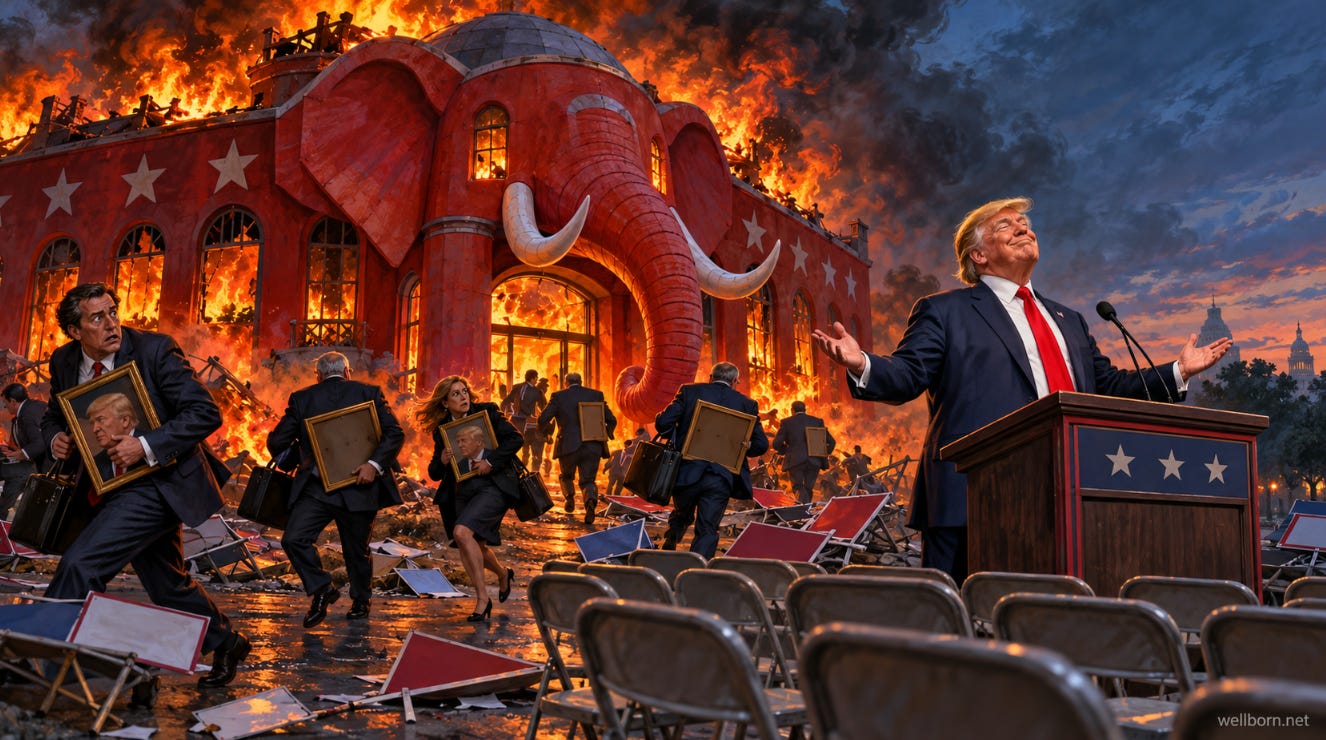
Every party that is about to lose an election knows it first, and the way you can tell is that it starts explaining. The Republican Party of October 2026 has entered the explaining phase with the specific confidence of an organization that has decided the polls are wrong, the crowds are full, the candidates who are running away from the president are running toward him in a way that looks like away, and the fire in the building, which a member of the party described to CNN this week as “a five-alarm fire,” is a rumor spread by the people who can see it. What follows is an inventory of the signs, assembled almost entirely from Republicans, because the Democrats have been too busy to supply any and because a party’s own tells are the only ones that count.
The polls, which have stopped being polite. The generic ballot, the question of which party a voter wants in charge of Congress, sits at Democrats plus seven or eight depending on who averages it, which is the neighborhood of 2018, the year Republicans lost forty seats. The president is at 31 percent with AP-NORC, 32 with Reuters, and 37 with Nate Silver, who is being generous. On the economy he is at 26. On the cost of living, 17, a number so low that it includes almost nobody who has bought groceries. Among unaffiliated voters, Marist has Democrats ahead 57 to 32, which is the margin by which people who belong to neither party have decided which one to punish. Kyle Kondik at Sabato’s Crystal Ball, a man whose entire profession is not saying things like this, said this week that “a bad Republican environment is just getting worse.” Henry Olsen, who writes for conservatives, said Americans are “disappointed, bordering on angry.” A scholar of this discipline notes that “bordering on angry” is the phrase a friendly analyst uses when the number in front of him is angry.
The map, which has started talking in red states. On Friday the New York Times and Siena published Senate polls in five states the president carried by double digits, and the Democrat led in three of them and was within a point in the other two. Texas: Talarico 51, Paxton 45. Ohio: Brown 49, Husted 46. Alaska: Peltola 50, Sullivan 43. Iowa: Hinson 48, Turek 47. Kansas, which is Kansas: Marshall 47, Hamilton 46. Harry Enten put Talarico at 70 percent to win Texas on Sunday and said the Democrats’ odds of the Senate were “going up like a rocket,” which is the sound of a CNN data analyst discovering a sentence he never expected to say about Texas. Maine has Collins down four to Troy Jackson in Monday’s Marist poll. New Hampshire has Sununu down seven. Florida’s Senate special is tied. Jon Husted, a sitting United States senator in a state Trump won by eleven, has not led a public poll since June, and his response has been to put out an ad saying the war with Iran should end, which is the Republican position in Ohio now, four months after it was treason.
The money, which is running in the wrong direction and also the right one. Republicans have more of it; this is the one item on the list that points up, and it should be stated because it is true. The committees entered the fall with twice the Democratic cash, and in Texas a PAC attached to the Senate Leadership Fund spent $131 million in seventeen days to rescue Ken Paxton, $7.7 million a day, $61 million of it in forty-eight hours. A Republican operative explained to Axios that “Texas is so expensive that you have to time your spending,” which is what a man says when he has set fire to $131 million and would like it understood that the fire was scheduled. Talarico, outspent five to one, led by six the following week. Meanwhile in Omaha, Nebraska’s Second District, the one House seat in the state anyone fights over, both parties’ super PACs pulled more than a million dollars out of the race in the same week, which in the Republican case means they have given it up and in the Democratic case means they no longer think they need to pay for it.
The tape. Last week the New York Times published secretly recorded audio of Paxton, the Republican nominee for Senate in Texas, telling donors that the president’s midterm convention in Dallas “dropped our numbers,” and that “everybody’s numbers dropped,” and agreeing, when asked, that the president was something of a drag. The president’s response, on Thursday, at a truck plant in Denton, was to call Paxton “a pain in the ass,” ask “Is he here, by the way?” and, on being told that he was, say “I don’t care,” and then fly to Oklahoma and play the tape of Paxton insulting him to a crowd before telling them to vote for Paxton anyway. The Republican nominee in the most expensive Senate race of the year has told his donors, on a recording, that the leader of his party is costing him the election, and the leader of his party has confirmed it by reading the recording aloud. That is a sign.
The exits. Thirty-six House Republicans declined to run again this year, which breaks the record of thirty-four set by House Republicans in 2018, the year they lost the House. Members of Congress know their districts the way a man knows his own basement, and thirty-six of them went down the stairs last winter, looked around, and came back up with a real estate listing. No pollster has a better instrument than that.
The candidates, who have begun describing the president as a man they once met. This is the item the party would least like inventoried, so here it is in full. Byron Donalds, running for governor of Florida with the president’s endorsement, removed the president from the front of his website in the last week of September and moved him to the endorsements page, where he sits alongside the sheriffs, and then, when asked, said he was “proud” of the endorsement, in the voice of a man who has been asked why the photograph is in the drawer. Maria Elvira Salazar, in Miami, cut an ad saying the deportations had gone “too far.” Ashley Hinson in Iowa called for an “immediate end” to the war and skipped the convention stage in Dallas while attending the fundraiser, which is the political equivalent of coming to the wedding and sitting in the car. Mike Rogers in Michigan put “the war with Iran needs to end, and end quickly” in a television ad, in a state the president is counting on. Roger Marshall in Kansas, who is a senator and should not be in this paragraph at all, posted that ICE “needs to coordinate with our local law enforcement,” which is the sentence a Republican writes when his internal polling has shown him Kansas at 47 to 46. Zach Nunn, Mariannette Miller-Meeks, Tom Tiffany, Dan Sullivan: all on record for ending the war the president said would take five weeks. Brent Buchanan, a Republican pollster, summarized the strategy for the Associated Press: “You’ve got to show that you’re different.” Different from what, he did not have to say.
The president, who has responded to all of this by campaigning only where he already won. His October schedule, per CNN, runs through Texas, Oklahoma, Alabama, Ohio, and Nebraska, every one a state he carried by double digits, which is the itinerary of a man who has been told by his own party where he is welcome and has decided to describe it as a victory lap. In Vandalia, Ohio, on Saturday, he spoke at a high school. In Mobile, Alabama, on Friday, he spoke in an indoor arena of which the Times’ reporter wrote that “some upper sections were almost completely empty.” On Monday the president posted that the arena was “totally MAXED OUT, including all upper sections,” and that thousands had been turned away, and, in a separate post, that the Times would be “forced to close.” He was describing Ohio. The Times had written about Alabama. The president of the United States, four weeks from an election, got into a public argument with a newspaper about the size of his crowd and defended the wrong crowd, and the newspaper, having reported the empty seats in one city, now has the president’s word that the seats were full in another. On Sunday he posted that Fox News should cover his rallies more or his supporters would “very quickly stop watching.” The network that has carried him for ten years is now on the list of things that are against him, between the pollsters and the upper deck.
The president, again, asking voters to pretend. In Durant, Oklahoma, on Thursday: “Pretend I’m running, please. If we don’t win, they’ll end up impeaching me.” A scholar of this discipline notes the two halves. The first is the admission, from the only person in the party whose approval is below the party’s, that the party needs him on a ballot he is barred from. The second is the forecast, which is accurate, and which he has been making since January, when he told Reuters that “when you think of it, we shouldn’t even have an election,” a position that has the advantage of being the only one in this inventory that would work.
The vice president, who has advised the base to stop complaining. On Fox on Thursday, J.D. Vance told Republican voters that “this is not the time to sort of gripe about all the little things,” the little things being whatever a 2024 voter wished the party had done, and the AP-NORC poll in the field that week found that about sixty percent of Republicans disapprove of the president’s handling of the cost of living. The vice president’s closing argument, five weeks out, to the sixty percent of his own party that is griping about groceries, is to stop. The scholar observes that in 2018 the equivalent message was “the economy is great,” and that this year the party has had to downgrade to “please be quiet.”
The anonymous congressman. “This is a five-alarm fire,” a Republican member of Congress told CNN this week, about the environment, adding a worry that the president might not know how bad it is in the districts. The congressman did not give his name, which is itself the sign: a member of the majority party, in the majority’s own party organ of record, describing the building as on fire, on condition that nobody find out he said so, because the only thing in the party more dangerous than the fire is being the one who mentioned it.
The things that point the other way. Honesty requires the list. The money, as noted, is real and will hold seats on the margin. The map was redrawn in eight states to absorb exactly this mood, and the forecasters think it cost Democrats the difference between a wave and a majority. Iowa and Kansas are within a point and Republicans can win a race that is within a point. The president says there will be “a big surprise,” and he has been right about surprises before, in 2016, when the polls were less lopsided than these and the party had not yet started moving his picture to the endorsements page.
But the inventory is the inventory. A nominee on tape. A senator winless since June. A record of departures. A governor’s candidate hiding the endorsement. Four Senate candidates, two congressmen, and a candidate for governor for ending the war. A president touring his own strongholds, defending the wrong arena, feuding with his own network, and asking voters to imagine him on the ballot because without him on it the party has no argument. A vice president telling the base to stop griping. A congressman who will only say fire anonymously. None of this came from a Democrat. All of it came from the party that will spend November explaining that it saw none of it coming, and the explanation has, as of this week, already begun.
I am sooo ready for the bloodbath! 😈
“ The president is a bit of a drag.”
That is a gross understatement.