


The setup
Lindsey Graham was born in 1955 in Central, South Carolina, a town small enough that his parents ran the only bar, the only pool hall, and the local liquor store simultaneously. He put himself through the University of South Carolina on ROTC money, went to law school there, entered the Air Force as a JAG officer, and built a legal career prosecuting and defending courts-martial. He came to Congress in 1995 on the Gingrich wave, made his name as one of the House managers in the Clinton impeachment, and won a Senate seat in 2002 that he has held through five elections since. For the first twenty years of his Senate career his defining relationship was with John McCain, whose foreign policy hawkishness and institutional traditionalism Graham absorbed and amplified. He was the junior partner in a friendship that shaped his entire public identity: the man who believed in American alliances, the rule of law, and the Senate as an institution worth protecting from demagogues.
Then McCain died, and Lindsey Graham became someone else.
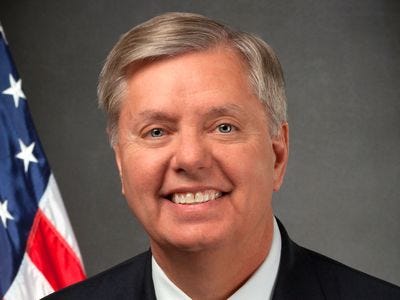
The defining moment
On July 21, 2015, standing in front of cameras in his home state, Graham delivered an assessment of Donald Trump that no opposition researcher has since improved upon. He called Trump “a race-baiting xenophobic bigot.” He said Trump was “unfit for office.” He said the Republican Party deserved to lose if it nominated him. He said, in a line that has aged with particular precision: “I think he’s hijacking the conservative movement. I think he’s appealing to the dark side of human nature.” On the same day he released Trump’s personal cell phone number to the press after Trump had read it aloud at a rally, which was petty and satisfying and completely beside the point. The point was the indictment. It was specific, it was on camera, it was in his own voice, and it was correct.
Graham did not stop there. In a May 2016 interview he said: “If we nominate Trump, we will get destroyed, and we will deserve it.” After the Access Hollywood tape he called on Trump to withdraw from the race. After Trump attacked a Gold Star family he said the response was “beyond the pale.” He tweeted in August 2016: “If you can’t admire @realDonaldTrump as a person, you’ve got a problem.” He meant it as a condemnation. It reads now as a confession about the eight years that followed.
The inflection point is datable. John McCain died on August 25, 2018. Within weeks Graham’s public posture toward Trump began shifting. Within months he was golfing with him. Within a year he was one of his most reliable Senate defenders. The transformation was not gradual ideological drift. It was a pivot, visible in the record, timed to the death of the one person whose opinion of Graham appeared to function as a check.
The receipts
The paper trail Graham generated about Donald Trump before August 2018 is long enough to sustain its own book, and every line of it is authenticated, dated, and searchable.
July 2015, on camera: “race-baiting xenophobic bigot.” “Unfit for office.” “Appealing to the dark side of human nature.”
May 2016, in print: “If we nominate Trump, we will get destroyed, and we will deserve it.”
October 2016, after Access Hollywood: called on Trump to withdraw. Said he could not in good conscience vote for him.
December 2015, on the Senate floor: “Donald Trump is trying to make this a religious war. The bottom line is that he is not fit to be Commander in Chief.”
February 2016, in a tweet that has never been deleted: “Donald Trump: ‘I could shoot somebody and wouldn’t lose any votes.’ This is what someone unhinged says. It disqualifies him from being president.”
January 6, 2021. The Capitol was attacked. Graham was evacuated. He returned to the Senate floor that night and delivered a speech in which he said: “Trump and I, we’ve had a hell of a journey. I hate it to end this way. Oh my God, I hate it. From my point of view he’s been a consequential president but today, first thing you’ll see, all I can say is count me out. Enough is enough.” He voted to certify the election results. He called on Trump to accept the outcome and move on.
Then, in February 2021, before the Senate impeachment trial was complete, he voted to acquit. In March 2021 he visited Mar-a-Lago. In April he was photographed golfing with Trump. By the 2022 midterms he was one of the most visible Trump surrogates in the country. By 2024 he was on the debate stage defending Trump’s record.
The “count me out” speech is now the most expensive eight words in the Graham archive. It cost him nothing in the moment and purchased nothing afterward, because he reversed within weeks and spent the following years ensuring the reversal was as visible and documented as the original break.
The downstream cost
Graham’s post-2018 transformation was not decorative. It had consequences.
He was chairman of the Senate Judiciary Committee during the confirmation of Amy Coney Barrett, rammed through eight days before a presidential election after Graham himself had said in 2016, on camera: “I want you to use my words against me. If there’s a Republican president in 2016 and a vacancy occurs in the last year of the first term, you can say Lindsey Graham said let’s let the next president, whoever it might be, make that nomination.” Barrett was confirmed. Graham said he had changed his mind because Democrats had changed the rules. The rule he cited was one the Republicans had implemented.
His foreign policy influence, built on two decades of hawkish credibility accumulated beside McCain, was deployed in service of an administration that hollowed out American alliances, deferred to authoritarian leaders, and treated NATO as a protection racket. The credibility he spent with McCain he cashed for Trump.
After January 6 he called for moving on and healing. After voting to acquit he said the chapter was closed. He then spent four years ensuring the chapter remained open by campaigning for the man he had voted to acquit for inciting the attack he had been evacuated from. He was in the building. He knows what it sounded like.
The verdict
Graham’s receipts are uniquely damning not because they are more numerous than other Registry entries but because they are more precise. He did not merely fail to oppose Trump. He produced the most accurate public description of Trump available in the summer of 2015, in his own words, in his own voice, with his name attached, and then spent the next eight years demonstrating that everything he said was true while standing next to the man he said it about. The race-baiting continued. The xenophobia continued. The appeals to the dark side continued. Graham watched all of it from the front row of the endorsement and called it consequential leadership.
John McCain is buried at the Naval Academy Cemetery in Annapolis. Graham attended the funeral and delivered remarks about his friend’s moral courage. He then flew home and started returning the president’s calls.