


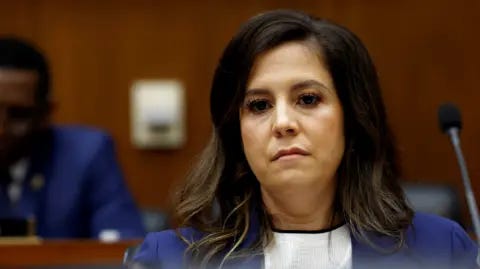
In October 2016, a thirty-two-year-old congresswoman from upstate New York was asked about the Access Hollywood recording.
She said the comments were inappropriate and offensive. She said they were just wrong, no matter when he said them or whatever the context. She said she hoped his apology was sincere.
That was Elise Stefanik, two years into her first term, having been elected in 2014 at the age of thirty as the youngest woman ever to serve in the House. She had gone to Harvard. She had worked in the George W. Bush White House and on debate prep for the Romney-Ryan ticket. She had run as a pragmatic conservative with an independent streak, and for a while she governed like one.
She voted against the 2017 tax law, the single largest legislative accomplishment of his first term. She called the withdrawal from the Paris climate agreement a mistake. She criticized his comments about Muslims and about women. She opposed the border wall.
By 2021 she had signed an amicus brief asking the Supreme Court to invalidate the election results in four states.
What happened in between
Everyone who has looked at this identifies the same moment, and it is not gradual.
In late 2019, during the first impeachment, Stefanik was placed on the president’s defense team and sat on the House Intelligence Committee. Her clashes with Adam Schiff became viral clips. A former aide to Republican House leadership described it to Time as a switch flipping.
Trump posted that a new Republican star was born.
In the final three months of 2019, Stefanik raised $3.2 million. That is a sevenfold increase over the previous quarter and made her the second-highest fundraiser in the entire House of Representatives.
A former Republican congressman who knew her well gave Time the most precise summary anyone has produced: she became a darling of the right and an enemy of the left, and she just decided to own that and monetized it.
She was named honorary chair of his New York reelection campaign. She voted against certifying the 2020 result after the Capitol was attacked. She voted against both impeachments. Years later, on Meet the Press, she referred to the January 6 defendants as hostages.
In May 2021, House Republicans removed Liz Cheney as conference chair for refusing to stop saying the election had not been stolen, and installed Stefanik in her place by a vote of 134 to 46.
The fact that explains the whole system
Here is the thing almost nobody mentions about that vote, and it was reported at the time by Fox News, in a headline, on their own website.
Stefanik voted with Trump less often than Liz Cheney did.
Cheney had the more reliably conservative voting record and the more consistently pro-Trump one. Chip Roy ran against Stefanik for the position specifically on the grounds that she was not conservative enough, and he was correct on the merits, and he lost 134 to 46 because Trump had endorsed her and posted that he supported Elise, by far, over Chip.
So the purge was not about policy. It could not have been about policy. The party removed the member who voted with him more and elevated the member who voted with him less, and the only variable that distinguished them was that one of them would say the election was stolen and the other would not.
That is worth stating plainly, because it answers the question people keep asking about all of these figures. The loyalty test was never a test of agreement. It was a test of willingness to say a thing you knew to be false, on camera, on request. Cheney could have kept the job by saying it. Her voting record already qualified her. She declined, and that was the entirety of the disqualification.
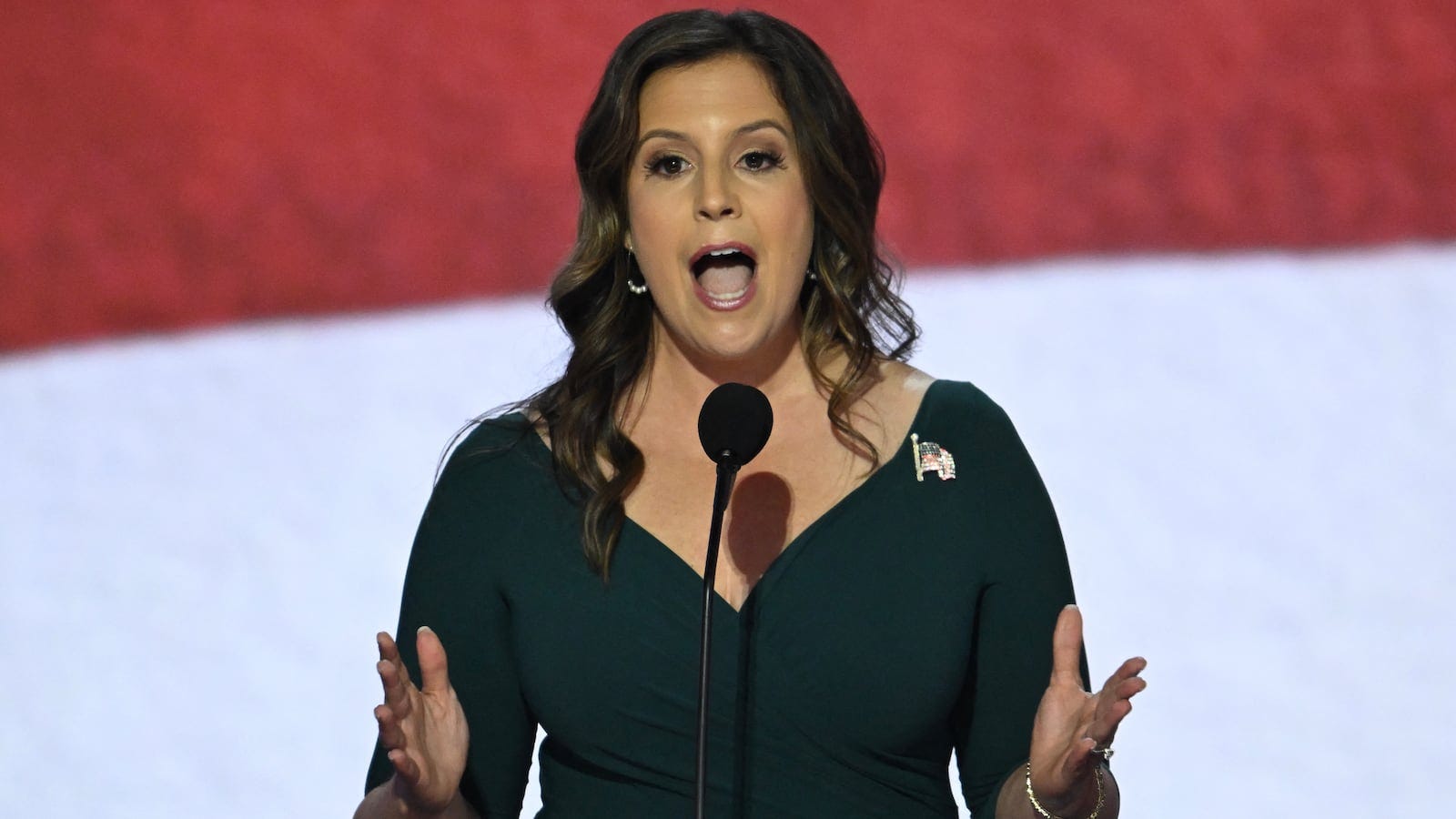
The reward, and the withdrawal
The transformation worked exactly as designed, and for four years Stefanik was the standing proof that it worked, which is why so many others followed the path she had cut.
In November 2024 she became his first cabinet selection: ambassador to the United Nations. To take it she gave up the conference chair, the number three position in the House, which went to Lisa McClain. Her nomination advanced out of the Senate Foreign Relations Committee in January 2025.
Then she waited. And waited.
On March 27, 2025, roughly a week before her confirmation vote, Trump withdrew the nomination.
The stated reason was the House majority. In his announcement he wrote that he did not want to take a chance on anyone else running for Elise’s seat, that the people love Elise, and that there are others who can do a good job at the United Nations.
Read that last clause as she must have read it. There are others that can do a good job at the United Nations.
She had made herself into the most conspicuous loyalist in the House of Representatives, at the cost of every position she had originally held and whatever reputation she had built before 2019, and the calculation that ended her cabinet appointment was that her body in a chair in the House was worth more than she was in the job.
Her public response was that she was proud to be a team player and proud to put the American people first.
What was left
She had surrendered the leadership position to take the nomination, so leadership had to invent a new one for her.
In November 2025 she launched a campaign for governor of New York, with Trump’s encouragement. He had endorsed Mike Lawler and Bruce Blakeman for reelection to their existing posts, which was widely read as clearing the field for her. Blakeman entered the governor’s race anyway.
Six weeks later, on December 19, she suspended the campaign and announced she would not seek reelection to Congress either. Her statement said she would have overwhelmingly won the primary but that it was not an effective use of time or resources, and that as a mother she would feel profound regret if she did not focus on her young son.
She is out. No House seat, no leadership post, no ambassadorship, no governorship. The youngest woman ever elected to Congress left it at forty-one with none of the things she traded for.
Pretending or revealed
The question people ask about these figures is whether they were always like this and finally felt free to show it, or whether they are performing something they do not believe.
With Stefanik you can actually check, because the before is documented in her own voice. She said the Access Hollywood remarks were just wrong no matter the context. She voted against his tax bill. She called Paris a mistake. Those are not the positions of a concealed authoritarian waiting for permission.
But I do not think the pretending-versus-revealed frame survives contact with what actually happened, and the reason is the $3.2 million.
She did not undergo a conversion. She ran an experiment. In the fourth quarter of 2019 she discovered that a particular performance produced seven times the money, national attention, and the personal endorsement of the most powerful figure in her party, and she did that performance again, and it produced more, so she did it again. Nothing in the record suggests she ever sat down and changed her mind about anything. She changed what she said, observed the result, and optimized.
That is not a person being corrupted. That is a person responding correctly to an incentive structure that somebody else built, and the reason it is worth writing down is that everybody in that building watched it happen in real time and drew the obvious conclusion. Cheney told the truth and was removed. Stefanik said the thing and got the job. The demonstration was public, it was rapid, and it required no coercion of any kind.
The part nobody planned for is the ending. The system that rewarded her also disposed of her, for a reason that had nothing to do with her performance and everything to do with a two-seat margin, and she thanked him for it publicly and called herself a team player, because by then there was no other move available.
She had spent six years making herself indispensable to one man, and it turned out that the only thing he actually needed from her was for her to stay in her chair.
Money explains her conversion, other things may explain others, but it is a remarkable fact that Trump can turn enemies so effectively into not just allies, but toadies. Lindsey Graham, JD Vance, Stefanik. The one that I am puzzling over lately is Todd Blanche, because I know enough about him personally to know that he wasn't the rabid hack he has become. He better be in it for the money and it better be a lot, because it's going to cost him his law license.
Amazes me how one republican after another thinks Trump won’t treat them as garbage and then he does. Then they are surprised. How stupid do you have to be.