


Here is the entire documented core, and it takes four sentences.
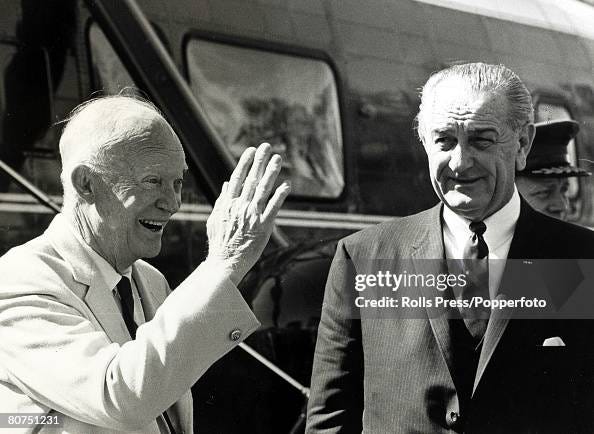
President Dwight Eisenhower vacationed in Palm Springs, California from February 17 to 24, 1954. On the evening of Saturday the 20th he dropped out of public view for several hours, long enough that reporters covering him began speculating he had fallen ill or died. The White House explained the next morning that he had chipped the porcelain cap on an upper front tooth while eating chicken and had been taken to see a dentist. He appeared at a church service in Los Angeles on Sunday morning, and a local dentist was introduced at a function as the man who had treated him.
That is the whole of it. Everything else in the story that has been built on those hours was added afterward, by people, in stages, over seventy-two years.
The accretion.
The additions can be laid out roughly in order, and laying them out is instructive because of what is missing from the sequence.
First came a location. The nearby Muroc Airfield, later renamed Edwards Air Force Base, which in 1954 was the most classified aviation facility in the country and therefore the most narratively useful. In later versions the location migrated to Holloman Air Force Base in New Mexico, and in others to Kirtland. The story has never settled on where it happened.
Then came witnesses. The earliest is a letter dated April 16, 1954, from a California writer named Gerald Light to Meade Layne of the Borderland Sciences Research Associates, describing his presence at Muroc as part of a civilian group assembled to observe. Light was a metaphysical writer. The letter is the document usually cited as contemporaneous evidence, and it is a letter from one occultist to another, written eight weeks after the fact, with no corroboration from anyone else present.
Then came a species. The visitors acquired physical description, becoming tall and pale and blue-eyed, and a name, Nordics.
Then a mode of communication. Telepathy.
Then a proposal. The visitors are said to have offered advanced technology and spiritual instruction in exchange for American nuclear disarmament, and Eisenhower is said to have declined.
Then a second meeting, with different visitors, who made a different offer.
Then an agreement, and then a name for the agreement. It is called the Greada Treaty in the modern telling, promoted principally by the writer Michael Salla, and by the time it acquired that name it had a signing, terms, and parties.
One thing is absent from that whole sequence, and it is any document at all. No archival release added a layer, no declassification or Freedom of Information response, no memoir by a participant, no photograph. Every increment in seventy-two years was contributed by a person retelling the story, and each retelling made it more specific than the one before, which is the opposite of how a factual account behaves under scrutiny.
The one claim that carries weight.
One piece of the story does purport to be archival, and it is the piece that persuades people who would otherwise dismiss the rest.
It is the assertion that the Eisenhower Presidential Library holds an extensive index of records relating to the president’s health, and that it contains no record of any dental work performed in February 1954. A file on dentists is said to contain nothing about the incident. The library is also said to hold acknowledgment letters covering the Palm Springs trip, with nothing among them thanking a dentist.
If true, that is a genuine anomaly and it deserves an answer. It is the strongest card in the deck and the reason the story survives among careful people.
That single archival claim is what the rest of it rests on.
That research is the work of William L. Moore.
Who William Moore is.
Moore co-wrote The Roswell Incident with Charles Berlitz in 1980 and was, for most of the decade that followed, among the most credible researchers in the field.
On July 1, 1989, at the MUFON Symposium in Las Vegas, Moore delivered a lecture in which he stated that he had been recruited by the Air Force Office of Special Investigations and had spent years passing falsified material into the UFO community. He named Sergeant Richard Doty of AFOSI as his contact. He described being directed to supply fabricated documents to a specific target. His defense was that he had done it to gain access, and that once he understood the operation in 1984 he withdrew from it.
The lecture ended his career. Video of it is publicly available.
The target was Paul Bennewitz, a physicist who ran an electronics company outside Albuquerque near Kirtland Air Force Base and the Manzano weapons storage area. Beginning around 1979 Bennewitz picked up transmissions and observed lights he could not account for, and concluded he had detected extraterrestrial activity. What he had almost certainly detected was classified American testing, which is a mundane explanation and also the reason the government could not simply tell him.
Rather than warn him off, AFOSI supplied him with what he was looking for. Over roughly four years he received forged documents, including one known as the Aquarius Document, and encouragement in his belief that an underground alien facility existed at Dulce, New Mexico. Bennewitz’s beliefs escalated. He was eventually hospitalized for psychiatric care. He died in 2003.
A 1992 article held in the CIA’s reading room corroborates that Moore and Doty ran the campaign. The episode has been documented at length by Greg Bishop in Project Beta, by Mark Pilkington in Mirage Men, and in Howard Blum’s Out There in 1990.
What this does and does not establish.
Care is required here, and the field usually fails to take it in either direction.
Moore’s confession does not retroactively falsify every claim he ever made. A person who participated in a disinformation program can also have sat in an archive and read a finding aid correctly. The dental-records claim might be entirely accurate. Nobody has published a contrary archival check, as far as I can determine, and somebody should.
What the confession does establish is that a single uncorroborated source cannot carry the weight this story places on him, and that the specific source in question has stated on the record that he distributed fabricated material into this exact literature during the years he was doing this research. Any responsible use of that finding requires an independent visit to Abilene. Seventy-two years on, the field that treats the claim as settled has not made one.
And the broader finding is harder. The Dulce base, the Grays as a described species, and a substantial share of the imagery that defines American UFO belief entered circulation through an operation the participant has publicly acknowledged. Those elements did not stop circulating in 1989. They still hold up stories people believe today, cited by people who have never heard of Bennewitz.
The part nobody treats as the scandal.
There is a real story in these documents and it is not the one anybody tells.
An agency of the United States government identified a private citizen who had stumbled onto something classified, and rather than warning him, prosecuting him, or ignoring him, chose to feed him fabricated evidence confirming his most alarming beliefs, sustained the effort for years, and stopped only after he had come apart. He was not a foreign agent. He was a businessman with an antenna and a theory.
That happened, it is corroborated, and a participant confessed to it publicly. It has never produced a hearing, an inspector general referral, an apology to the family, or a single line in any of the five tranches of UFO files the government has published since May.
The disclosure movement has spent seventy-two years asking what happened during six hours in Palm Springs, on evidence consisting of one metaphysicist’s letter and an uncorroborated archival claim. It has spent almost no time on a documented four-year federal operation against a named American citizen, which has a confession attached.
The first question may never be answerable. The second one already has an answer, and the answer has been sitting there since 1989.
The Bennewitz story is an abomination, and yet people still listen to Doty. I think he should be prosecuted, if for no other reason than hoping he would have to deliver the higher-ups who ordered him to do what he did. Grusch testified to the existence of a decades-long, systematic campaign of deception perpetrated on the American (and by extension worldwide) public by the Gatekeepers. Whether it was directed to hide the truth by trying to convince people “nothing to see here, move along” or to convince people of anomalous events that did not take place (Jacques Vallee has previously written about “staged” events), it’s way past time for the truth to come out.