


The first one was a heron.
Walt Pruett was fifty-three and asleep in the recliner with the Phillies losing on the television, and in the dream he was standing in his own backyard in the clothes he had on, and a great blue heron was standing in the grass by the shed where no heron had ever been or had any reason to be, and it looked at him the way a man looks at a clock.
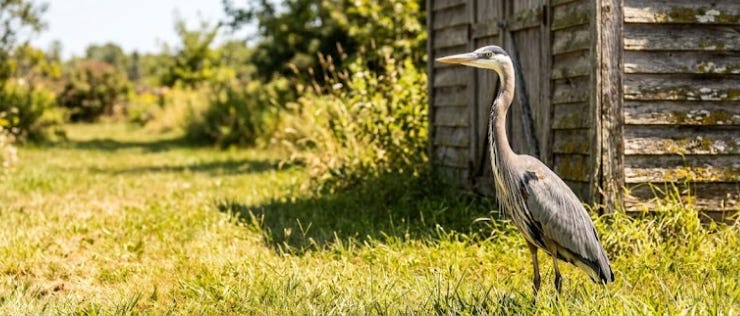
“You’re early,” it said.
He knew he was dreaming. That was the strange part, stranger than the bird. He had never once in his life known he was dreaming while he was in one, and now he stood in the wet grass and understood the grass was not real and that the heron was not real and that he could, if he wanted, walk back into the house and wake himself up. He did not want to. The heron’s voice was not a voice exactly. It arrived in his head already understood, the way you know a song’s next line before it comes.
“Early for what,” he said.
The heron considered the question for a long time, the way herons consider water. Then it lifted one foot, set it down an inch to the left, and said, “We’ll see,” and he woke up with the game over and his neck wrong and the feeling, which he would come to know very well, that he had been at a meeting where everyone else had the agenda.
He told Carol in the morning. She laughed, not unkindly. “A heron. In our yard. Giving you the business.”
“It said I was early.”
“You’ve never been early for anything in your life,” she said, and kissed the top of his head on her way to the coffee, and that was the first one.
They came every few weeks at first, then every few nights. He learned the rules the way you learn a new job: by getting things wrong. He could not make the animals come. He could not make them say anything. He could walk around inside the dream, pick up the hose, open the shed, and the yard would be exactly the yard, down to the rust on the gate hinge and the bare patch under the maple where Biscuit used to lie, and the animals would be where they were, and they would speak when they decided to.
A fox on the fence line, walking it like a tightrope, who told him that the thing he was worried about at work would not matter in a year. It didn’t.
A pair of crows on the power line who argued with each other about him as if he weren’t there, one insisting he was the wrong one and the other saying he was close enough.
A doe who stood in the middle of the lawn and said nothing for the whole dream, only looked at the house, and when he asked her what she wanted she said, “Not you,” and he woke up hurt in a way he could not have explained to anyone.
He started a notebook. He had adjusted claims for thirty years, and he wrote the dreams the way he wrote claims: date, time, conditions, parties present, statements made. Carol found it in the nightstand and read a few pages and put it back and did not mention it, which he understood was her way of taking it seriously.
“Have you told Jenna?” she asked once.
“Told her what? That her father talks to deer.”
“That her father has an interesting life.”
Jenna was thirty-one and lived in Pittsburgh with a husband neither of them had warmed to and a job at a hospital system doing something with data that she had explained twice. She called on Sundays. The calls were twenty minutes long and mostly about weather. She had been a kid who told her father everything, who used to sit on the closed lid of the toilet and talk at him through the shower curtain, and both of them knew the year that had stopped, and neither of them said so, because it was the year Danny died and there was nothing in that year any of them wanted to go back and touch.
So he did not tell Jenna. He wrote in the notebook. He went to sleep looking forward to it, which he had not done since he was a boy. The dreams were, he admitted to himself in the notebook and nowhere else, the most interesting thing that had ever happened to him, and the only thing that had happened to him that felt like it was happening on purpose.
The heron came back in the third year. Real this time. He was at the kitchen window with his coffee on a Tuesday in April and it was standing by the shed exactly where it had stood, gray-blue, enormous, absurd on a quarter-acre lot two miles from the mall.
He did not call Carol. He stood very still and waited for it to look at him.
It did not look at him. It stood for eleven minutes by the microwave clock, moving its head in the small increments herons move their heads, watching the grass, watching the back of the house, watching the upstairs windows, and then it opened wings wider than he was tall and went over the fence toward the creek behind the development, and he stood there with cold coffee and his heart going like he’d run somewhere.
“There was a heron in the yard,” he told Carol that night.
“A real one?”
“A real one.”
“Did it say anything?” She was smiling.
“No,” he said. “It didn’t look at me.”
She stopped smiling, because of the way he said it. Later he would think that was the moment she started to worry, and that she was worrying about the wrong thing, and that there had been no way to tell her so.
After the heron the yard began to fill.
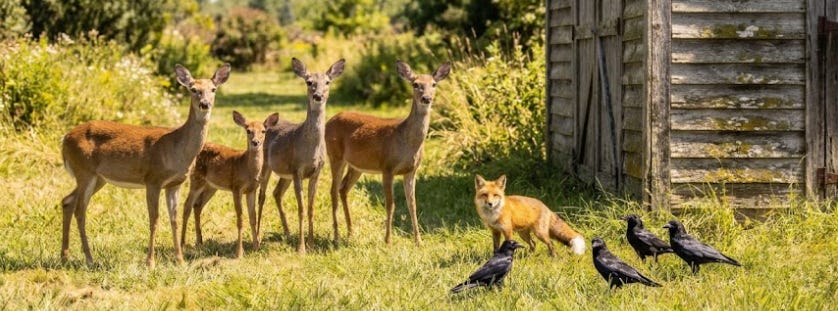
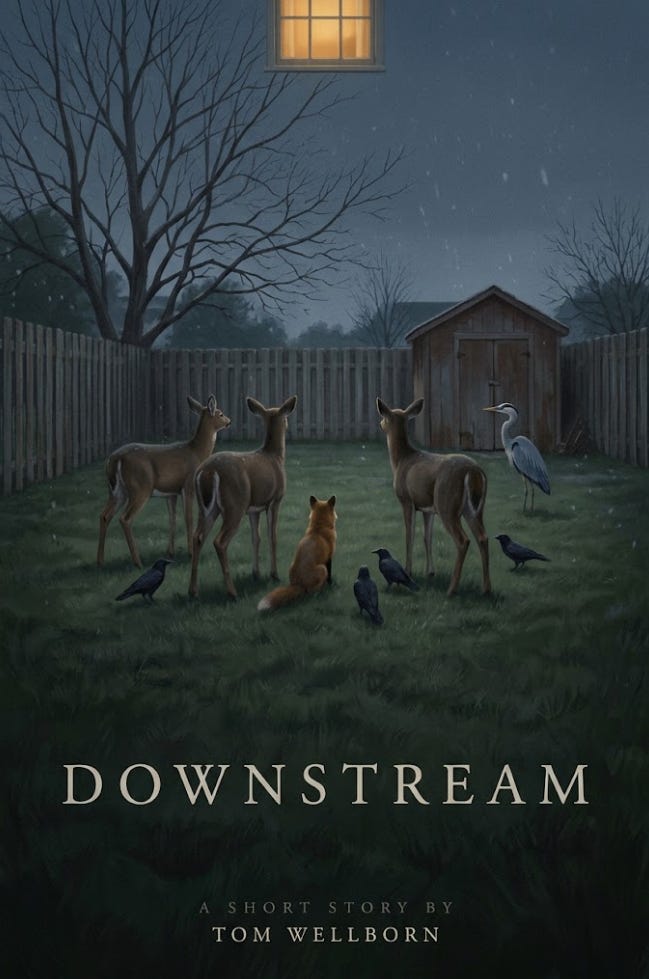
Not all at once. A fox on the fence line in May, walking it the way the dream fox had, toe over toe, without once turning its head. Crows on the wire, two, then four, then a number he stopped counting, silent in a way crows are not silent. A doe at dusk in June, then the doe and a yearling, then three does standing in the center of the lawn in a loose half-circle, facing the house.
Facing the house. He tested it. He stood in the yard among them, close enough to touch, and they did not run and did not look. He waved his arms. He said the names he’d given them in the notebook. The doe nearest him flicked an ear at a fly. He could have been the shed.
The dreams, meanwhile, were thinning. He noticed it the way you notice a tooth is gone, by the tongue going to the gap. A week without one. Then two. When they came now the animals said less, and what they said had the quality of someone talking over their shoulder on the way out of a room. The fox, in the last dream the fox was in, said only, “You did fine,” and he woke and lay in the dark with the certainty that he had been let go from something and thanked for his service.
He wrote that down. Then he closed the notebook and did not open it for a month, because he could not stand to see how little there was to add.
Carol was relieved. He watched her be relieved. He was sleeping, he had stopped talking about the heron, he spent his evenings at the window with the lights off, which she took for peace. “You seem better,” she said, and he said he was, because the alternative was telling his wife that the best thing in his life had stopped calling and that the deer in the yard were the ones who had taken over the account.
Carol bought the camera. One of the trail cameras hunters strap to trees, with a motion sensor and a night mode. “Something’s eating the hostas,” she said, which was true, and he helped her strap it to the maple and aim it at the lawn and said nothing about what he expected it to see.
It saw a raccoon, the neighbor’s cat, and Carol at six in the morning in her robe with the watering can. On the night of June 19, when he had stood at the window and counted three does and the fox on the fence from 9:40 until nearly eleven, it had tripped twice, at 9:52 and 10:31, and both frames showed the lawn, the fence, the maple’s shadow, and nothing else. The sensor had fired on something. The lens had found grass.
He looked at the frames for a long time on Carol’s laptop. Then he deleted them, and he was not proud of that, and he told himself it was because she would worry, and the truth was that she would believe him, and he was not ready to be believed.
Jenna came home in September.
She did not say she was leaving Mark. She said she was taking some time, and she brought two suitcases and the cat, and she slept in her old room with the door closed and came down for coffee with her face arranged, and on the fourth day Carol said, “Honey, you can just tell us,” and Jenna put her head down on the kitchen table and cried for a while, and after that the door stayed open.
Walt was glad in a way that shamed him. He had his daughter in the house. On the second night she came down at eleven for water and found him at the dark window and did not ask why, only got her glass and stood beside him, the two of them looking out, and after a while she said, “You used to do this when Danny was out late,” and he said, “I know,” and she put her hand flat on his back between the shoulder blades, the way her mother did, and went up to bed.
“There’s a lot of deer out there,” she said another night. “Is that new?”
“Couple of years.”
“They’re all looking at the house.” She said it lightly. Then she went up, and he stayed, and it was a long time before he let himself see what she had seen in a minute: that they were not looking at the house. They were looking at her window. Her old room, empty two years, and now not.
He went out onto the back step. The does did not move. He looked where they were looking, and the light was on upstairs, and her shape crossed the curtain once and was gone.
“Not you,” the dream doe had said, when he’d asked.
He had thought she meant it unkindly.
He started the notebook again. Not the dreams, which had all but stopped; the yard. Which animals, where they stood, where they looked. He drew the lawn on graph paper and plotted them the way he’d plotted collisions for thirty years: the fox always on the east fence, the crows always on the wire over the garage, the deer in a crescent whose open side, every night, faced the back corner of the house. Jenna’s corner.
In October the crescent had a shape he knew.
He sat with the notebook open to two pages three years apart. The dream from the first October, the doe who wouldn’t speak: he had sketched it, badly, the doe and two crows and the fox, where they’d stood. The yard tonight. The same positions, to the foot. The dream had been the diagram. The animals had been rehearsing. Or he had been shown the drill so that when it ran for real, one person on earth would know it was a drill.
He did not sleep that night, and when he did, near dawn, there was no dream, only dark, and he woke knowing that whatever had been using his sleep as a telephone had hung up for good, because it had the better instrument now, and the better instrument stood on four legs in his yard and did not need to be told anything.
Carol found the graph paper in November.
He came in from the yard and she was at the kitchen table with the notebook open and her reading glasses on and a cup of tea gone cold, and she did not close it when he came in, and she did not look caught. She looked like someone who had been waiting to be asked.
“The fox is on the east fence,” she said. “Every night. You’ve got it in here forty-one times.”
“Forty-three.”
“I’ve been leaving the porch light off for them,” she said. “Since August. I didn’t know why. I thought I was being ridiculous.” She turned a page, to the crescent, and put her finger on the open side. “That’s her room.”
“Yes.”
“Walt.” She took the glasses off. “I’m not going to ask you what you think it is. I don’t think you know. I want to ask you one thing and I want the true answer. Are they here to hurt her?”
He thought about the heron. He thought about the fox saying you did fine. He thought about three years of being spoken to by things that had never once lied to him, as far as he could tell, and had never once been kind, exactly, and had never once been anything but careful.
“No,” he said. “I think they’re here to make sure nothing does.”
She nodded. She closed the notebook and slid it across the table to him and picked up her tea and made a face at it.
“Then I’ll keep the light off,” she said.
The night Danny came, it was raining.
Walt had not dreamed in six weeks. He fell asleep on the couch with a book on his chest and was, at once, in the yard, in the rain, and the rain was wrong, falling slow, each drop visible, and the animals were all there, more than he had ever seen, deer and fox and crows and the heron by the shed and things he had no names for in the dark by the fence, every one of them facing the house, and in the middle of the lawn, in the open side of the crescent, a man stood with his back to Walt, looking up at Jenna’s window.
Walt knew the back of him. He knew the way the shoulders sat. He had known it on a seventeen-year-old and this was not a seventeen-year-old; this was a man of thirty-four, the age Danny would be, with Danny’s shoulders and Danny’s way of standing with his weight on the left foot, which he had done since the soccer injury at eleven, and Walt made a sound he had not made in seventeen years and the man turned around.
It was him. It was a guess. It was the face a father builds out of a boy’s face and a wish, and it was wearing the expression that meant he was about to ask for the car, and when it spoke the words came already understood, the way the animals’ had, and they came in Danny’s voice, and Walt could no longer tell which of those things was true.
“Hey, Dad.”
“You’re not him.”
“No,” it said, easily, the way Danny said things. “But I’m what you’ve got of him. It’s enough to steer by.”
“Steer what.”
It looked up at the window. “Her,” it said. “And the one she’s carrying.”
He had not known. In the dream he knew it the way he knew things in the dreams, and knew that Jenna had found out that morning and told no one, and that this was why the animals had thickened all autumn, why the crescent had closed, why the voice had come back after six weeks of silence in the one voice he could not hang up on.
“What are you.”
“Yours. A long way down.” It smiled Danny’s smile. “We can’t come back, Dad. Nobody comes back. We can reach, a little, into things that are alive, when they’re quiet. You were quiet in your sleep. You were the first thing on the line that could hear us at all, and we thought for a while you were the one we were looking for. You were close enough. The animals are easier. They stand where we put them.”
“And watch her.”
“And watch the line.” It turned back to the window. “It nearly ended once. You know when. We came to check that it holds.”
Walt stood in the slow rain in his own yard and said the thing he had not said aloud in seventeen years. “I should have driven him.”
“Yes,” it said, without turning. “And then he’d be here, and she’d have stayed in Pittsburgh, and there would be no one in that room, and none of us would be anywhere. That isn’t a comfort. I know it isn’t. It’s just the arithmetic.”
“Is it good. Where you are.”
A pause, the heron’s pause. “It’s downstream. Everything that happens here happens there, later, bigger.” It was thinning now, with the rain, with the animals, like a picture losing resolution. “The one she’s carrying is the first of us who learns how to reach. That’s why it’s now. That’s why it’s her. We’re not here because we could find you, Dad. We’re here because she’s the one who finds us.”
“Will Jenna see you?”
“She saw a deer once. When she was six. It talked to her. She thinks she made it up.” It was almost gone. “Let her.”
“Danny.”
For one second it was not a guess. It was his boy’s face exactly as it had been on the last morning, looking for the keys, and it said, “Don’t tell her, Dad. Tell the kid,” and then there was the yard, and the rain had stopped, and he was awake on the couch with the book on the floor and his face wet and Carol in the doorway in her robe, saying his name, and then not saying anything, and then coming to sit on the edge of the couch and hold his head against her the way she had held it the night the state trooper came.
Jenna told them on Sunday. Nine weeks. Mark did not know yet. Carol cried and held her and Walt held them both, and over Jenna’s shoulder, through the kitchen window, in the flat light of a November noon, the doe stood in the center of the lawn with a yearling beside her, and for the first time in three years an animal in his yard was looking at the glass, and the thing it was looking at was his daughter’s back.
He did not dream again. The telephone had been disconnected, and he found he could live with that, the way you can live with most things once you know what they were.
The yard changed. By December the animals had left his side of the house entirely. The fox no longer walked the east fence; it lay, now, under Jenna’s window, in the bare patch where Biscuit used to lie, every night from dusk until he lost it in the dark. The crescent closed into a ring. On the coldest nights there were more of them than the lawn could hold, and the camera on the maple went on recording grass, and Carol went on leaving the light off.
He decided in January, on a night with snow coming down, standing at the window with Jenna beside him, both of them with tea. She was showing, a little. She had told Mark. Mark had said the right things and was driving down on weekends and Walt had revised his opinion of him upward by one notch and would not be going further.
“Dad,” she said. “Can I tell you something weird?”
“Sure.”
“When I was little. Six, maybe. I had a dream a deer talked to me. In the yard. Right out there.” She pointed with her mug. “I’ve had it in my head all week. I don’t know why.”
He kept his eyes on the lawn. The ring of them, dark on the snow, all facing in.
“What did it say?”
“That’s the thing. I don’t remember what. Just that it did. And that it wasn’t scary.” She laughed at herself. “Pregnancy brain.”
He could have told her then. The notebook was in the drawer behind them with three years of dates and times and parties present. He could have said: your brother was in the yard, or something made of him was, and it came a very long way to look at you, and the deer are its hands, and the thing you’re carrying is the reason it’s here, and it is not scary, you’re right about that, it is the least scary thing I have ever been unable to explain. He had wanted, for three years, one person to say it to.
“Deer are like that,” he said.
She leaned her head on his shoulder, the way she had not done since she was twelve, and they watched the snow fall on the animals, who did not move, and who were not looking at either of them.
The baby came in June, a girl, in Pittsburgh, because Jenna had gone back to Mark and the house and the job, carefully, with conditions, the way you go back into a building after a fire. They named her Dana. Nobody said why. Walt and Carol drove out the day she was born and drove home three days later, and when they pulled into the driveway at dusk the yard was empty.
Not thinned. Empty. The grass, the fence, the shed, the bare patch under the maple. The camera with its little red eye.
He stood on the back step a long time. Then he went in and put the kettle on and got the notebook out and sat at the kitchen table and wrote the date, and the time, and Conditions: clear. Parties present: none. He looked at that a while. Then he added one line, the only line in three years that was not an observation.
It held.
He closed it and put it in the drawer. He did not open it again. But he started, that summer, a second notebook, a small one, and he kept it in his shirt pocket when Dana visited, and what he wrote in it was not dreams or deer. It was her. What she said when she was two. What she asked about the heron in the picture book. The day she was four and stood in the center of the lawn, in the open side of a crescent that was no longer there, and turned in a slow circle with her arms out, and said, “They’re not here yet, Grandpa,” and he said, “No, sweetheart, not yet,” and did not ask her who.
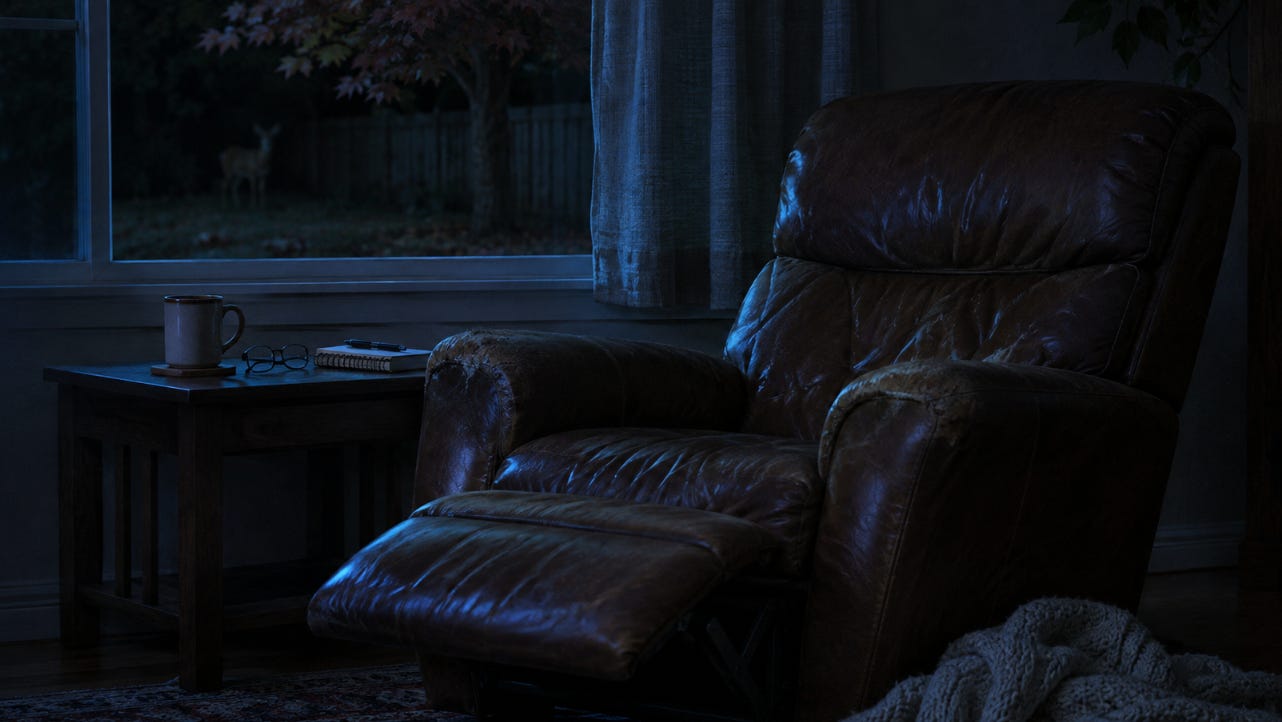
He died in March, eleven years after the heron, in his sleep, in the recliner, with a game on.
Jenna cleared the house in April. She found the first notebook in the kitchen drawer and sat on the floor and read all of it, every date and diagram, the heron and the fox and the crescent, and understood none of it and could not stop. She found the second notebook in the pocket of the shirt Carol had not been able to give away, and that one she understood, and that one she had to put down twice before she could finish.
The last page of the small notebook was dated the week before he died, in a hand that had started to shake. Dana, 11. Says she dreamed the deer again. Says this time it looked at her. Says it told her she was early.
Below that, the last line he ever wrote.
She isn’t.
Jenna sat with that in her father’s kitchen until the light changed. Then she got up, because her daughter had been quiet in the yard for too long, and went to the window.
Dana was standing in the center of the lawn with her back to the house. Around her, in a ring, close enough to touch, facing in, stood more animals than a quarter-acre could hold: deer and fox and crows on the grass itself, and by the shed, enormous, absurd, a heron, and every one of them was looking at the girl, and the girl was talking, and Jenna could not hear what she said through the glass, but she could see her daughter’s hands moving the way her father’s used to when he was explaining a claim, patient, exact, walking someone through the record, and she saw the heron lift one foot and set it down an inch to the left, and she saw Dana laugh.
She did not go out. She stood at the window with her hand flat on the glass, and she understood that she was looking at something she had been told about once, when she was six, by a deer, and had decided she made up.
After a while the animals went, not walking, thinning, and the yard was the yard, and her daughter turned around and saw her in the window and waved, and came in for lunch, and did not say anything about it, and Jenna did not ask.
She found her father’s pen on the counter. She opened the small notebook to the page after the last one, and under She isn’t, in her own hand, she wrote the date, and the time, and Conditions: clear.
Then, after a moment: Parties present: all of them.
Seriously. A beautiful piece.
The things that come from your imagination… it amazes me. This is so *good.* Thank you.