


This week the President of the United States drove out to Joint Base Andrews to personally meet Xi Jinping's plane, a gesture usually reserved for a beloved uncle returning from a long trip, and then walked him through a White House visit so ceremonially plush that the phrase "largely for show" appears in multiple respectable newspapers as a neutral description of it.
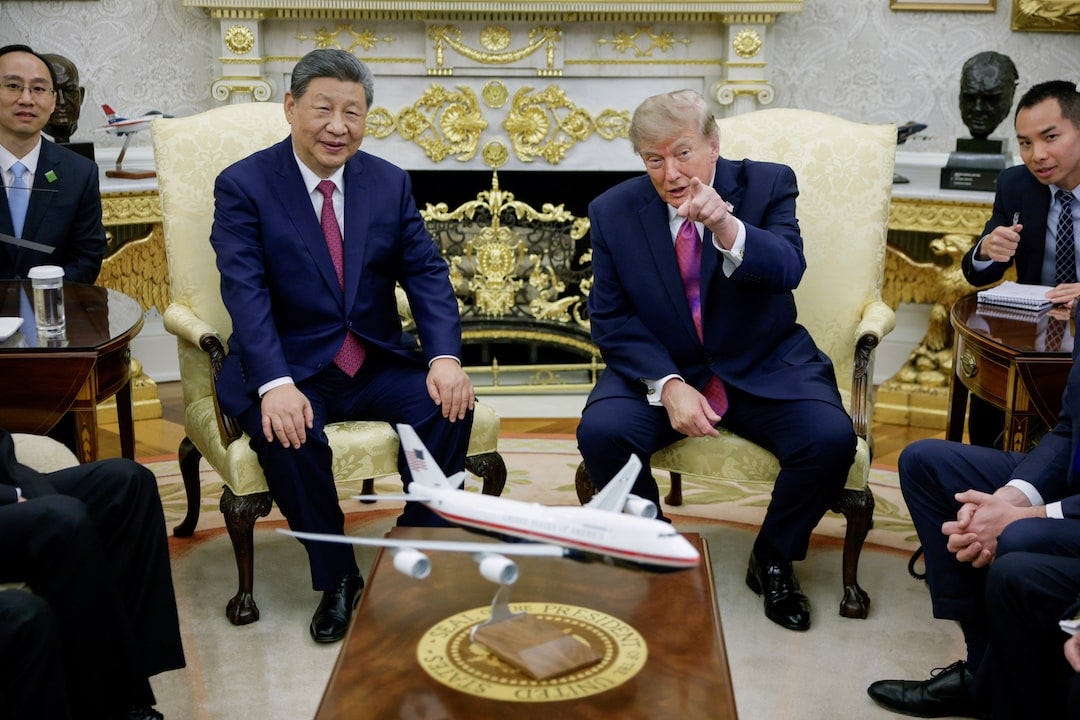
There was a state dinner. There were tech billionaires. There was sea bass. Asked afterward what had been accomplished, Trump said “everything,” which is a word, and then stopped, which is a problem. Reporters asked for details. The details did not come. What came instead was a two-month extension of the tariff truce that already existed, the diplomatic equivalent of agreeing to discuss the mortgage again in eight weeks, and a new “AI dialogue,” a phone line for the two countries to call each other about artificial intelligence, which the US Trade Representative compared to a Cold War hotline, the kind of device built specifically for the moment everyone already suspects things have gone badly wrong. Treasury Secretary Bessent mentioned, almost in passing, that China had actually proposed a “bigger deal” than the one on the table. The self-described greatest dealmaker in the history of the presidency was offered a bigger deal by the other side, and flew home with an eight-week extension and a phone.
Somewhere in the run-up to all this, Trump had also been trying to get the entire world to stop calling artificial intelligence “artificial intelligence” and start calling it “Super Intelligence” instead, capital S, capital I, a rebrand he has been pitching to foreign leaders with the confidence of a man who has concluded that the way to win the AI race is to be the one who names it. Asked about it during the summit, he said Super Intelligence would be “a big topic of discussion,” and then, in the same breath, that he wanted “to leave it exactly where it is,” a sentence that means nothing forwards, backwards, or upside down, delivered with the finality of a man who believed it settled something. It settled nothing. Nobody knows what “leave it exactly where it is” refers to, since the thing under discussion was a proposal to change a name, and leaving a name change exactly where it is means, definitionally, not doing it, which makes this the one coherent policy position Trump produced all week, arrived at by accident, while trying to say the opposite. Xi Jinping was standing nearby for this. He has not commented.
Taiwan came up too, or rather it was scheduled to come up and then didn’t, because Trump declined to answer questions about it. This is a man who has an opinion about the water pressure in American showers and has shared it publicly on multiple occasions, at length, unprompted, with feeling. On Taiwan, the single most dangerous flashpoint between the two most powerful countries on earth, he had nothing available. The job fell to Ambassador Perdue, who confirmed there had been “no change” in policy, a phrase that in diplomacy means someone spent forty minutes in a room making sure nothing happened and would now like credit for it. So on the two hardest questions of his own summit, what “everything” meant and what happens to Taiwan, the President of the United States produced silence and a rebrand, respectively, and called it historic anyway.
Then there is the matter of the television, which deserves its own paragraph, because it is the single most Trump thing that happened all week and it happened before Xi’s plane had even landed. Days ahead of the visit, Trump banned CNN, MS NOW, and Politico from the White House. The broadcast networks, who share pooled camera coverage of events like this, responded by jointly suspending that coverage for Xi’s entire first day rather than accept a pool with CNN cut out of it. The result was a summit designed as a global television showcase that spent its opening day largely without television. Trump’s explanation, posted afterward, was that the event had been “Actually made for Television” but the networks, being “Fake News,” had “refused to be there,” which is a bit like locking your guests out of the house and then complaining about the turnout. He admits, in his own words, that the whole thing was staged for cameras. He then blames the cameras for not attending the staging he personally ejected them from. Both halves of this are in the same post. The people most upset about it, remarkably, were the Chinese. Officials in Beijing had planned the visit as a demonstration of Xi’s stature on the world stage, and a stage nobody is filming is just a room with flags in it. Wu Xinbo, an adviser to China’s foreign ministry, called the reduced footage “regrettable,” and said more coverage “could have helped improve the atmosphere in US-China relations,” which is the sound of an official of the Chinese Communist Party gently explaining to the American president how a free press works, and wishing there had been more of it. A former senior State Department official, Edgard Kagan, observed that to have “kicked this fight right before the Xi visit” did not “suggest great planning.” Another former Trump State Department official, asked what the visit had actually delivered, offered: “The deliverable was a good time had by all, or something.” The “or something” is doing the work of an entire foreign policy review.
So to recap the ceremonial half of the week: the president met the plane, staged an event for television, banned the television, got told off about the missing television by the guest’s own government, and then blamed the television. Every step in that sequence was his own decision. At no point did anyone force him to pick a fight with three news outlets in the same week he was hosting the leader of a rival superpower for what his own team described as a made-for-TV event, and yet here we are, with a state visit whose opening day exists mostly in the memories of the people physically in the room and in the footage of the Chinese state media crews who, being the only ones left, got exactly the pictures they came for.
Now for the part where things stop being merely embarrassing and become the kind of story that actually deserves the word disgraceful. While Trump was out on the tarmac doing the greeting, American intelligence assessments were being reported by CNN and the Wall Street Journal describing something rather heavier than a tariff truce: Chinese groups have reportedly been supplying Iran with satellite imagery and targeting assistance, helping Tehran track shipping through the Strait of Hormuz and, more gravely, improving Iran’s accuracy in strikes on U.S. military installations, strikes that have killed American soldiers. The Wall Street Journal separately counted around 1,300 shipments of dual-use components, the kind that go into drones and missiles, moving from China to Iran in the first half of this year alone. Thirteen hundred is a lot of shipments. Ambassador Perdue says Trump personally told Xi this behavior was “unacceptable.” He apparently told him this somewhere between the airport handshake and the dinner at which he called the man a “truly great friend,” which means that on the same day, to the same person, the president delivered a warning about helping kill American troops and a heartfelt toast to their friendship, and then ate sea bass. Either that is a masterclass in compartmentalization or the two thoughts simply never met each other on the way through.
It gets better, or worse, depending on how much you enjoy watching a superpower get quietly out-messaged by a man standing three feet from its president. Xi, during his remarks, invoked something called the Thucydides Trap, a term of art for what supposedly happens when a rising power threatens an established one and the two drift toward war almost by structural inevitability. He said the trap “can be overcome,” and called for the two nations to “coexist in peace” with competition kept “within bounds.” Anyone keeping notes will recognize the material, because he said the identical thing four months earlier in Beijing. He was, in other words, repeating himself, slowly, in the specific tone of a man reminding a waiter what he ordered last time. The message underneath it, as analysts read it, runs roughly: we are aware this is a contest between two great powers, we are content to be one of them, and we are comfortable saying so twice. Trump gave no indication of knowing who Thucydides was, which is fair, since he died around 400 BC and has never appeared on Fox & Friends. Trump’s response to hearing the line for the second time was to call the whole event magnificent and move on to the next photo, which either means it did not register or means it registered fully and he concluded the correct presidential response to being handed a warning about a trap, twice, by the man setting it, was enthusiasm. Neither option is a great advertisement for the strategic minds currently steering the executive branch.
A member of Trump’s own party, Senator Thom Tillis, watched all of this unfold and described it, on the record, as “a WTF moment.” A sitting United States senator, from the president’s own party, surveyed the week, found that the English language had nothing adequate to offer, and reached instead for a text-message abbreviation. That is not the usual register for a Republican describing his own president’s signature diplomatic event of the season, and it suggests that even inside the tent, people were doing the math on hosting an elaborate state dinner for a government simultaneously accused of helping kill American service members, and arriving at a total they didn’t love.
None of this required anyone to invent anything. Every detail above is on the public record, reported by outlets across the spectrum, confirmed by an actual U.S. ambassador speaking on the record. What it adds up to, without embellishment, is a president who spent a week failing to explain what his summit accomplished beyond “everything,” failing to answer a direct question about Taiwan, trying to rename an entire field of technology by presidential preference and then failing to even do that, banning the press from an event he later complained the press didn’t cover, calling a man “truly great” hours after telling him his government’s actions were unacceptable, and getting quietly needled with the same geopolitical one-liner twice in four months without appearing to notice it landed. Somewhere in there is a man who appears to sincerely believe the tariff truce extension and the friendship toast were the headline of the week, rather than the fact that his own intelligence services were, at the exact same moment, telling reporters that the guest of honor’s country had materially helped kill American soldiers. Messaging problems get fixed by hiring a better communications director. What happened here was a man standing in the wrong room, smiling at the wrong moment, thanking the wrong person, and calling it a win because the room was expensively decorated and someone brought out the fish.
The tariff truce runs through January. The AI hotline exists now, presumably for the next time someone needs to call Beijing urgently to ask what exactly they’ve been shipping to Tehran. Taiwan policy remains, per the ambassador, unchanged, which is the diplomatic version of “we didn’t lose anything today that we can point to,” delivered by someone who was clearly told to say it and not invited to explain what “no change” is protecting against. And the president who orchestrated the whole spectacle is, as of this writing, still calling the visit magnificent, still declining to say what “everything” meant, and still, as far as anyone can tell, unbothered that his own government’s intelligence agencies spent the week contradicting his hospitality in real time. He got to stand next to a big plane. He got to say the word friend a lot. He got a phone line for a technology he tried and failed to rename mid-summit, and a made-for-television event that, thanks entirely to him, ran for a day without most of the television. Somewhere behind him, thirteen hundred shipments of drone and missile parts kept moving, a warning about a trap got delivered twice without apparent effect, a Chinese foreign ministry adviser was left explaining to the American press why it was a shame the American press had been thrown out, and a member of his own party summed up the entire week in three letters that were not, technically, a compliment.
Great recap! He is un utter embarrassment! 😤
You paint the picture well. Trump is ignorant and generally clueless. "Trump gave no indication of knowing who Thucydides was, which is fair, since he died around 400 BC and has never appeared on Fox & Friends." I like your style.