


You knew him. Everyone knew him. Every school had exactly one, the kid behind the gym who ran the place by a menace nobody had voted for, and if you close your eyes, you can still see him, the swagger that was mostly posture, the small, mean eyes forever scanning for someone smaller, the laugh that arrived a half second before he understood the joke. He took lunch money. He handed out names. He could not lose at anything, not tetherball, not a coin flip, not an argument about whose turn it was, without the entire world having to end. You spent a year of your life managing his moods so that he would not turn them on you. Then you grew up, and he grew up, or at least he left, and you assumed, the way children assume, that the universe kept a mechanism for such people, that somewhere down the line a teacher or a partner or a boss or simply the weather of adulthood would quietly file the edges off him.
I am here to report that one of them got through. One of them did not get filed. One of them kept every single behavior intact, carried it across sixty years without shedding a gram of it, and is now, as I write this, the most powerful human being on the planet. His name is Donald Trump. The bully graduated to a country. The lunch money is the Treasury now. The names he hands out are foreign policy. And the playground, I am sorry to tell you, is the world.
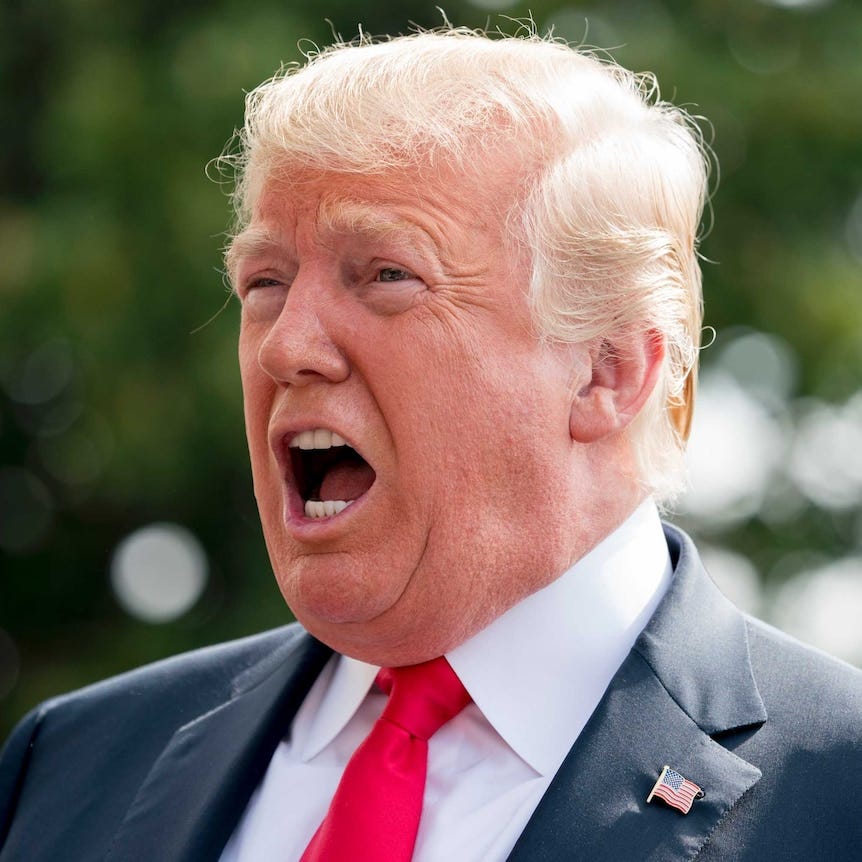
Start with the names, because the names were always the bully’s one art form, the single creative act he was capable of. He could not build anything, could not make anyone laugh on purpose, could not draw or sing or throw a ball, but he could find the one word that made a kid cry at recess, and he could repeat it until it stuck to the kid for life. Donald Trump has never stopped. He has merely scaled the gift up to the dimensions of the Republic. Little Marco. Lyin’ Ted. Crooked Hillary. Sleepy Joe. He conducts the diplomacy of a superpower the way he once ran the four-square court, by branding everyone smaller than he needs them to feel, and the genuinely frightening part is that it works, that grown senators answer to the names he assigned them like third graders who have accepted their slot in the pecking order.
He cannot lose. Not at golf, where he is famous for booting the ball out of the rough when he thinks the cameras are elsewhere, the grown-man version of nudging your piece across the board while your opponent is in the bathroom. Not at an election, the one game in the country with the clearest rules and the most witnesses, which he lost, fairly, on camera, and then refused to walk away from the way a six-year-old refuses to leave a birthday party that is not his, shrieking that it was rigged, that the other kids cheated, that the cake had his name on it. The only real difference between the six-year-old and the man is that the six-year-old cannot summon a mob. On January 6, the bully flipped the board for real, sent his crew to ransack the room where the score was being tallied, and the single thing that saved the game was that the hall monitors, that one time, did not run.
He takes what is not his, and has done it his whole life, and only the size of the lunch money ever changed. He stiffed the contractors who built his towers, the plumbers and painters and waiters and dishwashers, the way a bully shakes down the very kids who did the actual work on the group project. He ran a fake university and a fake charity, both shut down by the courts. And in his second act, he reached the purest distillation of the form, suing his own government and settling with himself for one billion seven hundred seventy-six million dollars of public money, then routing the proceeds to the same crew that had flipped the board on his behalf. The lunch money is the Treasury, and he has walked off with the whole school’s milk fund stuffed in his backpack.
He lies the way the bully lies, not to be believed but to be obeyed. The bully standing there with your stolen hat on his head, swearing he was never even near your hat, is not constructing an argument. He is daring you to call him a liar to his face and betting everything on the fact that you are smaller than he is. A major network counted twenty-eight false statements out of his mouth in a single week. He is not trying to persuade you that the sky is green. He is establishing that he can say the sky is green and that no teacher will come, and every time no teacher comes, the next lie carries a little more weight.
He picks, always and without a single exception, on whoever is smallest. He mocked a disabled reporter with his arms jerking, in front of a roaring crowd, the most recognizable bully move in the entire repertoire, the cruel imitation of the kid who moves differently. He pulled the children of migrants away from their parents and mislaid the paperwork that would have brought them back, which is the lunch-money instinct handed a federal budget. He has never once in his life picked a fight he might lose, never gone after anyone bigger or stronger or better defended, because the whole architecture of the bully rests on selecting targets who cannot hit back.
And here is the secret every playground already knows, the one that explains all the rest of it. The bully is a coward. He punches down precisely because he flinches up. Put him in a room with someone genuinely more powerful than he is, and the menace drains out of him into the most embarrassing flattery you have ever had to watch. Trump stood beside Vladimir Putin and took the man’s word over his own country’s. He said of a dictator who starves and murders his own people that the two of them had fallen in love. He fawns over every strongman on the map because the bully grasps, at the cellular level, the oldest rule of the schoolyard, which is that you suck up to the biggest kid so that he goes and hits somebody else.
He cannot function without his crew, the ring of smaller creatures who laugh on cue and fetch whatever he points at. Every bully assembles them, the hangers-on who are not strong enough to be the bully and not brave enough to stand against him, and who purchase their own safety with laughter. Watch his cabinet around the long table, each of them leaning in to admire the cut of his crown, competing to be the one whose flattery he notices, and you are watching the identical transaction that played out by the bike racks decades ago, transposed into a room with the seal of the United States bolted to the wall.
He brags the way a nine-year-old brags, with no tether to the possible. His father could beat up your father. He scored every touchdown in the game. He has the best words, the best economy, the biggest crowds, the highest IQ in any room, and he aced a cognitive test that he describes as a feat of genius rather than what it is, a screening exam for dementia that asks the patient to identify a drawing of an elephant.
For all of the noise, he is the most sensitive person in any room he walks into, the crybully, the one who dishes it out around the clock, and cannot survive a single syllable coming back. A comedy sketch can wreck his whole night. A magazine cover can trigger a week of rage typed out at three in the morning. He carries the thinnest skin and the loudest mouth on the playground at the same time, which is the exact chemistry that produces a bully in the first place, because the cruelty was always a wound walking around in search of somewhere to set itself down.
And now the surreal part, the detail that tips the entire picture out of the grim and into something from a fever dream. This particular schoolyard bully, Donald Trump, is seventy-nine years old. He is the oldest boy in the school by six full decades, and he is visibly coming apart at the seams. He falls asleep at the long table while his own people are still speaking. His hand is bruised and kept carefully out of the frame. His voice has thinned to something papery. The cognitive screen he keeps bragging about acing is the test they administer when they are checking whether you can still find your way home. He is a bully with a quietly deleted prescription and a lab number nobody will explain, a tyrant of the four-square court who now naps through the meetings he himself called, and an entire nation has rearranged its life around the moods of a failing old man with the emotional equipment of a twelve-year-old and the impulse control of a toddler who has just discovered the stove.
Here is what the comparison finally teaches, once the comedy of it burns off. The schoolyard bully is a temporary creature. That is the one mercy built into childhood. He is contained by the size of the schoolyard and the length of the school day and the certainty that June is coming, and even the worst of them is stopped eventually by a teacher who finally sees it, by a bigger kid who finally swings, by the plain arrival of an adulthood that has no further use for him. We tell frightened children to endure the bully because the bully ends. The whole consolation of the form is that it ends.
This one did not end. He was never sent to the principal, never made to apologize, never grew the part of the self that the rest of us grew somewhere around the age of ten. He aged without maturing at all, a body going to seed around a personality that froze solid in the sixth grade, and somewhere along the way, the playground stopped being a playground and became a nation, and then the world, and the lunch money became the Treasury and the names became policy, and the board he overturns when he is losing became the Constitution. There is no teacher in this version. There is no June. There is only Donald Trump, the oldest boy in the school, slower now and meaner for the slowness, standing in the middle of a yard the size of the planet, scanning the way he always scanned, deciding who is small enough to take next.
Somebody was always supposed to stop him. Nobody ever did.
That part was never childish. That part has always been on us.