


On Monday afternoon, the President of the United States signed an executive order directing the federal government to stop calling artificial intelligence “artificial intelligence” and to call it “Super Intelligence” instead, capital S, capital I, with the specific confidence of a man who has looked hard at the most consequential technology of the century and concluded that the problem was the adjective. The White House fact sheet says he has “inaugurated the era of Super Intelligence,” which is a thing you can apparently do with a pen if the pen is yours. Nothing about the technology changed. The chips are the same chips. The models are the same models. But every federal document that used to say one thing will now say another, and somewhere in the Commerce Department a career employee is running a find-and-replace on eleven thousand pages, and that employee is, in a sense, the entire domestic policy of this administration in a single chair.
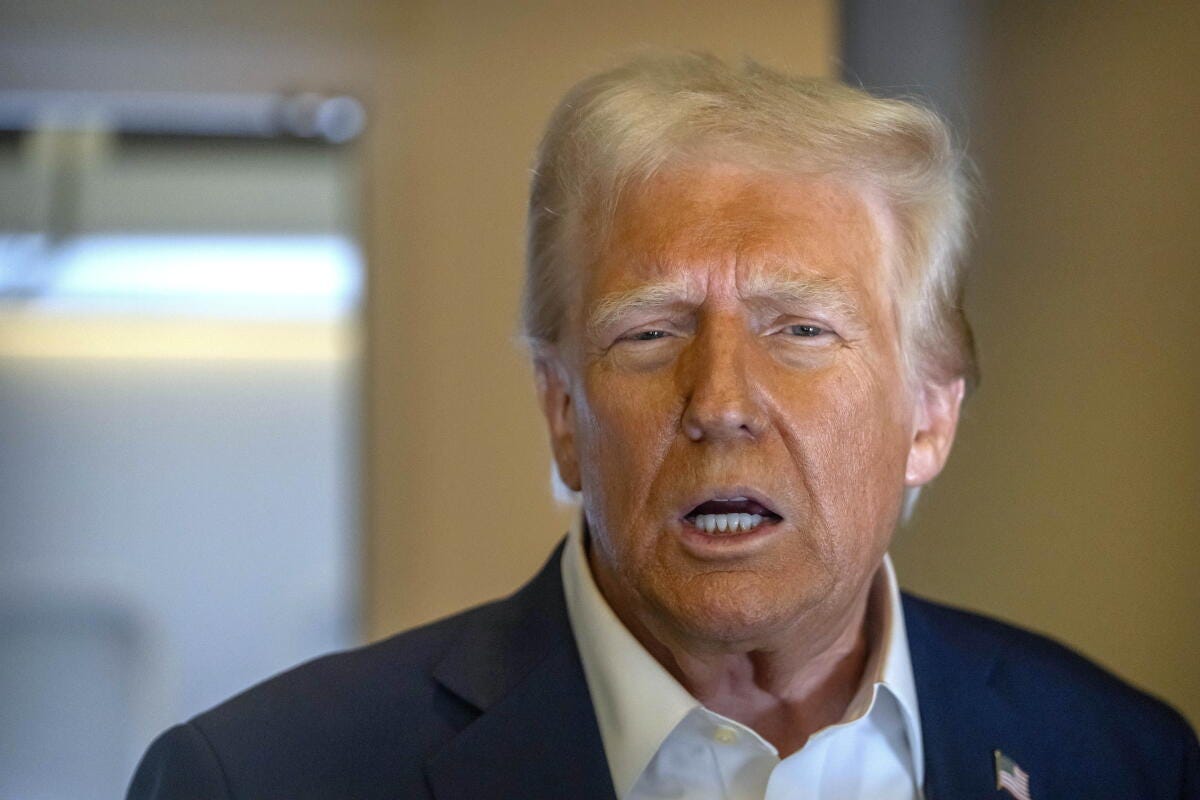
Because renaming is what Donald Trump does, and it is the one form of governance at which he has never failed. By the third year of his second presidency it has become a discipline with its own logic, its own escalation, and its own strange beauty, like watching a man methodically carve his initials into every tree in a national forest and then propose renaming the forest.
Geography first, because that is where he began. On the afternoon of his inauguration he signed an order changing the Gulf of Mexico to the Gulf of America, a body of water that had been called the Gulf of Mexico by every map, sailor, and hurricane forecaster on earth for roughly four hundred years and now, by federal decree, was ours, which it always had been in the only sense that mattered to anyone except him. Within weeks Fort Bragg was Fort Bragg again, after four years as Fort Liberty, the trick being that the Bragg it now honored was a different Bragg, a Private First Class named Roland from the Second World War rather than the Confederate general, so that the sign could go back up and the reason for the sign could stay in the drawer. In August, during a feud with the Canadian prime minister over tariffs, he announced that Lake Ontario would henceforth be Lake America, pressured Apple into changing it in the maps app, got Google to change it for American users, and celebrated with an AI-generated video of Canada geese carrying rifles, which is the first known instance of a head of state deploying armed waterfowl in a border dispute, and I have checked.
Then the institutions. In September of last year the Department of Defense became the Department of War, a rebrand the president described as sending a message of strength, though the message a department sends is usually contained in what it does rather than what the sign says, and the department that day did the same things it had done the day before, only with new letterhead. Three months later, and this is the detail that a novelist would cut for being too much, he renamed the United States Institute of Peace after himself. The Donald J. Trump United States Institute of Peace. He had spent the spring gutting it. He renamed the peace institute for himself and the defense department for war in the same calendar year, and if there is a more complete summary of the man available anywhere it has not been written.
The Kennedy Center required two attempts, which is instructive. In December the board he had installed voted to rename the building “The Donald J. Trump and the John F. Kennedy Memorial Center for the Performing Arts,” a name with the rhythm of a subpoena. A federal court threw it out in May. By then, in February, the administration had also renamed the Honors: the Trump Kennedy Center Honors, so that when the building’s name came off, the award’s stayed, which is a bit like losing a lawsuit over the deed to a house and keeping your name on the mailbox.
Money next, and here the discipline reaches its purest form, because the objects being renamed are instruments rather than places or buildings, and instruments cannot object. The children’s investment accounts created in last year’s budget law were drafted as MAGA accounts, and became Trump Accounts, and are reported to the Internal Revenue Service on a form numbered 4547, a sequence the IRS arrived at by some method other than counting. The million-dollar residency visa is the Trump Gold Card, and it has his face on it, in gold, so that a foreign national buying his way into the country can carry a small portrait of the man he bought it from. The government’s discount-pharmacy website is TrumpRx. The national parks pass, which for decades carried a photograph of a canyon or a bison, now carries a photograph of him, so that a family arriving at Yellowstone hands the ranger a picture of Donald Trump in order to see a geyser. A commemorative passport issued this summer bears his image and his signature. And the free-admission days at the parks, which used to fall on Martin Luther King Day and Juneteenth, have been consolidated onto a single date, Flag Day, which the calendar has been persuaded to call President Trump’s Birthday.
The military got a battleship class. Announced three days before Christmas: the Trump-class, the first new battleship line in seventy years, named for the first man ever to name one after himself while alive. The sixth-generation fighter is the F-47, and if you are wondering whether the number is a coincidence, the IRS form is 4547 and the passport has his signature on it, so, no.
Then the buildings, which are where the discipline stops being funny and starts being a genre. Beginning in the spring, enormous banners bearing his portrait went up on the facades of the Department of Agriculture, the Department of Labor, and the Department of Justice, several stories tall, so that a citizen walking to the Smithsonian passes three separate federal agencies each displaying the face of the same living man, a form of civic decoration whose previous practitioners are well known and were not, on the whole, elected twice.
And then the failures, which are the most revealing entries in any inventory, because they show what he wanted and could not get. He tried to rename Penn Station in New York and Dulles Airport in Virginia, in both cases by withholding federal transit money until the locals agreed, which they did not. He asked for the naming rights to the Washington Commanders’ new stadium, which is to say he asked to have a football stadium named after him in exchange for nothing, on the theory that the name was the payment. Those three did not go through. The triumphal arch he wants at the Arlington end of Memorial Bridge is proceeding, and was reclassified last week as a military complex, which is a category of thing you can name whatever you like.
A scholar of this discipline is obliged, at this point, to note what it replaces. Donald Trump has spent his life putting his name on things, and the historical record on how that goes is unusually complete. Trump Shuttle folded in 1992. Trump Steaks, Trump Vodka, Trump Ice, Trump Mortgage, and Trump Magazine are gone. Trump University settled for twenty-five million dollars. The Taj Mahal closed. Three residential buildings on the West Side of Manhattan voted, as buildings, to take his name off the front. His name has come down from more towers than it has gone up on, and every one of those was a thing he built, or bought, or licensed, with his own money or someone else’s. The federal renaming project is the first time in his life he has been able to put his name on things that were already there, already paid for, already working, and that cannot vote to remove it. A gulf holds no board meetings, and the IRS has no say over a form number. This is the appeal, and it is the whole appeal: at eighty, he has finally found objects that cannot fail him, because he had nothing to do with making them.
Which brings the inventory to its consequence, and the consequence is the arithmetic. Every rename is free. It costs nothing to change the Gulf, or the parks pass, or the word for a technology, and each one produces a day of coverage, a wave of official documents, and a physical object with his name on it that will outlast the news cycle by years. Meanwhile the things that require building, the Institute of Peace, the Kennedy Center’s programming, the counterintelligence division, the Cyber Division, the election-security offices, are hollowed out, because building is expensive and slow and, in the end, gets named after whoever finishes it, which is rarely the person who started it. A man who renames the peace institute for himself while emptying it has told you which of the two operations he considers the real one.
And the last entry, the one signed Monday, is the tell for the whole list. The other renames were of things that exist. Super Intelligence is a rename of a thing that does not yet exist, a name applied in advance to a technology that has not arrived, so that whenever it does, and whoever builds it, and whatever it does to the rest of us, the government’s word for it will already have been chosen by him. He has now named the future, and the future, like the gulf, did not get a vote. The one thing every name on this list has in common is that the next president can remove it with the same pen, in an afternoon, the way the court removed it from the Kennedy Center in May, which means the sum total of the most durable-looking project of this administration is a list of signs waiting for a January.
So well written! I amaze myself that I can still laugh when I read posts such as yours but that’s the well written part I’m reacting to! Thanks!
Many thanks, Tom, for the recounting of the many attempts by a deeply insecure precedent to reassure himself of his worth, but do you really need to be a retired physician/psychiatrist to see the truth of Trump's psychopathology? Nah, you got it!