


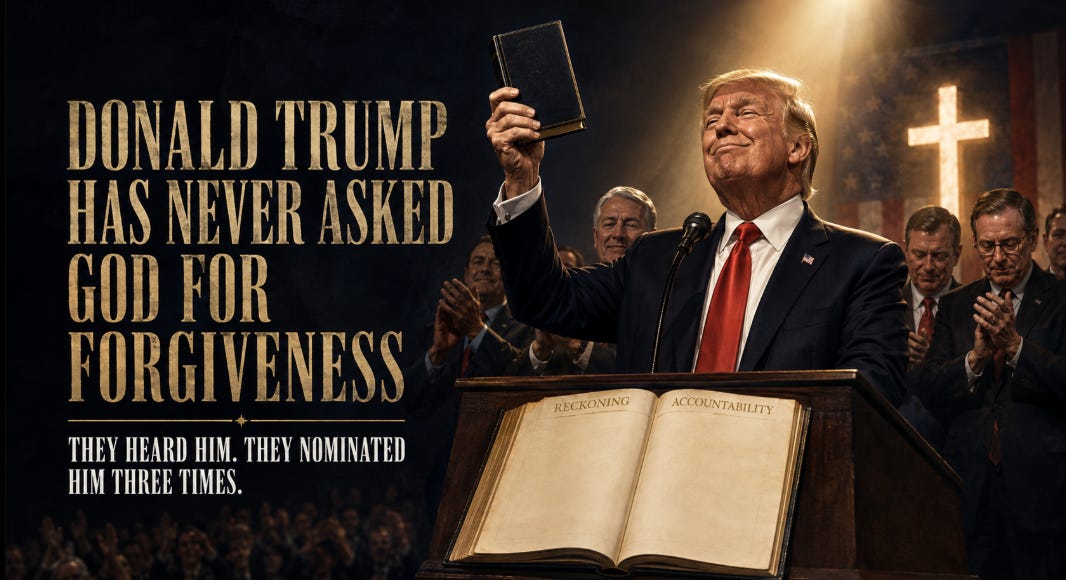
Let us begin with the question, which had to be asked twice.
On July 18, 2015, at the Family Leadership Summit in Ames, Iowa, a gathering underwritten by the Family Research Council, Liberty University, and the National Organization for Marriage, and attended by the sort of voter who can tell you what year they were saved, the pollster Frank Luntz asked Donald Trump whether he had ever asked God for forgiveness.
Trump said it was a tough question, which it is not, and then delivered a short unsolicited briefing on the fact that he is Protestant, and Presbyterian, and that he goes to church, and that people are shocked to learn this, which was true and remains the only part of the answer that has aged well.
Luntz asked again.
And Trump said that he was not sure he ever had. He said he did not think so. He said that if he does something wrong he simply tries to make it right, and then, in a phrase that has followed him for eleven years, that he does not bring God into that picture.
It would be easy and cheap to file this as a gaffe. It was not a gaffe. A gaffe is when a man says the wrong thing. This was a man being asked a direct question by a friendly moderator at a friendly event, taking a moment, declining the offered escape route, and then supplying an accurate account of his interior life to a room full of people for whom that account was theologically disqualifying.
He was not confused about what he was being asked. He answered it correctly. It is the rest of us who have not caught up.
The doctrine is the part everyone talks around, so let us handle it directly. Protestant Christianity, of which the man is a self-described member, does not treat repentance as an optional devotional flourish for the especially enthusiastic. It is the mechanism. The entire architecture rests on the proposition that human beings are inadequate, that they cannot correct this themselves, and that the correction is available only by acknowledging the inadequacy and asking. The Reformation, the thing that produced Presbyterians, began in a dispute over the meaning of the word repentance. That is not an ornament on the tradition. That is the foundation stone, and a man standing on it announcing that he has never once availed himself of the central provision is not a lax believer or a backslider or a man who does not attend often enough. He is describing a completely different religion, one with no sin in it, in which the deity is a sort of enthusiastic supporter who is delighted with the current arrangement.
He then attempted a save, and the save is the best documentary evidence in the entire file.
Asked to clarify, he explained that when he goes to church and drinks his little wine and has his little cracker, he supposes that is a form of asking for forgiveness, and that he does it as often as he can because he feels cleansed.
His little cracker.
That is the Eucharist, the central sacrament of Western Christianity, the thing over which Europe conducted a century of warfare, described by a Presbyterian at an evangelical summit as a cracker of modest dimensions. And note the mechanism he assigns to it, which is not forgiveness but cleansing, a spa treatment, a thing you receive rather than a thing you request. He goes as often as he can because it makes him feel better afterward. He has approached the sacrament the way one approaches a car wash.
The elaboration came a year later and is somehow worse. Speaking to Jake Tapper in 2016, he explained that he likes to be good, that he does not like having to ask for forgiveness, and that he is good, and that he does not do a lot of things that are bad.
Read that as a proposition rather than a soundbite. He is not saying that he has repented privately and prefers not to discuss it. He is not saying that his faith is a personal matter. He is saying that the transaction has never been necessary, on the merits, because of the quality of his conduct. That is a man conducting his own audit, in public, and issuing himself a clean opinion. Every accountant in America would like a client like this and no accountant in America would sign it.
The record of terrestrial apology matches the celestial one exactly, which is at least consistent.
The pattern is not confined to the vertical relationship. He has never, in a documented public life running to sixty years, issued a clean apology to any person for anything, and the near-misses are instructive because of how much machinery he builds to avoid the word.
In 1989 he took out full-page advertisements in four New York newspapers calling for the return of the death penalty in the matter of five teenagers accused of assaulting a jogger in Central Park. In 2002 another man confessed and DNA confirmed it. The convictions were vacated. The city paid forty-one million dollars. And in 2016, and again in 2019, and as recently as a debate stage in 2024, he declined to apologize, maintaining that they had confessed and that some people still think they did it, which is the reasoning of a man who believes an exoneration is simply one more opinion in a crowded field.
Forty-one million dollars is what the city paid. Five men lost a combined forty-one years inside. And the position, maintained across three decades and four presidential campaigns, is that some people still think they did it, which is true in the same sense that some people still think the moon landing was filmed in a warehouse, and which he offers not as evidence but as permission.
He spent years asserting that the first Black president was born in Kenya. When he abandoned it he did not apologize for it. He announced that Hillary Clinton had started it and that he had finished it, which is the rhetorical equivalent of setting a building on fire and then billing the fire department.
And after the Access Hollywood recording he produced the only document in his life that anyone has ever called an apology, a ninety-second video in which he said he had said it, that he was not proud of it, and that Bill Clinton had done worse and Hillary had bullied the women involved. The apology occupied roughly the first quarter of the runtime and the counterattack occupied the rest. It is the shape of a man who has learned that these things have a form, without ever learning what the form is for.
The church attendance, for the sake of completeness, is roughly what you would predict from the theology. He is not a regular attender. For long stretches of his first term the Sunday morning record shows him at a golf club in Virginia that bears his own name, which is at least a form of worship and has the advantage of a shorter service. This is not disqualifying on its own, since plenty of serious believers are irregular and plenty of regular attenders are monsters. It is included here only because it is the second data point in a set where every data point runs the same direction, and because the man himself raised church attendance, unprompted, as evidence, in the same answer in which he conceded he had never repented. He offered the attendance as the counterweight. It is worth knowing how much it weighs.
Which brings us to the merchandise.
In March 2024 he began selling a Bible. Sixty dollars, near enough. It is bundled with the Constitution, the Declaration of Independence, the Pledge of Allegiance, and the lyrics to a Lee Greenwood song, which is a canon in the way that a mall food court is a cuisine. He has licensed his name to the book whose entire subject is the necessity of the thing he has stated, twice, on the record, that he has never done.
There is no contradiction from his side. There never was. He is not selling a doctrine he privately fails to meet. He is selling an object to a market segment, and he has been transparent about which of those two things is happening for eleven years running. In 2016 he stood at Liberty University, the largest evangelical university on earth, and cited Two Corinthians, and the room laughed, and he kept going, and they voted for him anyway, in numbers that would have been implausible for an actual deacon.
And in 2020 he stood in front of a church holding a Bible aloft after the square in front of it had been cleared, and he held it the way a man holds a fish he did not catch.
None of this is the interesting part.
Here is the interesting part.
They knew.
That is the fact this entire piece exists to arrive at. He did not confess this to a reporter under duress, or admit it in a leaked recording, or have it extracted in a deposition. He said it in July of 2015 into a microphone at a summit organized by the institutional leadership of American evangelicalism, in front of that leadership, on camera, having been given a second chance to say something else. It was reported that weekend by CNN, by the Christian Post, by every outlet covering the primary. First Things, a serious journal of religious thought, published a piece about it within days pointing out precisely what was missing from the exchange.
The information was available. The information was free. The information was volunteered.
And the movement that had spent forty years insisting that character was the whole ballgame, that had impeached a president over a private moral failure, that had built a political identity on the proposition that a leader’s inner life determines a nation’s fate, looked at a man who had just told them he had never in seventy years felt the need to ask forgiveness for anything, and nominated him. Then re-nominated him. Then, after everything, did it a third time.
In 2024 an organization called Evangelicals for Harris ran an advertisement consisting of nothing but the 2015 clip and one line of text asking whether there is any greater denial of Christ than to say you do not need his forgiveness. It was a fair question, competently produced, aimed at the correct audience, using the man’s own recorded words, and it moved approximately nothing, because it was answering a question nobody was asking anymore.
They had not been deceived. That is the thing. Deception would be a better story and a more comfortable one, and it is the story that gets told, that a con man fooled the faithful. But you cannot con someone with a fact they have possessed for a decade. What happened was simpler and much harder to look at. They were offered a choice between a doctrine and a result, and they selected the result, and they have been paying the interest on that transaction ever since in the form of every subsequent thing they have had to explain away.
There is a version of this argument that says the evangelical leadership made a calculated trade, judges for tolerance, and knew exactly what they were buying. That version is largely correct and it is also the version its own participants have offered, sometimes proudly, in interviews, at length. The transaction was six Supreme Court seats, a reversal of Roe, and an ambassador to Israel, in exchange for declining to apply a single one of their stated criteria to one specific man for a period of eleven years and counting. As transactions go it was not irrational and it has delivered most of what was promised.
What it cost is not measurable in seats. It is that a movement whose entire claim on public life was that character is upstream of policy has now spent a decade demonstrating, in public, with enormous energy, that it does not believe this. Every future argument they make about the moral fitness of a public official now arrives with a receipt attached. They can still make the argument. Nobody is obliged to hear it.
He has been completely honest about this from the beginning, which is very nearly the only subject on which that sentence is true. He does not think he has done anything requiring forgiveness. He has said so plainly, more than once, at moments when lying would have been easy and profitable and expected of him.
A man who cannot conceive of having wronged anyone is not a man with a religious problem. He is a man with no brake. Forgiveness, whatever else it is, requires first the admission that you did the thing, and second the admission that somebody outside yourself gets to rule on it, and he has never accepted the first and has spent his entire public life systematically dismantling anyone who claimed the second. The judges. The inspectors general. The prosecutors. The journalists. The generals. His own attorneys general, twice.
It is all the same posture. There is no authority above him and there is no ledger he did not write.
He told them that in Ames, Iowa, in July 2015, in a convention hall, into a microphone, at their invitation.
They gave him a standing ovation and went to the polls.
this was an excellent article. nothing that I can add to it I shared it on my FB page. I don't expect any response from my followers because no one wants to admit they were wrong. they have learned very well from him.
As you pointed out, the strange thing is that he didn’t lie. He lies about everything. He is completely amoral:religion is simply a scam he admires. On a different note, I was all over the backroads of North Georgia up to Chattanooga Tennessee today, and did not see one, not a single trump sign. They may still vote for him but they are no longer proud of it or him.