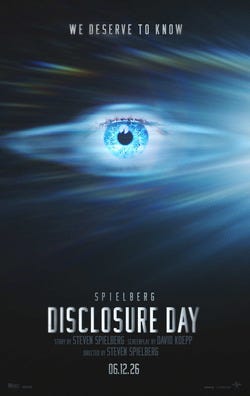
Steven Spielberg has made an alien film before. Several. But Disclosure Day is something different, and he seems to know it. This one is not interested in wonder for wonder’s sake. It is interested in reckoning.
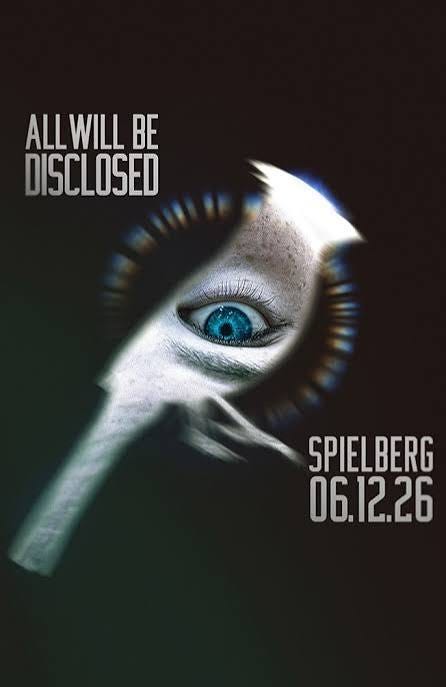
The film’s most immediate achievement is visual credibility. The CGI-rendered UAP footage woven into the narrative mirrors, with striking fidelity, the craft geometries and flight behaviors described by Navy pilots, radar operators, and AARO witnesses over decades. Tic-tac shapes. Instant velocity changes. No heat signature. No flight surfaces. Whoever did the research did the reading. For anyone who has spent time with the testimony, these sequences carry a different weight than Hollywood’s usual flying saucers. They feel remembered, not invented.
The black ops scaffolding is also handled with care. The film depicts a classification architecture that operates beneath congressional oversight, sustained not by malice but by institutional momentum and the terror of what full disclosure would mean for social order. This is exactly what Grusch described. It is what Elizondo described. The machinery of the cover-up in this film feels bureaucratically real because it probably is.
The religious dimension, represented through the nun, is the film’s most philosophically honest thread. Spielberg does not resolve it cheaply. The question the film asks, and refuses to answer for you, is whether a universe populated by non-human intelligence makes God more or less coherent. The nun does not lose her faith. She loses her certainty, which is something else entirely. The distinction matters.
Two creative choices deserve scrutiny from anyone tracking the lore closely. The tall gray is given a spoken language, which departs from decades of experiencer testimony where grays of all heights are described as communicating purely telepathically, projecting meaning directly rather than producing sound. The film may be gesturing at a species hierarchy, which the lore does accommodate, but the vocal language still reads as an invention rather than an extrapolation. The second, more interesting choice, is NHI presenting as animals. This is not new to the literature, it surfaces prominently in abduction research and in documented screen memory accounts, but it will strike most audiences as a surrealist flourish when it is actually closer to the testimony than anything else in the film.
What stays with you is the empathy. Not as a sentiment, not as a genre beat, but as the film’s actual thesis. The intelligence depicted here does not arrive with weapons or demands. It arrives with something that reads, uncomfortably, like grief. Grief at what we are doing to each other, to the planet, to the possibility of what we could become. The film suggests that empathy is not a soft human quality to be outgrown in the face of cosmic reality. It is the variable. The one that determines whether contact ends in transformation or catastrophe.
That is not a science fiction premise. That is the oldest moral argument there is, restated at civilizational scale. Spielberg has made the most serious UFO film Hollywood has produced, and done so by treating the testimony, the witnesses, and the question itself with the respect they have always deserved.