


At 9:11 AM Central this morning, the Department of War switched on war.gov/UFO. The portal has a name now: PURSUE, Presidential Unsealing and Reporting System for UAP Encounters. It is the consolidation of a thing the federal government has done piecemeal for forty years through FOIA, congressional letters, and the occasional unauthorized Navy leak, finally given a public-facing front door. Hegseth, Gabbard, Patel, and Isaacman all attached statements. Trump’s February 19 Truth Social post is reproduced inside the page itself, in case anyone forgets whose directive this is.
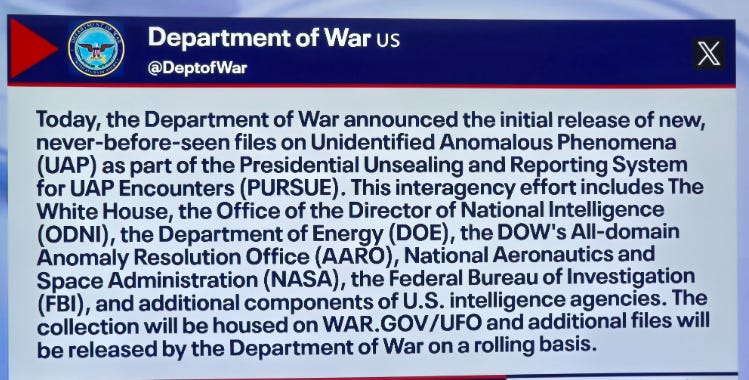
The framing is what you would expect. Unprecedented transparency. No clearance required. The American people can finally make up their own minds. Hegseth’s pull quote calls the prior classification regime “justified speculation.” NASA’s Isaacman gets the cerebral line about unlocking the secrets of the universe. Patel speaks for the FBI and emphasizes that no prior administration has done this. The political choreography is precise.
What actually went live is more modest.
The inventory
Release 01 is, as best I can reconstruct it from the live page (which was glitchy on launch and showed “0 Files” in the document table when I checked early this afternoon), seventeen image assets and at least two Apollo-era documents.
The images break down as follows. Six FBI infrared stills, all from the Western US, dated September and December 2025, are almost certainly tied to last fall’s drone wave. One witness composite sketch from a 2023 Southeastern US incident. One NASA Apollo 17 archival frame with three lights highlighted above the lunar terrain. The rest are sensor stills from US military operators: Middle East 2013 and 2022, Greece October 2023 (two frames), United Arab Emirates October 2023, Africa 2025, INDOPACOM 2024 (the now-famous football-shaped object near Japan), southern US 2020, and a North America 2026 Army incident.
Beyond the slideshow, the release also contains Apollo 12 archival imagery and Alan Bean’s “flashes of light” report from 1969, plus an Apollo 17 cockpit transcript in which an operator describes “a few very bright particles or fragments” drifting past the spacecraft. The lunar material is the genuinely novel addition. Everything else has either circulated through AARO context or sat one FOIA away from the surface.
What the filenames tell us
The most interesting thing on the page is something the page does not advertise. The filenames carry sequential identifiers.
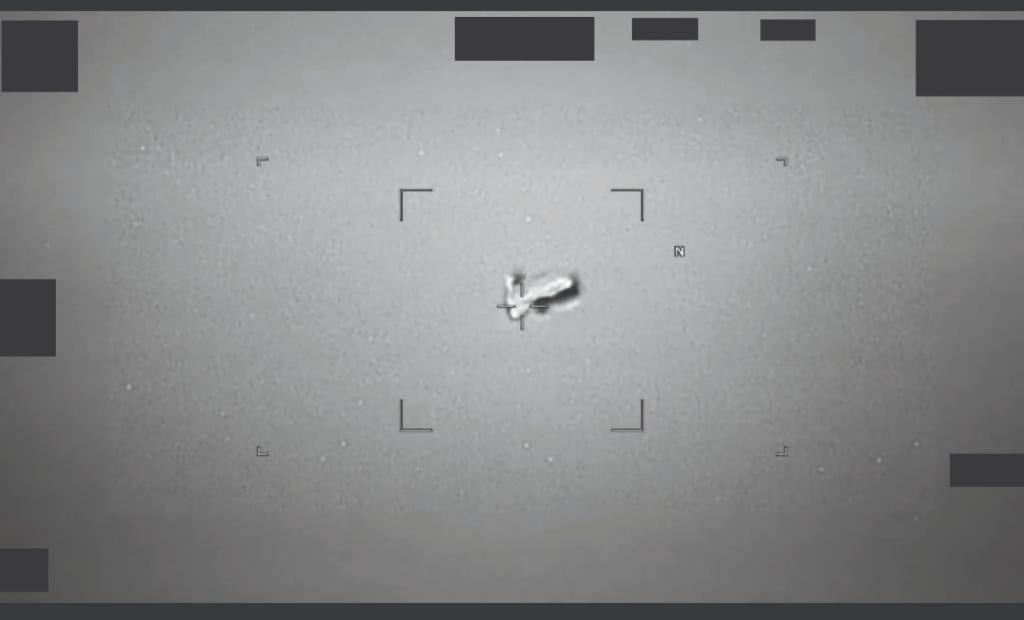
The Department of War cases are tagged DOW-UAP-PR##. Across the seventeen visible items, the numbers present are PR19, PR26, PR34, PR35, PR38, PR43, PR45, PR46, and PR49. That is nine numbers spanning a range of at least 1 to 49. Twenty-six press-release IDs in that range are missing from Release 01. PR1 through PR18, PR20 through PR25, PR27 through PR33, PR36, PR37, PR39 through PR42, PR44, PR47, and PR48 are simply absent.
The NASA item is tagged VM6 (visual material 6, presumably). The FBI photos are split into an A-series and a B-series, with the B-series running to at least B20. None of these series appears complete.
This is not necessarily proof of a holdback. Numbering can include cases that resolved out of unresolved status, were re-classified, are still in agency review, or were never intended for this batch. But the ratio is striking. Across a public-facing release framed as “unprecedented,” roughly four out of every five sequentially-tracked items in the Department of War’s own catalog were not made public today. The plain reading is that PURSUE Release 01 is a teaser cut from a much larger archive that the Department of War has already organized internally.
What got held back
Two specific gaps are explicit. Anna Paulina Luna posted this morning that her 46 UAP videos, the ones she demanded by name in a March letter, are not in this tranche. She says they are coming in a later release. AARO’s open caseload exceeded 2,000 incidents earlier this year. Release 01 is a hair under one percent of the caseload by count.
Sean Kirkpatrick, the former AARO director, has been reminding anyone who will listen that the operational explanation for most viral UAP infrared footage is that modern thermal sensors render hot objects, including jet engines, as long, pill-shaped blooms. He is right that this explains a lot of what circulates online. He is also a former AARO director, so he is the institutional caveat the Pentagon points at when the football near Japan starts trending.
The framing question
Whether PURSUE is real disclosure or production-managed disclosure depends entirely on what tranches two through n contain. If the Luna 46 lands in Release 02 with provenance and metadata intact, that is meaningful. If the PR1 through PR18 cases surface with operator interviews and sensor data, that is meaningful. If the missing FBI A-series ever appears with a chain-of-custody attached, that is meaningful.
If, instead, the rolling cadence becomes additional Apollo curiosities and short infrared clips with light captions, dispensed every few weeks for the news cycle, then PURSUE is the same thing AARO was, with a better URL and a more aggressive press shop.
We will know in a few weeks. Until then, the most useful thing in Release 01 is the filename schema itself, because it confirms there is a much larger catalog already organized, already named, already numbered, and already sorted into series.
The portal is at war.gov/UFO. Bookmark it. Watch the PR numbers.
I appreciate the computer science approach. 👍