


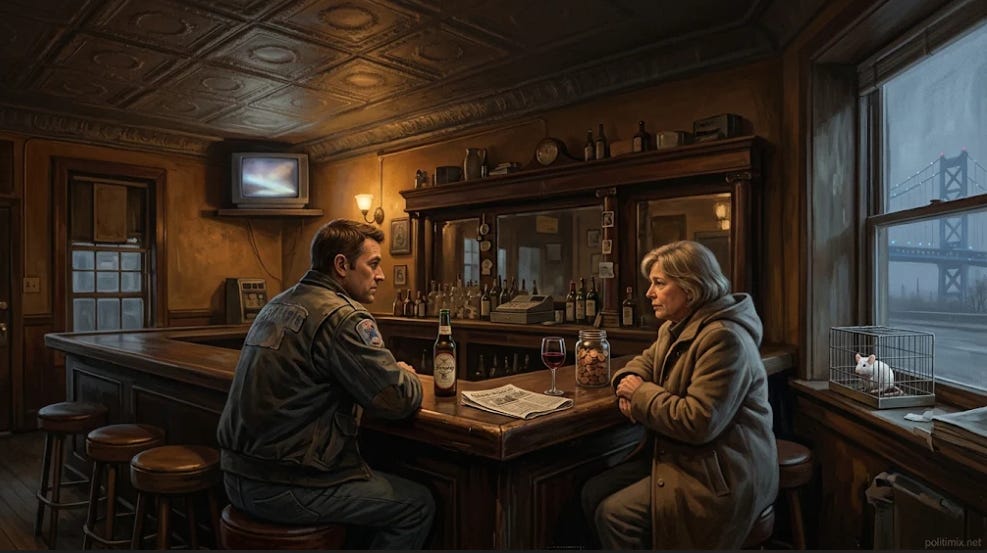
Bob, whose name was not Bob, walked into Fitzwater’s on a Tuesday in October wearing the face he had been wearing since 2016, and the face did what it always did at the door, which was to hold the expression from the sidewalk for one extra beat before it caught up to the room. Nobody noticed. Nobody had ever noticed. That was the face’s whole job, and it was good at it, and it was getting tired.
He took the third stool from the end, which had been his stool for ten years, and Dennis put a Yuengling in front of him without being asked, and Bob said “Thanks, Dennis,” and put seven dollars and sixty-eight cents on the bar with his right hand, a five, two ones, two quarters, a dime, a nickel and three pennies, because the beer was six dollars and forty cents and twenty percent of six forty is one twenty-eight and he had never in his life been able to make himself round. Dennis kept a jar for the pennies. It had been full for years. The left hand stayed in his jacket. It had been cold since Sunday. He had done the arithmetic on the hand the way he did all arithmetic, exactly and without flinching, and the arithmetic said a year, perhaps, and he had put the hand in his pocket and come to the bar.
“You’re early,” Dennis said.
“Call ended early.”
“Anybody die?”
“Not today.”
Dennis nodded like that was a weather report, which, from Bob, it was. Dennis was sixty-one and had owned the bar for twenty-two years and had the kind of face that looked like it had been left out in the rain and dried on a radiator, and he was the only human being in Philadelphia who had ever asked Bob a question Bob had to answer truthfully. The question had been, in the summer of 2016, “What are you drinking,” and Bob had stood there for four full seconds trying to remember what he had decided, and Dennis had said “Yuengling, then,” and that had been that.
The bar was a corner bar in Fishtown, the old kind, with a tin ceiling painted so many times it had lost its pattern, a television that was always on and never loud, and a smell underneath the beer smell that Bob had spent his first year trying to identify and had finally concluded was the mop. He had chosen it because it was eleven minutes from the station on foot and because, on the night he first walked in, a man at the end of the bar had been crying quietly into a glass of something brown and nobody had said anything and nobody had moved away. Bob had stood in the door and watched that for longer than a person would have, and then he had come in and sat down, and he had been coming in and sitting down ever since.
At 6:40 the door opened and the face from the sidewalk came in on Marguerite and she took the stool at the corner, which was her stool, and Dennis put a glass of the house red in front of her, and she said “Thank you, Dennis,” and put down exactly what it cost plus twenty percent, and Bob looked at the television.
“Bob,” she said.
“Marguerite.”
That was the greeting. It had been the greeting for nine years and four months. There had been a period in 2019 when she had said “Robert” for about three weeks, as an experiment of some kind, and he had not known what to do about it and had said nothing, and she had stopped.
The job was the job. He had picked it in his second year, after the first year of walking around, after he had understood what he was looking at.
He had come to look at them. That was the whole assignment, and it had been written by someone who had never been here and did not know what the word meant. Observe the population. Assess. Report. He had observed for a year and he had assessed and he had written the report, forty pages, in the compressed notation his people used, and he had sent it home, and home had said received, and then home had said nothing else, and in 2018 home had stopped saying received.
He did not know what to make of that. He had decided, after a while, not to make anything of it.
But in the first year he had found the thing. It was not in the report. He had been standing on Frankford Avenue in the rain in March of 2016 when a man in front of him had sat down on the curb and put his hand on his chest, and Bob had done what his people did without thinking about it, which was to reach toward the man’s mind to see what was wrong, and he had found the man’s mind going thin at the edges, going the way a sound goes when it’s leaving a room, and he had stayed with it.
He had not meant to. There was no protocol. He had simply found that he could not pull back from a thing that was leaving, and so he had sat on the curb beside the man in the rain and kept his hand on the man’s shoulder like a person would, and kept the other thing, the real thing, on the thinning edge, and when the ambulance came the man was still alive and the medics did their work, and the man’s eyes, the whole time, stayed on Bob, and Bob had understood that the man knew something was there.
He did not know what he had done. He did not know, then or ever, whether he had done anything. He only knew he had been there, in a way the medics weren’t, and that it had cost him something, because when he stood up his left hand was cold and stayed cold for two days.
He had enrolled in the paramedic program at Community College of Philadelphia that September. The certification took a year. He was the oldest in his class by the face’s reckoning and the youngest by his own, and he passed everything, and he had been on a medic unit out of the firehouse on Girard since the fall of 2017.
Once a year, in May, on a day off, he took the PATCO train under the river to Haddonfield, New Jersey, and walked up Kings Highway to the statue of the dinosaur. It was a hadrosaur, eight feet of bronze on a corner by the bank, and it was there because in 1858 a man named Foulke had dug the first nearly complete dinosaur skeleton anyone had ever found out of a marl pit at the end of what was now a street of houses, and the town had put a plaque in the cul-de-sac and a statue on the corner and otherwise gone on being a town. Bob stood in front of the statue for a while each year, and then walked down Maple Avenue to the cul-de-sac and stood in front of the plaque, which was small and said what had happened without making a fuss about it, and then he went home. He could not have explained the trip to anyone and had never tried. The nearest he had come, in the notation, was that it was the only monument in the region to something that had been here before the people, and that the people had dug it up with care and put it in a museum and named a town’s worth of things after it and then, every year since, had been kind to him on the platform without knowing why he was there. A woman at the bakery on the corner had once given him a cookie shaped like the dinosaur, free, because he had been standing there so long, and he still had it, in a drawer on Palmer Street, uneaten, going on six years.
His partner for the last four years was a woman named Dolores Trinh, who was thirty-four and had two children and a laugh you could hear from the back of the rig, and who had, Bob knew, noticed something. She had never said what. Dolores had a rule about things she did not understand, which was to leave them alone until they bothered her, and so far it had not bothered her that on Bob’s calls the ones who were going to die anyway went quiet before they went, and looked at Bob while they did it. She had told him once, at three in the morning outside Temple, “You’ve got a thing with them,” and he had said “What thing,” and she had said “I don’t know. A thing,” and gone to get coffee.
What Marguerite did was, as far as the bar knew, something with the city. Records. An office on Arch Street. She came in at 6:40 on Tuesdays and Thursdays and sometimes Saturdays and always ordered the house red and always left before the second half of whatever game was on, and she did community theater at a church hall in Port Richmond, a fact the bar had learned from a flyer she had put up once, in 2021, and then taken down the next week without comment.
Bob had gone. He had sat in the back of the church hall and watched her play the mother in a play about a family at Thanksgiving, and she had been, by every standard he had learned, terrible, in a particular way. She said every line as if she had just been told what it meant. She stood where she was supposed to stand with a precision that made the other actors look like they were wandering. When the daughter character cried, Marguerite had turned her head to look at her, fully, the way you look at something you are trying to understand, and held the look about one second past what the scene could bear, and the audience had laughed, not unkindly, and the director, a round man in a scarf, had said afterward in the lobby that she was brave.
Bob had not told her he was there. He had left before the lights came up.
He thought about that night more than he thought about most nights. He thought about the look. He had catalogued, in ten years, four hundred and some human expressions by his own count, and had learned to make sixty of them with the face, and the one she had given the crying daughter was not one of them. It was the look he had given the man on the curb. He had not, at the time, let himself follow that thought anywhere.
There were things about her he kept.
In the spring of 2020, when the bar was closed and the city was quiet and Dennis was selling beer out the side door in growlers to anyone who knocked, Bob had walked past Fitzwater’s on his way back from a shift that had been nothing but the one thing, call after call, the same thin edge in apartment after apartment, and she had been standing on the sidewalk across the street with a growler in her hand, looking at the closed bar. Not at the door. At the building. The way you look at a person in a hospital bed. He had stood on his side of the street and looked at it too, and neither of them had crossed, and after a while she had lifted the growler about an inch, which was a toast, and he had lifted his hand, and that was the only time they saw each other in four months.
In the fall of 2022 a man who had sat at the far end of the bar every Friday for as long as Bob had been coming had stopped coming, and three weeks later Bob had found the obituary in the Inquirer, half an inch of it, no picture, and had torn it out and put it in his jacket, and on Thursday he had put it on the bar in front of her stool before she came in, and said nothing when she sat down and found it, and she had read it, and folded it, and put it in her purse, and said “Thank you, Bob,” and that was the first time she had said his name with anything in front of it.
In 2023 they had argued for a month about the Phillies. Not about the team. About the fans. He held that they were suffering and she held that they were enjoying it and the argument had gone on across nine or ten Thursdays, a sentence or two each time, with evidence. He brought a clipping about a man who had thrown a battery at an outfielder in 1999. She brought the fact that the man had come back the next season. He said that proved his point. She said it proved hers. Dennis had said, in the third week, “You two should get a room, and in the room there should be a chalkboard,” and they had both stopped talking for the rest of the night, and the next Thursday they had picked it up again exactly where it was.
In the winter of 2024, on a Thursday when the bar was nearly empty and the television was showing a river somewhere that was not the Delaware, she had told him, unprompted, about her first night in the city. It was the only time she had ever talked about herself, and he had sat very still so as not to stop her. She had come in October of 2015, she said, with nothing arranged, and had walked from wherever the bus had left her down to the river because it was the only direction that made sense, and had stood at Penn’s Landing in a coat that was wrong for the weather and watched the lights come on across the bridge one at a time, blue, and had not known what she was supposed to do next. A man fishing off the rail, for nothing, she thought, since nobody caught anything there, had looked at her for a while and said “You all right,” and she had said, “I don’t know yet,” which was the first true thing she said in Philadelphia, and he had torn his hoagie in half and handed her the other half in its paper and gone back to fishing. “I didn’t know you took the paper off,” she said. “I ate some of the paper. He didn’t say anything. He let me.” She had bought the same hoagie, from the same place on Second Street, on the same date, every October since, and taken it down to the rail, and the man had never been there again, and she ate it anyway, with the paper off, and that, she said, was the closest thing she had to a religion.
Bob had filed it with the four hundred other things, under a heading he did not have a word for, and had not understood until April what she had been telling him, which was everything.
What he kept from all of it was one thing, which he had not named. She noticed what he noticed. In ten years in this city he had sat among people who were kind and people who were funny and people who were in pain, and he had loved them all in the only way he had, which was to pay attention, and not one of them had been looking where he was looking. She was. When a stranger paid for a stranger’s drink in 2021 and left before he could be thanked, Bob had watched it happen and filed it with the four hundred other things, and a week later Marguerite had said, out of nothing, “I keep thinking about that man,” and he had known which man without asking, and had had to look at the television for a while.
The night of the Eagles game in January of 2025, the bar was full the way it was only full for that, forty people in a room built for twenty-five, and when the Eagles went in from the one with ninety seconds left the room came off the floor. Bob had seen it before and had never gotten used to it: the way a crowd of separate people became, for about four seconds, a single animal, every arm up, every mouth open, strangers holding each other by the shoulders and shaking. He stood in the middle of it. He always stood in the middle of it. It was the closest he had found, in this body, to the thing his people did without bodies at all.
She was three feet from him. Everyone around them was hugging. A man Bob had never seen had Dennis around the neck. Dolores, who had come because he had asked her once, in 2022, and had come every year since, was being lifted off the ground by someone’s brother. And Bob and Marguerite stood in the middle of the animal, three feet apart, with their hands at their sides, and looked at each other, and did not move, and the four seconds ended, and the room put itself back down.
Dennis saw it. Bob knew Dennis saw it because Dennis came down the bar when the room had settled and leaned on it in front of the two of them and said, to the space between them, “You two are the slowest thing I have ever seen in my life,” and went back to the taps.
Marguerite said, after a while, “He may be right.”
Bob said, “I don’t know what he means.”
“Yes you do.”
He did. He had known since the obituary. He had decided, as he decided everything, carefully and once, that it was not a thing that could be done, because she was a human being and he was wearing a face, and whatever it was that she noticed in him, it was the face she was noticing, and it would be a theft. He had never told her that. He had told her nothing. For ten years he had protected her from a thing she had, he believed, no way of knowing.
“You’re a strange man, Bob,” she said.
“You have no idea.”
“I might,” she said, and finished her wine, and left before the second half, which had ended.
The calls were the calls.
A woman on Lehigh Avenue in a chair by the window who had been dead, Bob thought, for about an hour before the daughter found her, and who was not, when he put his hands on her, entirely gone. There was a thread. He held it. Dolores got the pads on and the strip showed what Bob already knew, a flat line with the small useless wander in it that the textbook called fine asystole, and she pushed the first epi and got on the radio to medical command while the daughter stood in the kitchen door with both hands over her mouth, and Bob, with his hands on the woman’s chest doing compressions at a hundred and ten a minute because the Lucas was still in the rig, went still in the face for a moment, and the woman’s eyes, which had been half open and seeing nothing, moved, and found him, and stayed. Command gave Dolores the pronouncement at 11:52. The daughter said afterward, in the hallway, “She looked at you,” and Bob said “They do that sometimes,” which was true.
While Dolores did the paperwork, Bob packed the bag by the window, and on the sill beside the chair there was a cage, a small one, with a wheel and a water bottle and a white mouse in it, which the woman had evidently kept, and which was sitting very still on its hind legs looking at him. He stopped. He looked at it. The mouse, which had been startled, stopped being startled and looked back, and went on looking, with the small black eyes, and something passed between them that Bob did not have a word for in either language and that was, as near as he could get to it, professional. Two observers, one in a cage and one in a jacket, each of whom had been in the room for the whole thing, each of whom knew exactly what the other was. The mouse did the thing that is to a mouse what a smile is. Bob did the sixty-first expression, the one he had never used, and found that he had it after all. Then the mouse turned back to its wheel, and Bob turned back to the bag, and neither of them mentioned it to anyone, and the daughter, when they left, was holding the cage in both arms like a child.
A man on the Vine Street Expressway in a car that had gone into the barrier at sixty, with a pressure that would not hold no matter what they hung, who was not going to make it to Jefferson, and knew it, and was afraid, and Bob rode with him in the back with the bag of saline squeezed under his knee and one hand on the man’s forearm above the line and the other thing on the edge, and the man said, with what he had, “Are you,” and did not finish, and Bob said “Yes,” and the man let go of what he was holding, which was fear, and died on Eighth Street. Dolores drove. She did not ask what the man had been asking.
A boy, nine, on a sidewalk in Kensington, who was going to live, and did. Bob reached anyway, which he never did with the living, which was not done, and which he did that once because the boy’s hand had found his first, and found the boy’s mind bright and wide and not thin at all, and pulled back as fast as he could, because that was not his to touch, and the boy said, strapped to the board, “You’re cold,” and Bob said “Sorry,” and the boy said “It’s okay,” and looked at him the whole way in.
After the man on the expressway, the left hand did not warm up for a week. He kept it in his jacket at the bar. Dennis noticed and said nothing. Marguerite noticed and said, “Is your hand all right,” and he said “Circulation,” and she looked at the jacket pocket for a moment with the look from the church hall, and let it go.
He knew what the hand meant. The suit, if that was the word, and it was the nearest word, had been built for a ten-year assignment, and this was the eleventh year, and every time he reached for an edge he drew on something the suit needed, and the suit had begun, in small ways, to tell him so. A hand that stayed cold. The face holding its last expression a beat past the moment. A morning in September when he had stood at the mirror and watched the face take four seconds to agree to be awake. The arithmetic had not changed since October. A year, perhaps, if he stopped reaching.
He did not stop.
He could not have said why. He had tried, once, to write it down in the notation, as if for the report he no longer sent, and had got as far as the observer finds that the population’s terminal state is and had stopped, because there was no word in the notation for what he found there. He had the human words. Company. Witness. They were not big enough either. He only knew that each of them, going, was alone in a way nothing in his own experience had prepared him for, and that he could, at some cost, make it so that they were not, and that he had never once been able to choose the cost over the thing.
Dennis told them on a Thursday in March. He told them together, which was how he had come to see them, the way you’d tell a couple. He came down the bar after the dinner crowd thinned and put both hands flat on it in front of their two stools and said, “So I’ve got a thing,” and told them. Pancreas. The scan had been Monday. The doctor had used the word months, and had not put a number in front of it.
Marguerite put her hand on Dennis’s hand. Bob watched her do it. He had seen her touch perhaps six people in ten years and this was the longest, and she held it the way she held the look at the church hall, fully and a beat too long, and Dennis let her.
“Who’s going to run the bar,” Bob said, because it was the question that had arrived first and he had learned that humans asked those.
“Marcus,” Dennis said.
Marcus was twenty-three. He had been coming in since he was eleven, with his father, a quiet man named Ray who had sat at the end where the obituary man later sat, and who had died in 2019 of the same thing in a different organ. Marcus had kept coming. He came in alone now, on Sundays, and drank one beer and watched whatever was on and talked to Dennis about nothing, and Dennis had been teaching him the taps for a year without either of them calling it that.
“He doesn’t know yet,” Dennis said. “I’m telling him Sunday. I wanted to tell you two first because you’re here more than he is and because,” and he stopped, and looked at the two of them, one and then the other, with the radiator face, “because I figure you’ll handle it the way you handle everything, which is you’ll sit there and not say anything and somehow that’ll help. Don’t ask me how.”
Bob did not say anything. Neither did Marguerite. Dennis laughed, which hurt him, and went back up the bar.
What Bob had not reported, and what he thought about on the walk home that night, was the actual finding.
The assignment had been a question. His people had wanted to know whether the population was, in the notation’s word, admissible. Whether it could be approached. The word had a history among his people that he did not think about much and that amounted to this: a population found admissible was approached, and the approach was total, and after it the population was something else, something his people considered better and the population, as far as he had ever been able to learn, was never asked about. He had read the histories. He had come here with the histories in him. He had spent one year looking and had understood within six months that the answer his people wanted was yes, and that the answer was yes, and that he was never going to send it.
So the report he had sent in 2016 said what it needed to say and no more, and the finding was not in it, and when home stopped saying received he had felt something he had no word for in either language and had eventually recognized as relief.
He had never considered, in ten years, that anyone else was asking the same question. There was no reason to. His people were the only people, in his understanding, who went places. The histories said so. The histories had been written by his people.
It was the third of April. He was on, Dolores was driving, and the call came in as a collapse, a female, sixties, a sidewalk on Girard under the El. He had done more of these than he could count. They pulled up and there was the small crowd there always was and a man in a Wawa apron kneeling, and the crowd opened, and Bob had his bag off the rig and was on his knees with two fingers on her carotid and the other hand on her sternum before he had looked at her face, because that was the training, pulse and hands first, and he reached, because that was the other thing, and what he found was not thin.
What he found was a wall. Not a wall. A surface, smooth, closed, turned away from him like a face in a crowd. He had never felt anything like it in a human being. Human minds, at the edge, were open the way a door is open in a house where someone has just left. This was a door that was shut, and behind the door was something enormous and very old and very tired, and as he touched it, it turned.
It turned and looked at him.
He heard, in no language, oh. Then: oh, it’s you.
He looked at her face. Marguerite, grey, eyes closed, a cut on her forehead from the sidewalk. Dolores was saying his name. He said, aloud, “I’ve got her,” and started the protocol with his hands, and kept the other thing where it was, on the door, which was open now, and on the other side of it she said, in no language, I didn’t know. Ten years. I didn’t know.
Neither did I, he said.
Your hand is cold, she said, which made no sense, because she could not have felt his hand from where she was, and then he understood that she could feel it from exactly where she was, because she was not touching his hand. She was touching him.
They got the pads on and a line in and got her on the stretcher and into the rig, and the twelve-lead showed what a sixty-four-year-old heart shows when it has been bad for a year and has just been worse, and Dolores drove, and Bob rode in the back with his hand on her forearm above the IV the way he had ridden with the man on the expressway, and for the nine minutes to Temple they had the first conversation they had ever had, and no part of it was aloud, and Dolores, driving, looked once in the mirror and saw her partner sitting very still with his hand on a woman’s arm and his face gone quiet in the way she had decided not to ask about, and the woman’s eyes open, and on him, and decided not to ask about that either.
What he learned in nine minutes:
That she was not his people. That her people were a thing he had no word for and the histories had no entry for, which meant the histories were wrong, which he had suspected for some time. That her people did not send observers in suits. They sent them in. All the way. The conversion was done once and could not be undone and the observer lived the rest of a human life as a human, with the one thing kept, the thing he was touching now, kept somewhere behind the door. That she had come in 2015 for the same reason he had. To look. To answer a question. That her people’s question was the same question with the sign reversed: they wanted to know if the population was, in her notation’s word, dangerous, and if the answer was yes they would come, and the coming would be total, and the population would not be asked.
That her answer had been yes within six months, and that she had never sent it.
So we’ve both been sitting in that bar, he said, not filing.
I thought I was the only one.
So did I.
Your people would come if you said yes.
So would yours. A different yes.
And we’ve both been saying nothing. He felt her do something behind the door that in a human would have been a laugh and in her was something older. For ten years. On adjacent stools.
What’s wrong with you, he said. Physically.
I’m sixty-four. I was fifty-three when I came, in a body they chose because nobody would look at it twice. Nothing’s wrong with it that wouldn’t be wrong with anyone’s. It does what they do. A pause, which in no language was still a pause. My heart is bad. It’s been bad for a year. Dennis knows. I told him in January. He said, and I’m quoting him, “Well, you two had better get on with it.”
With what.
He didn’t say. He never does.
They pulled into the bay. He took his hand off her arm, and the door, which had been open the whole nine minutes, did not close, and he found that he could feel it from the loading bay, and from the parking lot, and, that night, from his apartment on Palmer Street, faintly, the way you can hear a radio on in another building. He lay on the bed with the face turned to the ceiling and understood that this was never going to go back to how it was, and found that he did not want it to, and found that he had not, in ten years, wanted anything for himself, and did not know what to do with it, and did it anyway, which was to lie there and listen to the radio.
She was out in two days. A stent. She came into the bar on the Thursday with a bandage on her forehead and took her stool and Dennis put the house red down and said “You’re not supposed to have that,” and she said “I’m aware,” and drank it.
“Bob,” she said.
“Marguerite.”
The greeting had not changed. What had changed was everything behind it, and Dennis, who could not hear the thing behind it, heard it anyway, because he looked at the two of them, one and then the other, and said, “Something happened,” and Marguerite said “Bob picked me up off the sidewalk,” and Dennis said, “That’s not what I mean,” and went to the taps.
They talked that night, aloud, for the first time in a way the bar could hear, about ordinary things, and underneath, in the other way, about the only thing. He told her about the suit. The arithmetic. A year, perhaps. She took it the way she took the obituary, folded it and put it away, and said, in the other way, then we have the same year, and aloud, “The Phillies are going to be terrible,” and he said, aloud, “They’re going to be fine,” and she said, “You’ve changed your position,” and he said, “I’ve been persuaded.”
Dennis, who heard only the aloud part, said from the taps, “Jesus Christ, finally.”
They tried it once. For the record, and because Dennis had said get a room, and because they were both, in their separate ways, thorough.
It was the following Saturday, at Bob’s apartment on Palmer Street, which she had never seen and which she walked through the way she walked onto a stage, finding her mark. Bob had prepared. He had, over ten years, assembled from television, from overheard conversation at the bar, and from a number of calls where the circumstances had been unfortunate, a complete procedural account of what humans did in this situation, and he had reviewed it that afternoon the way he reviewed a protocol, and he had bought candles, because the account was unanimous on candles, and had not been able to find out what they were for.
She had her own account. Hers came from the theater and from a pamphlet she had been handed in 2017 by a woman outside a clinic on Locust Street, which she had kept.
“I believe there is music,” she said.
He put on the Phillies pregame, because it was what was on, and they both agreed, after a moment, that it was probably not what was meant, and left it.
He took off his shoes and set them beside each other, parallel, by the door. She watched him do it and took hers off and set them beside his, parallel, and they stood and looked at the four shoes for a while, and she said, “I think that may have been the most intimate thing I’ve ever done,” and he said, “I think so too,” and neither of them was joking.
They sat on the bed. The account called for it. Bob put his hand on her shoulder, and it was the cold one, and she said “Oh,” and he said “Sorry,” and changed hands, and the other one was warm but the face, which had been asked to produce an expression it had never been asked for, took three full seconds to find anything at all and settled on the one he used for a patient who was going to be fine, which she recognized, and said so.
“That’s the one from the sidewalk.”
“It’s the only one I have for this.”
“The pamphlet says to communicate.”
“I’m communicating.”
“The pamphlet says the sound is optional,” she said, “but it doesn’t say for whom.”
They lay down. Fully clothed, side by side, on top of the blanket, looking at the ceiling, where a water stain had the outline of Delaware. The pregame ended and the game began. At some point his hand found hers on the blanket and she said, “Is this part of it,” and he said, “I don’t think so. I think this is a separate thing,” and she said, “I’d rather do the separate thing,” and he said, “So would I.”
And then she turned toward him, behind the door, the way she turned toward the crying daughter, with everything, and he reached, the way he reached on the curb, and for a while neither of them was in the room at all. They were in the other place, where he was what he was and she was what she was, and what passed between them there had no account, no pamphlet, no procedure, no candles, and was, by every standard either of them had learned in ten years of watching, obscene. It lasted until the seventh inning. The Phillies lost. Neither of them noticed.
Afterward, on the blanket, she said, aloud, “Did we.”
“I think so. In the way that counts.”
“Nothing happened.”
“Nothing physical happened.”
“The pamphlet would say nothing happened.”
“The pamphlet,” Bob said, “was written by a human.”
She did the laugh, aloud this time, which he had never heard, and which sounded exactly like a woman in her sixties laughing on a bed in Fishtown, and was.
On Tuesday Dennis said, “Well?” and Bob said, “We got a room,” and Dennis looked at him for a long moment with the radiator face and said, “I’m not going to ask,” and did not, and brought him a Yuengling, and would not let him pay for it, which had never happened, and Bob sat with the free beer in front of him and understood that he had been, for the first time in his life on this planet, congratulated.
He went to see her play, that May, and this time he did not leave before the lights. She had the mother again. A different play, same church hall, same round man in the scarf. She was no better. She still said each line as if she had just been told what it meant, and stood where she was supposed to stand with the precision that embarrassed the others, and when the daughter cried she turned and gave the girl the look, the full look, a beat past what the scene could hold.
Only this time Bob knew what it was. It was her, behind the door, reaching. She could not reach the way he could. Her people had not made her that way. She could only turn toward a thing and attend to it with everything she had, and that was what the look was, and she had been doing it to the crying daughter and to Dennis and to the obituary and to him, for ten years, in a church hall and a corner bar, and the audience had laughed because they could see something was happening and could not see what.
He did not laugh. He sat in the back row with his cold hand in his jacket and watched her attend to a girl who was pretending to cry as if the girl’s whole life depended on being seen, and he understood that he had been in love with her since the obituary, in the way his people did the thing, which did not have a word either and did not need one, and that it had never been the face she was noticing. It had been the reaching. She had been noticing him notice. For ten years. On the adjacent stool.
Afterward, in the lobby, the director said to him, assuming he was a husband, “She’s very brave,” and Bob said, “Yes,” and meant it in a way the director could not have followed.
Dennis went down in August. It was fast at the end the way the doctor had said it would be, and the bar stayed open because Marcus kept it open, with a face that was starting to look like it had been left out in the rain, and on a Thursday night the call came not to the rig but to Bob’s phone, from Marcus, who said, “He’s asking for you two.”
The room at Jefferson was small. A window on Walnut Street. Marcus in the chair. Dennis in the bed with the radiator face gone grey and thin and the eyes still in it, and the eyes found Bob at the door and found Marguerite behind him and Dennis said, with what he had, “Slowest thing I ever saw,” and closed them.
Bob took the side of the bed by the window. Marguerite took the other. Marcus stood at the foot. Nobody said anything. Dennis had told them that was how they helped.
Bob put his hand on Dennis’s chest, over the gown, flat, where the pads would go, the way he would on a call, and reached.
The edge was there. Thin. Going the way a sound goes. He went to it the way he had gone to all the others, and stayed, and was arranging himself to stay the way he always did, alone with the leaving thing, when he found he was not alone.
She was already there.
Not reaching. She could not reach. She had done the thing she could do, which was to turn toward Dennis with everything behind the door and attend, and the attending had carried her further in than he had thought it could, and she was there, at the edge, beside the thinning thing that was Dennis, waiting, and when Bob arrived she did the thing that in a human would have been a laugh, and said, in no language, you’re late.
And they were together. There. Not in the room, where a man with a cold hand sat on one side of a bed and a woman with a bad heart sat on the other, three feet of dying bartender between them, not touching. Here, where there were no hands, where he was what he was and she was what she was and neither of those things had a shape, and the only thing between them was Dennis, going, and they stayed with him. Together. The whole way.
Dennis knew. Bob felt him know. He felt the thinning thing turn, the way the man on the curb had turned, and the man on the expressway, and the woman on Lehigh Avenue, toward the presence it could feel and could not name, and then felt it find that there were two, and felt it understand, in whatever a dying man understands with, exactly what it was feeling, and be, for the last thing it was, pleased.
In the room, Dennis opened his eyes. He looked at the ceiling. He said, clearly, to no one, “Oh. There’s two of you.”
Marcus said, “Dad?” because that was the word that came.
Dennis said, “Good,” and that was all.
The wake was at the bar. Marcus did it right. The taps open, the television off for the first time in anyone’s memory, the regulars in a line along the bar in the order of their stools, which nobody had planned and everybody did. Dolores came, and stood next to Bob, and did not ask, and at one point put her hand on his cold one and left it there and said, “Jesus, Bob,” and that was all.
Marguerite found Marcus by the end of the bar, where his father had sat, and Bob watched her do the thing he had never seen either of them do in ten years, which was to act.
She told him a story. Aloud. The human way. She told him that in the fall of 2018, when Marcus was fifteen and had stopped coming in with his father because fifteen, Ray had come in alone on a Sunday and sat where Marcus was sitting now and told Dennis, who was the only one he thought was listening, that his son had gotten a part in the school play and had not told him, and that he had found out from another parent, and had gone, and had sat in the back, and had left before the lights came up because he did not want the boy to feel watched. And that he had been so proud he could not say it, and had said it to Dennis instead, and Dennis had said “Tell him,” and Ray had said, “I will when he’s older,” and had died the next spring.
Marcus stood very still. Then he put his beer down on the bar and put both hands over his face, the way the daughter on Lehigh Avenue had put hers over her mouth, and Marguerite put her hand on his shoulder and held it a beat too long, and Bob, across the room, with his cold hand in Dolores’s warm one, watched the one thing the two of them had ever been able to give, given.
How did you know that, he said, the other way.
I was in the back row, she said. The school play. I went to everything. I didn’t know why. I think I was practicing.
Marcus closed up at one. He turned the television back on, out of habit, and turned it off again, and said to the two of them, “Stay as long as you want,” and put the keys on the bar in front of Bob’s stool, and went home.
They stayed. The lights were half on. The mop smell was there, underneath. Bob moved, for the first time in ten years, to the corner stool next to hers, and she did not remark on it, and they sat there until the sky over Frankford Avenue went grey and told each other everything.
They did not talk about themselves. They talked about the humans. Ten years each, uncatalogued, unfiled, unreported. The man on the curb. The growler held up an inch. The crying daughter who was pretending and the one who was not. The obituary man, whose name was Walter, and who had told her once that he came on Fridays because his wife had. The boy in Kensington who had said it’s okay. The man at the rail, who had let her eat the paper. “I still don’t like the paper,” she said, and Bob said, “I know,” and she said, “Of course you do.”
He told her about the dinosaur. He had never told anyone. She listened the way she listened, with the look, and when he got to the cookie she said, “You’ve kept a cookie for six years,” and he said, “It’s shaped like him,” and she said, “I’ve never been across the river,” and he said, “It’s May in three weeks,” and she said, “Then we’ll go,” and that was the only plan the two of them ever made, and it was a good one, and the reader may assume they kept it. A thousand small observed things that neither of them had ever been able to tell anyone, because the only people who would have understood were on the other side of a report, and would have used them, and now, here, in a closed bar in Fishtown, they told them to each other instead, which was the only use either of them had ever wanted. They told them aloud. They told them the other way. By four in the morning they had stopped being able to tell the difference.
She said, near the end, aloud, “You never filed.”
“No.”
“Neither did I.”
“I know.”
“Do you think they’ll come anyway? Either of them?”
He had thought about it. “I think,” he said, “that we are two people who sat in a bar for ten years and didn’t say the thing, and that the whole time, that was the thing. If anybody ever reads it, that’s what it says.”
She did the laugh.
“You’ve gotten very human,” she said.
“You’ve been human the whole time.”
“I was practicing,” she said.
Marcus came in at seven to set up for the day and found them in the corner booth, where they had moved at some point neither of them remembered, asleep sitting up, a foot apart, not touching, two regulars who had never, in all the years he had been coming here, looked like anything but furniture, and he stood in the door for longer than a person would have, and then he went into the back and started the coffee, and did not wake them.
Bob’s hand, in his lap, was warm. He would not know that for another hour. By then it would be cold again, and he would put it in his jacket, and she would look at the pocket with the look, and he would say “Circulation,” and she would say “Bob,” and he would say “Marguerite,” and that would be the greeting, for whatever was left, which was the same year, on adjacent stools, in the only city on the planet where two beings whose people would have ended it on a word had decided, separately and then together, to sit still instead, and leave it exactly as it was.
Singularly magnificent.
Wow. All I have is wow, and a sincere thank you!