


Observational Anomalies: The interstellar comet 3I/ATLAS exhibits multiple surprising features not typical of ordinary Solar-System comets. For example, Hubble Space Telescope images show it surrounded by a bright, teardrop-shaped dust coma. Key reported anomalies include:
Unusually large size and mass: 3I/ATLAS’s nucleus appears much larger than any previous interstellar object. Analysis of its trajectory (which shows essentially no measurable non-gravitational “rocket” acceleration) implies a mass ≥3×10^10 tons and diameter ≳5 km
avi-loeb.medium.com. (By comparison, 1I/ʻOumuamua was only ~0.1 km.) Hubble data suggest a maximum width of ~3.5 mi (5.6 km)
livescience.com. Such a massive object is unexpected given models of interstellar debris.
Exotic composition: Spectra from JWST and ground observatories reveal a very CO₂-rich coma. JWST/NIRSpec measured a CO₂/H₂O ratio among the highest ever seen in any comet. (Water is present but at much lower abundance.) Likewise, high-resolution spectra show strong neutral nickel (Ni) lines but only trace iron (Fe). In fact, 3I/ATLAS releases more Ni than any solar-system comet or even 2I/Borisov. Hydrogen cyanide (HCN) has also been detected in the coma. These findings suggest unusual volatile chemistry (e.g., metal carbonyls Ni(CO)₄/Fe(CO)₅) that differs from typical comets.
Deep negative polarization: Optical polarization measurements show an extremely strong negative polarization branch (–2.77% at 6.4° phase angle), deeper and narrower than any known comet or asteroid. (This implies unusual dust-grain properties.)
Sunward jet (“anti-tail”): Unusually, 3I/ATLAS developed a forward-directed dust jet pointing toward the Sun, visible in HST imaging. Normally, solar pressure drives comet dust away; here, large grains are believed to be pushed sunward by a collimated outgassing jet.
Orbit and trajectory oddities: Its orbit is retrograde and highly hyperbolic (eccentricity ≈6.14). Remarkably, the orbital plane lies within ~5° of the ecliptic – a ~0.2% random chance according to some estimates. Even more unusually, its trajectory brings it close to Mars, Venus, and Jupiter in succession (probability ~0.005%). Its incoming direction was also nearly aligned (within ~0.5°) with the 1977 “Wow!” radio signal on the sky (chance ~0.6%). These alignments (ecliptic, planets, Wow!) have raised eyebrows, since typical interstellar comets would approach at random orientations.
Non-gravitational acceleration: Despite vigorous outgassing, no significant non-gravitational acceleration has been measured. Astrometric fits (4,000+ observations) show residuals consistent with pure gravity, constraining any acceleration <3×10^–10 au/day². In other words, the outflowing gas has so little recoil effect that 3I/ATLAS must be extremely massive. (By contrast, 1I/ʻOumuamua showed clear outgassing-like acceleration with no visible coma.)
Early distant activity: NASA’s Swift observatory detected water (via OH) from 3I/ATLAS at ~2.9 AU from the Sun, far beyond the usual activation distance for comets. The inferred water-loss rate (~40 kg/s) and ~8% active surface area are much higher than expected for that heliocentric distance. In short, 3I/ATLAS is active far from the Sun, like a “fire hose” of water long before perihelion.
These features – enormous size, exotic chemistry, peculiar polarization and tail geometry, aligned trajectory, and massive cometary activity – collectively deviate from expectations for a normal icy body. Figure:
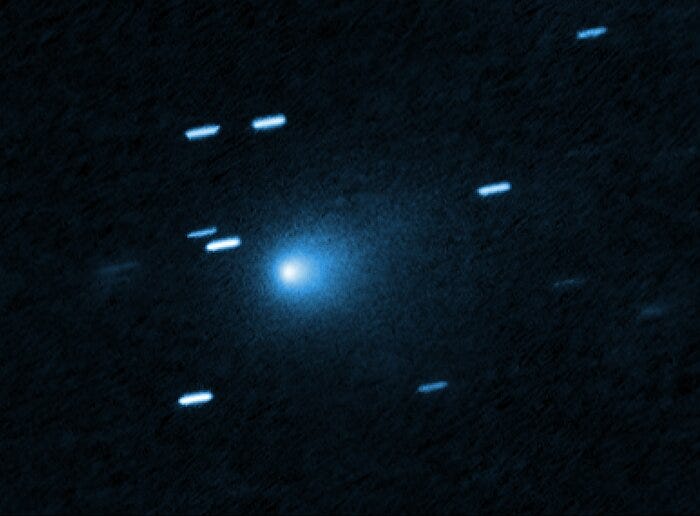
Hubble image of 3I/ATLAS (July 2025). The comet’s nucleus is surrounded by a dense, teardrop-shaped dust cocoon pointing sunward. Several anomalies (composition, trajectory, polarization, etc.) have been reported for this object.
Scientific Interpretations: The prevailing consensus is that 3I/ATLAS is a natural interstellar comet, albeit an unusually large and volatile-rich one. Researchers offer explanations for each oddity within cometary physics:
CO₂ dominance: The extreme CO₂/H₂O ratio is interpreted as a sign of formation in a very cold region of its home system. As the Planetary Society notes, 3I/ATLAS’s CO₂-rich coma suggests it accreted far from its star, where CO₂ ice freezes out. In other words, it may have formed in the outer parts of a protoplanetary disk (perhaps around an older star in the Galactic thick disk). Under those cold conditions, CO₂ ices could survive and later sublimate as the comet approaches the Sun, outpacing water.
Metal chemistry: The strong nickel signal can be explained by the sublimation of metal-bearing molecules. The VLT/UVES team proposed that Ni and Fe atoms come from volatile metal carbonyls (Ni(CO)₄, Fe(CO)₅) trapped in the ice. At a few AU from the Sun, these carbonyls would sublimate, releasing gaseous Ni and Fe. This mechanism is consistent with known comet data and helps account for the high Ni/Fe ratio. (Notably, 2I/Borisov showed a more normal Ni/Fe, implying 3I/ATLAS is chemically distinct.) Similarly, the detection of HCN, a common prebiotic gas, is not unheard of in comets – it adds to the chemical richness but does not, on its own, imply artificiality.
Anti-tail physics: Detailed modeling shows that a comet can produce a sunward dust spike if large grains are ejected in a collimated jet. The Planetary Society explains that heavy dust (or ice) particles are not blown out by sunlight, but can be shoved forward by gas jets from the comet’s surface. In other words, the “backwards” tail can arise naturally from outgassing geometry. HST and ground-based imaging indeed observed the anti-tail persisting over weeks, consistent with a sustained gas jet.
Polarization: The unusually deep negative polarization simply indicates very atypical dust properties (size, shape, or composition) for 3I/ATLAS. Polarimetric anomalies have been seen in other comets (e.g,. fine carbon-rich dust), and while this instance is extreme, it can be explained by assuming an unusual grain population rather than requiring intelligence. In any case, its significance is still under study.
Orbit and alignment: Although the ecliptic alignment and planetary flybys look contrived, they are not impossible for a random interstellar object. The Solar System’s plane is not far from the galactic midplane, so there is an enhanced (though low) chance that an ISO ejected from another system enters near the ecliptic. A SETI-affiliated analysis notes that the observed low inclination has ~0.2% likelihood of coincidence, which is unlikely but not zero. Likewise, close approaches to Mars/Venus/Jupiter have a tiny probability (~0.005%), but natural comets can occasionally have such rare trajectories; until we understand ISO population statistics better, chance alignments cannot be ruled out.
Size and population: The large inferred size is surprising, given that we expected many smaller ISOs first. If confirmed, it may imply a biased detection (only the brightest are seen) or a richer reservoir of big interstellar debris than thought. It does not by itself prove artificial origin, but it is a stress for population models.
Importantly, no smoking-gun evidence of technology has been found. Astronomers emphasize that 3I/ATLAS “looks like a comet” and “behaves like a comet”. As Tom Statler (NASA Small Bodies lead) says, it “very strongly resembles, in just about every way, the comets that we know” and “evidence is overwhelmingly pointing to this object being a natural body…It’s a comet”. Likewise, the Planetary Society notes that all three known interstellar visitors have so far shown cometary characteristics, and that 3I/ATLAS is “clearly a comet”. The mainstream view is that 3I/ATLAS – though extraordinary – is an exotic comet, and each anomaly admits a natural explanation given its unusual formation environment.
At the same time, there is a healthy debate. A minority of scientists (notably Avi Loeb and collaborators) stress the coincidences and oddities. Loeb’s team has cataloged ~7 anomalies (size, jet, composition, polarization, orbit, etc.) and argues these merit considering non-natural explanations. SETI researcher E. Haque has offered an alternative “astrogeological” model – for example, he suggests 3I/ATLAS could be a lithified rock from an exoplanet’s sedimentary basin, accounting for its size and spectra without aliens. In practice, the field awaits more data (e.g., JUICE and Juno flybys, Mars orbiter images) to resolve uncertainties.
Speculative NHI Scenarios: If one takes the anomalous features at face value, several speculative extraterrestrial-technology hypotheses have been proposed (though none are supported by direct evidence). These are meant as thought experiments rather than firm claims. Plausible scenarios include:
“Trojan Horse” Alien Probe: One idea is that 3I/ATLAS might be a deliberate spacecraft disguised as a comet (a modern Trojan Horse). In this view, the object’s hidden engines or mass might use controlled outgassing to navigate. Loeb and colleagues have noted that 3I/ATLAS’s low-inclination, retrograde trajectory allows a potential reverse Solar Oberth burn (using the Sun’s gravity) that could steer it onto new orbits. They speculated that, with a small non-gravitational thrust (~5.9×10^–5 au/day² at 1 AU), 3I/ATLAS could have been set to intercept Jupiter or later Earth after perihelion. In other words, the alignment with planets and near the Wow direction could be interpreted as intentional targeting. Under this scenario, the strange Ni/CO₂ mix might be explained as an on-board fuel or machine wear, and the object’s huge inertia could be due to engineering requirements. Loeb likens it to a “dark forest” or Trojan Horse mission (a tool to potentially threaten or surveil humanity). He assigns a low (but nonzero) probability (30–40%) to the possibility that 3I/ATLAS is not fully natural.
Alien Survey or Seed Craft: Alternatively, 3I/ATLAS could be a benign probe meant to gather information or seed other systems. For example, an advanced civilization might launch self-propelled “ark” ships carrying life or data. In this view, 3I/ATLAS’s size and mass might house long-lived habitats or instruments. Its forward jet could be a reaction thruster used to correct course or slow down, rather than random cometary activity. The high Ni content could be industrial scrap or reactor material. The alignment to the inner Solar System might be for observation of Earth or other planets. If carrying micro-probes or signals, it might attempt to leave detectable traces (some have looked for radio signals along the Wow alignment, though none have been reported yet).
Interstellar Relic or Debris: A third possibility is that 3I/ATLAS is a fragment of alien technology ejected from a distant conflict or catastrophe. This “space junk” scenario could explain its odd composition as broken-down machinery. Perhaps a large spacecraft was destroyed, and 3I/ATLAS is a shard of its hull, with whatever volatile residues frozen in. Its trajectory could then be accidental, shaped by chance encounters and not intentional navigation.
Artificial Light-Sail? By analogy with ʻOumuamua (for which Loeb once hypothesized a light-sail), one could imagine 3I/ATLAS has a hidden sail. However, the lack of any measurable acceleration makes this unlikely. If a sail exists, it must be oriented so that sunlight does not appreciably push the object, or else it’s balanced by other forces. Thus, the light-sail idea is not favored here.
Extraterrestrial Communications Beacon: Some have speculated that aligning with the Wow signal direction and having unusual features could be a way to attract attention (like an interstellar “calling card”). If so, 3I/ATLAS might be broadcasting in radio/X-rays (not yet detected), or might carry an inscription for other species. This notion is very speculative and has no evidence, but is analogous to “message in a bottle” ideas for alien artifacts.
These scenarios remain highly conjectural. As Loeb himself emphasizes, the probability of a technological origin is judged low (“a black swan event”), and he urges rigorous testing rather than claiming. Indeed, Loeb points out (somewhat humorously) that 3I/ATLAS either accelerates (→ aliens?) or doesn’t (→ also aliens?); hence, extraordinary proof would be needed to overcome Occam’s Razor. No anomalous radio or optical signal has been found so far, and no obvious engineered features have been seen in high-resolution images.
By comparison, the first interstellar object, 1I/ʻOumuamua, also sparked exotic theories (e.g., a lightsail) because it had non-gravitational acceleration without visible outgassing. In contrast, 2I/Borisov showed nothing artificial. 3I/ATLAS’s blend of anomalies is unique, but most experts remain skeptical of alien hypotheses until a definitive signature appears. As Statler notes, in almost every way, 3I/ATLAS “resembles the comets that we know”. The current scientific consensus holds that 3I/ATLAS is an extraordinary interstellar comet. Nevertheless, the object is being watched closely (by planetary spacecraft and Earth telescopes) so that any truly unexplained behavior can be caught.
Sources
ar5iv.labs.arxiv.org
avi-loeb.medium.com
esahubble.org
iflscience.com
livescience.com
planetary.org
researchgate.net