Congresswoman Foxx,
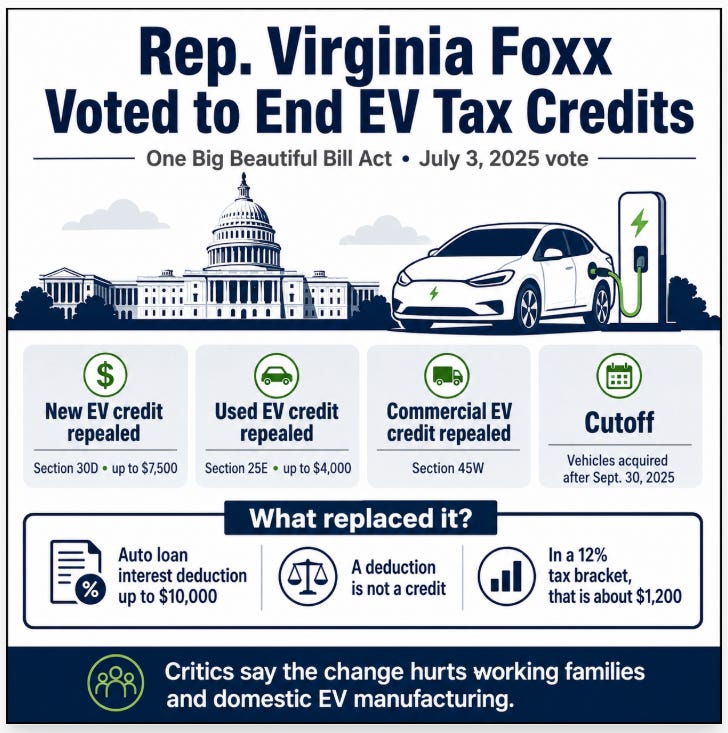
You voted for the One Big Beautiful Bill Act on July 3, 2025. That bill repealed the Section 30D credit of up to $7,500 for new clean vehicles, the Section 25E credit of up to $4,000 for used clean vehicles, and the Section 45W commercial clean vehicle credit, effective for vehicles acquired after September 30, 2025. This is the public record. The roll call is on Clerk.House.gov. The IRS has posted the cutoff in its own guidance. Before lecturing a fourth grader about taxpayer money, it is worth being precise about whose pocket you actually reached into.
The credits you helped kill were not blank checks for the wealthy. The Section 30D credit was means-tested at $150,000 modified adjusted gross income for single filers and $300,000 for joint filers. The used credit was tighter still at $75,000 and $150,000. MSRP caps were $55,000 for cars and $80,000 for SUVs, vans, and pickups. Final assembly had to occur in North America, and battery component and critical mineral sourcing rules ratcheted up each year to push supply chains out of China and into the United States and its trade partners. That is, industrial policy aimed at working and middle-income buyers of domestically built vehicles. It is the opposite of the caricature you offered the Mango family.
You replaced part of this with an auto loan interest deduction of up to $10,000 per year on American-assembled vehicles. A deduction is not a credit. A deduction reduces taxable income. A credit reduces tax owed dollar for dollar. For a household in the 12 percent bracket, a $10,000 deduction is worth roughly $1,200. The credit you eliminated was worth up to $7,500 at the point of sale, available at the dealership through the IRS transfer mechanism so that buyers without large tax liabilities could still receive the full benefit. The replacement is, on its own terms, a downgrade for the working families you say you are defending.
Now to the national debt argument, since you raised it with a ten-year-old. The Congressional Budget Office scored the OBBBA as adding several trillion dollars to the federal deficit over a ten-year window. The clean vehicle credits were a rounding error inside that bill, dwarfed by the corporate and high-income tax provisions you voted to extend and expand. You did not vote to shrink the debt. You voted to rearrange it, peeling away incentives aimed at ordinary car buyers while protecting far costlier line items. Warning a child that his generation will inherit the debt, while casting the deciding kind of vote that grows it, is not fiscal responsibility. It is theater.
On the manufacturing record, the IRA credits, paired with the production tax credits in Section 45X, drew well over $100 billion in announced battery, EV, and components investment to the United States between 2022 and 2025, the bulk of it landing in red and purple states, including Georgia, Tennessee, Kentucky, South Carolina, Ohio, Michigan, and North Carolina. Toyota’s battery plant in Liberty, North Carolina, sits in the same state you represent. Those jobs depend on a domestic EV market large enough to absorb the output. You voted to shrink that market on purpose.
On the global picture, China produces roughly 60 percent of the world’s electric vehicles and refines the majority of the critical minerals that go into its batteries. The IRA credits were one of the few federal tools actively prying that supply chain loose. Killing the demand side hands Beijing the rest of the runway and tells American automakers that the federal government will not have their back the next time a competitor dumps subsidized vehicles into adjacent markets.
On household economics, the Department of Energy and independent analyses consistently estimate EV owners save several hundred to over a thousand dollars per year in fuel costs, with additional savings on maintenance because there is no oil to change, no spark plugs, no timing belt, and regenerative braking that extends pad and rotor life. Those dollars stay in driveways in your district. They do not flow to refineries in Texas or to crude exporters overseas.
On the framing that any subsidy is unfair, the federal government provides the oil and gas industry with direct tax preferences, leasing terms, and indirect support estimated at roughly $20 billion per year, on top of trillions of dollars in unpriced externalities, including the documented health costs of particulate pollution and the climate damages quantified by the EPA, NOAA, and the IMF. There is no neutral baseline. There is only the question of which industries you choose to subsidize. You chose the older, more entrenched, more politically connected one and called it the free market.
On the reading list you sent the child. Fox News opinion segments, National Review, The Washington Times, and the Wall Street Journal editorial page are not data. They are a curated set of conclusions in search of a citation. Pointing a ten-year-old at four sources that all share a prior, then accusing his teacher of indoctrination, is the textbook definition of the behavior you projected onto her. If you have peer-reviewed evidence that the IRA clean vehicle credits were net harmful to American workers, American manufacturing, or American household budgets, publish it. Not editorials. Data.
Until then, the fourth grader was making the better argument, and he was making it with more grace than his representative in Congress managed to extend in return.
Respectfully,
A person who is looking out for your constituents because you are not