


Three days, three facts, in order.
On Saturday, September 5, Iran’s Revolutionary Guard fired ballistic missiles at the aircraft carrier USS George Washington and a guided-missile destroyer in the Strait of Hormuz. Both ships took evasive action. Central Command says neither was hit. Hours later, American forces struck three Iranian crude tankers, destroying one and disabling two.
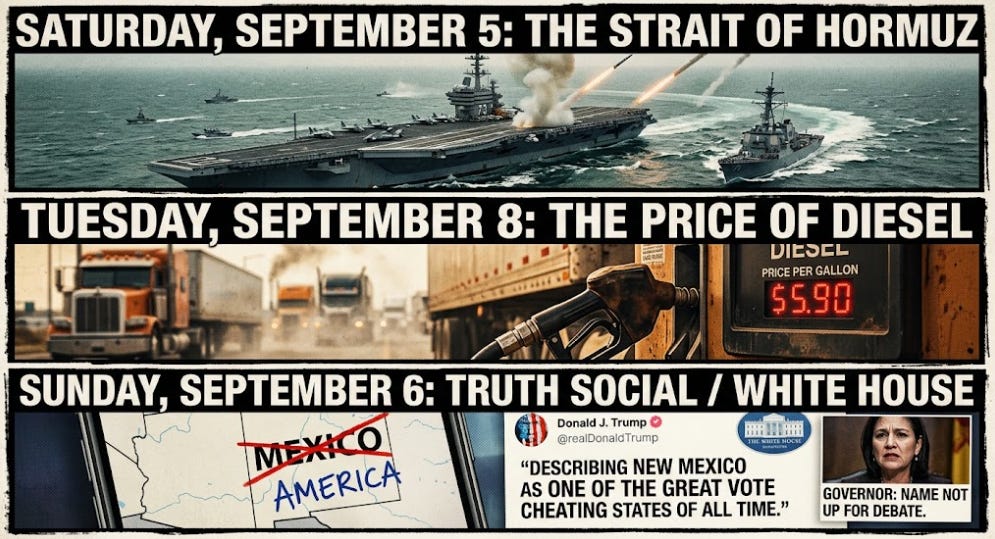
On Sunday, September 6, the president posted on Truth Social a map of New Mexico with the word Mexico crossed out in red and the word America written beneath it. The official White House account reposted it. The president followed up that evening, writing that many people had suggested the change, and describing New Mexico as one of the great vote cheating states of all time. The post followed an online hoax, already debunked, claiming he had signed an order to that effect. There is no such order. The governor of New Mexico said the state’s name is not up for debate.
On Tuesday, September 8, today, diesel fuel is at $5.90 a gallon, the highest price ever recorded in the United States. Regular unleaded set a Labor Day record at $4.15. Brent crude closed yesterday at $97.31 after touching $98.06, its highest since late July. And Canada’s retaliatory tariffs on American goods, announced by the prime minister after talks collapsed in August, take effect this morning.
That is the weekend. It is also the whole argument.
What happened at sea, stated plainly
The war with Iran is six months old. It began on February 28 with American and Israeli strikes. As of the Pentagon’s last public accounting on August 19, eighteen American service members had been killed and 757 wounded. The headquarters of the Fifth Fleet in Bahrain was rendered unusable by Iranian strikes in the war’s first months and the Navy’s chief said last week it will not be reoccupied any time soon. The Strait of Hormuz has not reopened. An American naval blockade of Iranian ports continues.
The weekend’s exchange was the first direct ballistic missile attack on an American carrier in the conflict. Iran’s parliament speaker responded to the tanker strikes by threatening retaliation against energy infrastructure across the Gulf, specifically including American oil and gas interests. The secretary of Iran’s Supreme National Security Council said a restricted zone would be announced within days, running from the American blockade line into the Gulf itself. Iran’s foreign ministry promised a response that would be faster, heavier, and more painful.
The defense secretary’s position, posted on X, is that Iran’s tanker fleet is defenseless because Iran has no navy or air force, and that every Iranian shot at an American ship will be answered with a sunk tanker. That is a coherent doctrine. It is also a description of a war that has become, in its seventh month, a tanker war, fought over the same chokepoint it was supposed to open, with the enemy now announcing which routes through that chokepoint it will permit.
What it costs at the pump
Diesel is the number that matters, and it is worth explaining why, because most Americans do not buy it.
Diesel is the price of everything that moves. It fuels the trucks that carry food to grocery stores, the tractors that plant and harvest, the trains, the ships, the delivery vans. When diesel reaches an all-time high, the increase does not stay at the pump. It arrives, with a lag of weeks, in the price of ground beef and lettuce and shipping and every manufactured object that traveled to reach a shelf. Companies have already reported raising prices on beer, french fries, paint, and packaging to cover freight and commodity costs. Diesel at $5.90 means the next round of those increases is already in the pipeline.
The Gulf benchmark, Murban crude, is at $106.80. That is the price of oil that has to get out of the Gulf, and it is nine dollars above Brent, which is the market pricing the risk of the strait in real time.
None of this is projection. It is Tuesday.
What it costs at the border
Canada’s retaliatory tariffs take effect today. They are the answer to the fifty percent tariffs the United States imposed on roughly twenty billion dollars of Canadian goods in August, after which talks collapsed on August 21 and the prime minister announced the response. He also said, in the same period, that a country is at war when it is attacked, and that Canada had been attacked.
Canada supplies millions of barrels of crude a day to refineries in the upper Midwest and enough electricity to power roughly two million homes in Maine. It is the largest trading partner of most American border states. A trade war with it is not an abstraction to anyone who buys gasoline in Minnesota or pays an electric bill in Portland.
So today, on the same morning, two policies that this administration chose, a war it started and a trade war it started, land on the price of fuel from two directions. The war closes the strait and raises the price of oil. The trade war raises the price of the Canadian oil that would have partly replaced it. Neither was forced on the country. Both were decisions.
The scale
Thirty-seven percent of Americans name prices and inflation as the single most important problem facing the country. That figure was 36 in June and 36 in July. It has not moved in three months, which makes it the most stable number in American public opinion, and it was measured before diesel hit a record and before Canada’s tariffs took effect.
The president is now polling net negative on border security, which was his strongest issue, in the same month his own Department of Homeland Security announced fifteen straight months of zero releases at the southern border and apprehensions down 94 percent. By the administration’s own metrics the border policy worked, and the public turned against it anyway. That tells you the scale on which people are weighing this administration is not the one it wants to be weighed on.
The scale is the pump, the grocery receipt, and the diesel surcharge on the delivery. On that scale, the two largest policy choices of this presidency both register as costs, this week, simultaneously, with eight weeks to go.
The calendar
Reporting from the weekend describes a White House trying to keep the conflict in check until November 3.
That is a remarkable thing to have on the record. It means the tempo of an active war, with American ships under ballistic missile fire, is being managed against a domestic election date. Not against Iranian capability, or the reopening of the strait, or the recovery of the Fifth Fleet’s headquarters. Against a Tuesday in November.
Iran can read a calendar. So can every other government watching. An adversary that knows its opponent is trying to avoid escalation for eight specific weeks has been handed a schedule, and the restricted zone announcement, the missiles at the carrier, the threats against Gulf energy infrastructure, and the promise of something faster and heavier all arrived inside that window. The administration’s incentive is to absorb provocations until November. Iran’s incentive is to provide them.
The same instinct governs what the public is allowed to see. The administration has pressed commercial satellite companies to restrict imagery showing damage to American assets in the region, and has declined to tell Congress what the damage has cost. The Pentagon has not publicly updated the extent of it since June. A war managed toward an election date is also a war whose visible costs are being managed toward the same date.
A strategy would have an objective in the Gulf. This has a date in the United States, and both sides are watching the same clock.
The administration’s case, fairly
It deserves stating, because the piece is stronger for answering it than ignoring it.
Iran fired first this weekend. The tanker strikes were proportionate, targeted infrastructure rather than people, and produced no casualties on either side. The blockade is holding. American officials say more oil is now flowing through the strait than in the spring, when it was effectively closed. Iran has no navy and no air force, its tanker fleet is exposed, and every missile it fires costs it a ship. On that reading, the weekend was a demonstration of American leverage, and Iran’s threats are the noise of a country running out of moves.
Some of that is true. Iran did fire first on Saturday, the tanker strikes were measured, and the blockade is real.
The answer
The war’s stated purpose was a short campaign that would end the Iranian threat and reopen the strait. It is in its seventh month. The strait is not open. The enemy is announcing exclusion zones. An American carrier came under ballistic missile attack. The Fifth Fleet has no headquarters. Eighteen Americans are dead and 757 wounded, and the price of the fuel that moves the country’s food is at the highest level ever recorded.
A war that is being held in check is, by definition, not being won. It is being managed, and what it is being managed toward is not an outcome in the Gulf. It is a date on a calendar in the United States.
And on the one day of that weekend when the president was not responding to a carrier under fire, he was posting a map that crossed out the name of an American state, in response to a hoax, and calling it a vote-cheating state, eight weeks before that state votes.
That is where the attention went. Anyone trying to understand what Americans are weighing right now, and on what scale, has those three days to work with. A carrier dodged missiles. Diesel hit a record. The president renamed a state on the internet.
The public is not confused about which of those it will remember at the pump.