


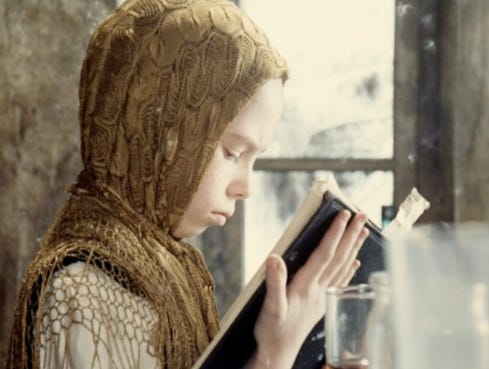
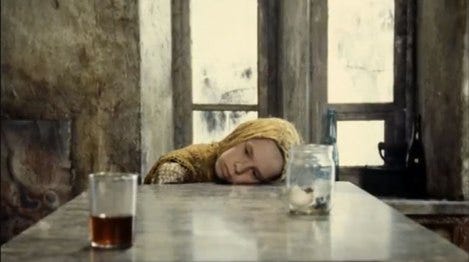
She is the last thing the film shows you. Not the Zone, not the Room, not the three men who walked there and back. A girl at a kitchen table, head wrapped in a scarf, chin near the wood, three glasses in front of her. She does not speak. She has no dialogue, not one line, in two and a half hours of film. She does not walk. Her father carried her on his shoulders in the only scenes that let her outside. Stalker spends its entire length in a haunted industrial wasteland chasing the impossible. Then it ends in an apartment, on a child, and the impossible is finally, plainly, on screen.
The men went looking. That is the whole plot, and the series has spent four essays on the looking. The Stalker performed faith, and the film undercut him every time he opened his mouth. The Professor performed competence, and carried his certainty into the Zone as twenty kilos of plutonium. The Writer performed suffering, and wore a crown he issued himself. The Wife performed nothing, and because she performed nothing, the film let her speak to us directly, and what she said was that she would do it again. Four people, four relationships to the sacred, three of them in costumes and one of them bare.
Then there is Monkey, and Monkey is none of it.
She does not perform faith, because she does not need to be believed. She does not perform competence; the one genuinely impossible act in the film has no method anywhere near it. She does not perform suffering, though she has more cause than the Writer ever did. She is not even granted what the Wife is granted, the direct address, the argument, the case made aloud against the audience’s pity. The Wife is sincerity with a voice. Monkey is sincerity with the voice removed. She wants nothing on screen, asks for nothing, explains nothing. The Room is a desire engine, and every other character is defined by what they want and whether they will admit it. Monkey is the only person in the film standing outside the economy entirely. She is what the Room would produce if the Room could produce without being asked. Grace, in the old sense of the word. Unmerited, unrequested, already in the house.
This series began with a poem. A real one, written by the director’s own father, placed in the mouth of a fictional dead man and recited by the Stalker in a flooded laboratory as a private prayer to no one. But there has to be more. Insatiable longing, smuggled in from outside the fiction. The film ends with the other poem. Over the last shot of Monkey at the table, we hear her voice for the only time in the picture, and she is reading Tyutchev, and the Tyutchev is a love poem. The one time the film lets her speak, the words are not hers and they are addressed to no one in her world. Two poems, then. Both real, both borrowed from outside the film, both spoken by people who did not write them. The father recites longing near the start. The daughter recites love at the end. The film frames itself between them, and so does this series, if you let the last essay turn around and face the first. The thing the Stalker reached for and never named, the more, was reading at the kitchen table the whole time.
The Writer’s essay built the iconography of borrowed suffering and then exposed the Writer as its thief. A martyr without a cross, the crown self-issued, the man underneath pierced by nothing. Monkey is the version that was never stolen. The Zone made her. The lore is explicit, and the Wife confirms it without flinching: she knew, before she married him, that there would be a daughter who would not walk. Monkey carries a consequence she did not earn, for a vocation that was never hers, paid out of a body she did not choose. That is the actual thing the Writer dressed himself as and could not be. Borrowed pain, real this time. No wreath. No audience. No speech. A nickname where a name should be. The Writer’s thorns were wire and brambles, and he walked through the corridor that placed them on his head. Hers are permanent, and no one in the film points to them, including her. The camera points. You point. It is the same shot as the wreath in the meat grinder, held in the same hush, and this time there is no joke inside it.
The Wife’s essay said the sacred had been in the apartment the whole time, and the men had looked in the wrong place. This is where that sentence finishes. The miracle is not a wish waiting to be granted. It is a wish already granted, off-screen, before the film began. The Zone gave the Stalker the genuinely supernatural thing he spent his life walking toward. It gave it to him in the one form he can never reach through the Room. It put the miracle in the next room of his own apartment and let him spend the film walking away from it. And the granting cost his daughter the use of her legs. He is the only pilgrim in the film whose wish came true, and he never entered the Room. He spends the picture leading strangers to a threshold he believes himself too impure to cross, and the miracle has been riding on his shoulders the entire way there and back. The Room is the fantasy that desire can be paid for by no one. Monkey is the standing proof that it cannot, and that the bill is handed to whoever was nearest and least consulted.
Look at what the Zone actually did. It took her legs and gave her the power to move what she cannot touch. Locomotion denied, telekinesis granted, in a single gesture, the wound and the gift folded into the same event. There is no separating them. That is the Zone’s true signature, clearer here at a kitchen table than anywhere in the wasteland the men crossed to find it.
And the family calls her Monkey. Sit with that. The most powerful being in the film carries its smallest name. The Writer crowned himself upward, toward a sainthood he had not earned. The family named the miracle downward, into a pet, into something domestic and small, because no household can sit at a table three times a day with a thing it calls sacred. The diminutive is not cruelty. It is how love survives proximity to the uncanny. You cannot live with a miracle. You can live with Monkey.
So the film ends where it was always going to end. Not on the Zone, which gave up its mystery to no one. Not on the Stalker asleep and defeated, not on the Writer already writing the trip, not on the Professor walking back to whatever houses a man like that. It ends on a girl alone at a table, and three glasses that slide and tip with no hand near them, while a train passes underneath and the wood shakes, and Tarkovsky refuses, in the last seconds he has, to tell you which tremor is the miracle and which is only the train. The sacred declines, one final time, to prove itself. The men went to the Zone to find something. The Wife was already there. The daughter was the thing they went looking for, sitting in the next room the whole film, reading a love poem, granting no wishes, asking for nothing, and answering to Monkey.
The series: https://tomwellborn.substack.com/s/stalker-a-tarkovsky-film