


Both of them were New Yorkers on September 11, 2001. One had been sworn in as the state’s junior senator eight months earlier. The other owned a building seven blocks from where the towers fell. What each of them did with that proximity is a matter of public record, and the record does not treat them the same.
The phone call
Hillary Clinton was on her way to the Capitol when the first plane hit. By late morning she was on the Capitol steps with the rest of Congress, joining an impromptu chorus of “God Bless America” while the building she worked in was itself being evacuated on fears of another attack. The New York Times reported the next day that she was in tears. That evening she went on CNN and pledged support for President Bush and pressed for a response to the attack.
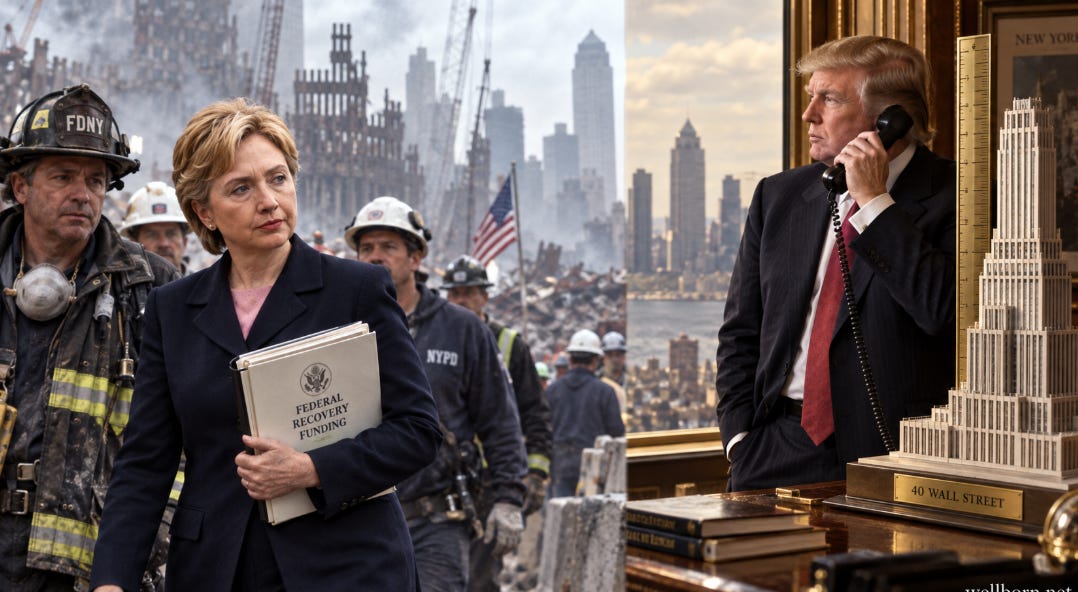
Donald Trump, a private citizen with no office to report to, spent part of that afternoon on the phone with a New Jersey television station, WWOR, explaining that his building at 40 Wall Street was now the tallest in Lower Manhattan. “40 Wall Street actually was the second-tallest building in downtown Manhattan,” he said, “and now it’s the tallest.” It wasn’t. 70 Pine Street, one block over, stood twenty-five feet taller and remained standing. Trump got the fact wrong on the same call in which he used the collapse of the World Trade Center to advertise his own real estate.
Four miles away
Fourteen years later, running for president, Trump added a detail to his story. He said he had watched people jump from the towers with his own eyes, from a window in his apartment that he described as “specifically aimed at the World Trade Center.” CNN checked the geography. Trump’s apartment, in Trump Tower on Fifth Avenue, sits more than four miles from where the towers stood. His campaign did not respond when CNN asked how he had seen individual people falling from a building four miles away.
Clinton’s account of that week does not require anyone to check a map. She and Senator Chuck Schumer flew into LaGuardia the next morning on one of the handful of flights still permitted in American airspace, then walked toward the wreckage. She has described what she found there plainly: few survivors, the ones who lived grievously injured, the scale of the loss overwhelming. Nobody has ever had to fact-check whether she was close enough to see it.
“You got it.”
Two days after the attack, Clinton and Schumer sat down with President Bush in the Oval Office. Clinton has recounted the exchange the same way for twenty years: Bush asked what New York needed, she told him twenty billion dollars, and Bush said, “You got it.” The number is not a campaign talking point she invented afterward. Bush repeated the twenty-billion-dollar figure in his own public remarks that fall and again the following March, standing in the Rose Garden with the New York delegation beside him, thanking Clinton and Schumer by name for the work of getting it delivered.
Getting it delivered took years, not a handshake. Congress approved an initial ten point seven billion dollars in December, a little over half of what Bush had pledged, with the rest arriving in installments over the following two years as Clinton and Schumer kept pressing for it. She would later cite this period, not always gracefully, as the defining work of her Senate career, telling a 2016 primary debate audience that she had “spent a whole lot of time and effort helping them rebuild.” The moment landed badly, because it came in answer to a question about her Wall Street donors rather than as a standalone claim. The underlying work it was defending is not in dispute.
Where the money went
Two billion dollars of that recovery package was earmarked for small business and commercial redevelopment in Lower Manhattan, run through the Lower Manhattan Development Corporation and the Empire State Development Corporation. Among the more than eight thousand early recipients was 40 Wall Street LLC, the single most valuable property in Donald Trump’s portfolio. The building he had bragged about on television on the day of the attack later collected federal recovery money that Hillary Clinton had personally gone to the Oval Office to secure.
On his own giving, the paper trail is thin. Trump pledged ten thousand dollars to the Twin Towers Fund as part of a donation drive organized by Howard Stern. A New York City comptroller’s review of the fund’s donor records within a year of the attacks found no record that the pledge was ever paid. PolitiFact, searching independently, could not find evidence that Trump donated to any 9/11 charity in the immediate aftermath. He did give one hundred thousand dollars to the National September 11 Memorial and Museum, in 2016, on his first visit to it, in the middle of a presidential campaign. Around the same time, he told a Buffalo rally that he had personally helped clear rubble at Ground Zero, saying he had been there and “helped a little bit.” No account from that week, including his own contemporaneous interviews, mentions it.
Thousands and thousands
The claim that did the most damage came in November 2015, at a rally in Alabama, when Trump told a crowd he had watched, on television, “thousands and thousands of people” in Jersey City celebrating as the towers fell. Pressed by George Stephanopoulos the next morning, he did not walk it back. “It did happen,” he said. “I saw it. It was on television. I saw it.” New Jersey law enforcement said no such celebrations had been documented. Reporters searched for any contemporaneous footage and found none, only unrelated video of celebrations in the West Bank.
Trump’s defense, when the story wouldn’t die, was to read a 2001 Washington Post article aloud at a rally, one that mentioned police detaining people who were “allegedly seen celebrating” near a rooftop in Jersey City. It was, on its face, the strongest evidence he ever offered. Both reporters who wrote that original 2001 story told the Post’s own fact-checker it didn’t say what Trump needed it to say. One of them, Serge Kovaleski, said he did not remember anyone reporting thousands or even hundreds of people celebrating. The other, Fredrick Kunkle, said he had gone to the building and the neighborhood himself and had never been able to verify the report existed at all. Trump’s own citation, checked against the men who wrote it, disproved him.
What they did with it afterward
Clinton’s post-9/11 record, for all its length, stayed inside a fairly narrow lane: funding, healthcare, and infrastructure for the city and the people who responded to the attack. She was a lead cosponsor of the James Zadroga 9/11 Health and Compensation Act, which established medical monitoring for first responders and survivors, and she continued to cite the fight for that funding as her defining Senate work for the rest of her career.
Trump’s post-9/11 record ran in a different direction entirely, treating the attack less as an obligation than as a rhetorical weapon to be pointed at whichever opponent was in front of him. In a 2016 primary debate he blamed the attacks on Bill Clinton for not killing Osama bin Laden and on George W. Bush for ignoring CIA warnings. On the campaign trail that August he told a Florida crowd that the hijackers “most likely, under the Trump policy, wouldn’t have been here to knock down the World Trade Center,” and in the same period called Hillary Clinton the “founder of ISIS.” Nineteen days later, both candidates attended the same fifteenth-anniversary memorial service in Lower Manhattan. Clinton left early, feeling unwell, and did not deliver formal remarks. Trump issued one.
The bill he signed
One piece of this record complicates a purely one-sided account, and it belongs here rather than left out. In 2019, as president, Trump signed H.R. 1327, permanently authorizing the September 11th Victim Compensation Fund. It is a real and meaningful act, and first responders who had spent years fighting for the money are better off because of it.
It is also worth being precise about what that signature actually represents. The bill was written and driven through Congress by a bipartisan group that included New York Democrats Carolyn Maloney, Jerrold Nadler, and Chuck Schumer alongside Republican Peter King, after comedian Jon Stewart spent months publicly shaming lawmakers, at one point testifying through tears in front of a nearly empty committee room. The House passed it 402 to 12. Trump’s role was the final procedural step in a fight that Congress, first responders, and a television comedian had already won by the time it reached his desk. That is still worth crediting him for. It is not the same thing as having led it.
The shape of the record
Run the two files side by side and the asymmetry is not close. Clinton’s 9/11 record is documented in the Congressional Record, in signed budget commitments, in a piece of federal legislation carrying a first responder’s name. Every dollar and every date in it can be checked against a government transcript. Trump’s 9/11 record is documented mostly in fact-checks, because so much of it consists of things he said he saw that the available evidence says he could not have seen: people jumping from a building four miles from his window, celebrations that the two reporters whose own story he cited both said never happened, a season of rubble-clearing that appears nowhere in his own words from that week.
He got the building. She got the money for the city.