


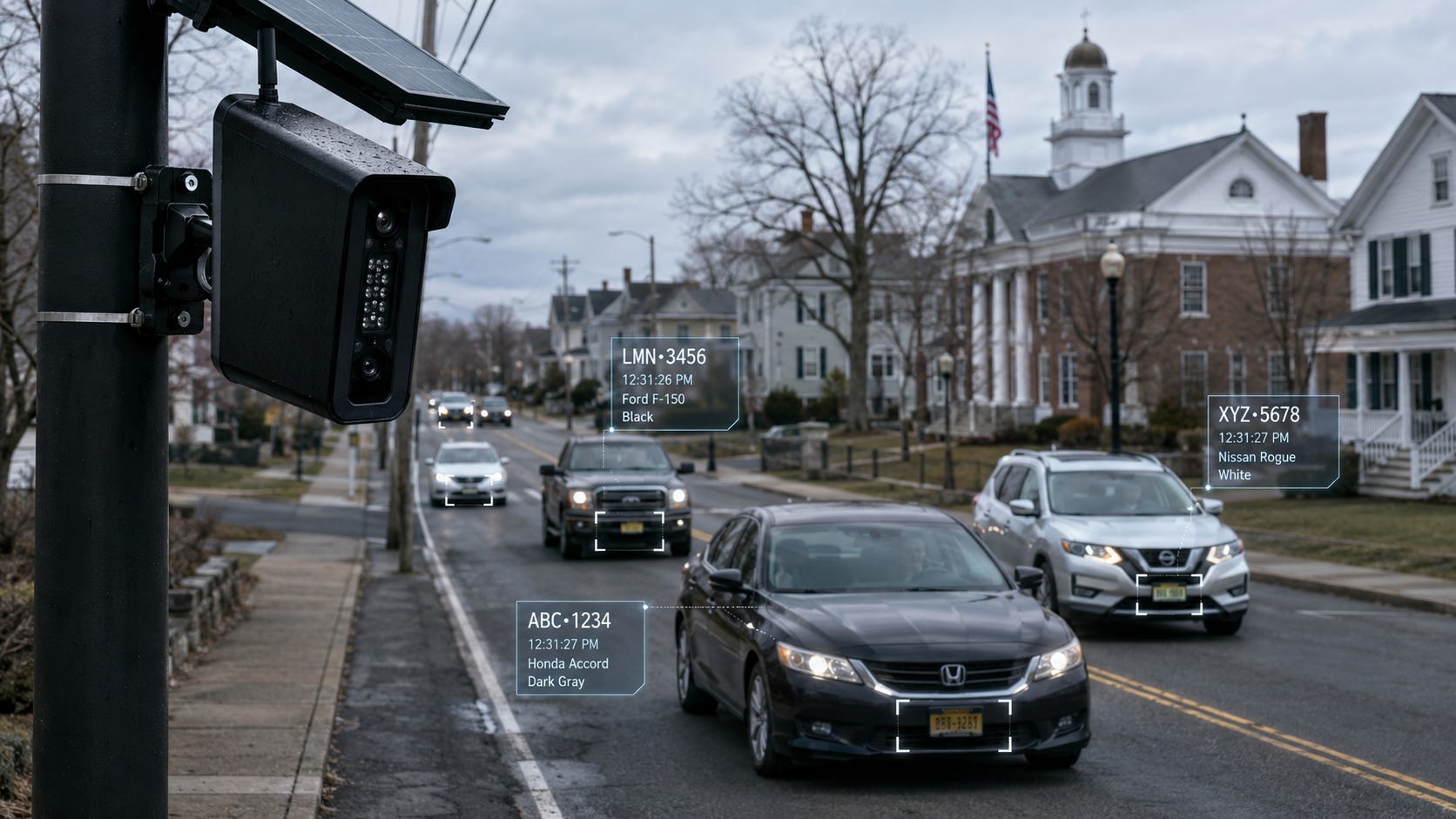
On the evening of August 11, residents packed a council meeting in Franklin Township, Somerset County, to object to twenty-two cameras that photograph every vehicle that passes them and record the make, model, color, and plate.
A man named Michael Vintzileos, from North Plainfield, stood up to speak, and Mayor Phillip Kramer repeatedly asked him to state his name and address for the record.
I am not going to labor that. It labors itself.
Leslie Primo, of Somerset, said the cameras should have been publicized before they went in and put her objection in one line. We can police without stalking. AJ Hoffman, a software engineer from Franklin Park, called it warrantless mass surveillance and said it threatened freedom of speech, assembly, and association. The petition against the program has passed eight hundred signatures.
Franklin Township has used plate readers since 2010. That is not the change. The change is the scale, and the scale is in the state's own audit.
Five hundred and twenty-three of New Jersey's roughly five hundred and thirty law enforcement agencies now use automated license plate reader technology.
That is 98.7 percent of them.
What the cameras are
A Flock Safety camera is a solar-powered unit on a pole. It photographs every passing vehicle, not only vehicles connected to an investigation, and uploads the image, the plate, the vehicle characteristics, the location, and the timestamp to a searchable cloud database.
The company says its equipment is in more than six thousand communities across forty-nine states. The volunteer mapping project DeFlock has plotted more than a hundred and twenty thousand cameras.
The objections are not hypothetical and they are not new. Officers in multiple jurisdictions have been caught running searches on relatives, friends, and former romantic partners. Inaccurate plate reads have contributed to wrongful stops, arrests, and detentions. The New York Times has reported data being shared with the Department of Homeland Security and Immigration and Customs Enforcement.
Since January, according to DeFlock's tally, forty-seven jurisdictions have canceled contracts, twenty-five have voted proposals down, and twenty-two have switched cameras off.
And last Thursday the company announced it would recommend that agencies cut retention from thirty days to seven, and add tools to restrict inter-agency sharing and flag potentially abusive searches.
That last item is worth pausing on, because it is the part people miss. The pushback moved a private company's default settings for six thousand communities. It worked.
The Princeton problem
Now the complication, and it is the reason a lot of this energy is going to be wasted.
In Princeton, a resident named Chris Potts filed a petition asking the council to ban Flock cameras, disclose the locations of any cameras already installed along with any data-sharing agreements, and require a public hearing before similar technology is introduced. As of August 11 it had ninety-three of the hundred signatures it needs to go before the mayor and council.
Princeton's police chief, Matthew Solovay, responded accurately. There are no Flock cameras in Princeton. The department does not use Flock Safety technology.
The department does use automated license plate readers. From a different vendor.
So a ban on Flock in Princeton would change nothing at all, and this is not a Princeton problem. In Asheville, North Carolina, the council moved this month toward terminating its Flock contract while explicitly leaving the door open to buying the same capability from Axon, its other surveillance contractor. In Cincinnati the police use Motorola. In Niagara Falls the proposed contract runs through SHI International, a New Jersey reseller, in partnership with Flock.
One councilwoman in Asheville, Kim Roney, said the quiet part: if the department swaps Flock for Axon, we still have a constitutional problem.
The fight is being conducted against a logo. The logo is not the thing.
Who approved it
Here is the finding that should bother you most, and it comes from a tracker that has been assembling the paperwork.
The site whoapprovedthis.org compiles Flock contracts from council agendas, minutes, and signed documents, and records how each one was approved. As of early August, the single largest category in the file was Unknown. A hundred and fifty-eight records where the approval method could not be established from public documents.
Not voted down. Not approved unanimously. Unknown.
In Menominee, Michigan, the council discovered that cameras had been activated before it authorized anything, and voted unanimously in May to cancel. In North Branch, Minnesota, the council approved seven cameras on a 3 to 2 vote in May, three went up without being switched on, public pressure built through the summer, and on August 12 the council reversed itself unanimously.
Both of those towns found out what had happened because somebody went and looked.
How to find out about your own town
This is the part that makes the piece worth your time, because unlike almost everything else I write about, you can settle this yourself in an afternoon.
Start with the agenda. Search your municipality's website for the council agendas and minutes covering the last three years and look for the words Flock, license plate reader, ALPR, or automated license plate. Contracts are usually approved by resolution and resolutions are numbered and archived. If the town uses a portal, the search box on the portal is faster than the site's own search.
File the request. In New Jersey the tool is the Open Public Records Act. Requests go to the municipal clerk, who is the designated custodian, and there is a standard form on most town websites. Ask for the executed contract or subscription agreement, any purchase resolution and the vote, and the department's ALPR policy or directive.
Then read for four things.
The retention period. How many days the images and plate reads are kept before deletion. Thirty was standard. Seven is now the vendor's recommendation. Some departments set their own and some never set one.
The sharing settings. Whether your town's data goes into a statewide lookup network, a national one, or neither. This is the single most consequential setting in the system and it is usually a checkbox somebody chose once.
The audit provisions. Whether searches are logged, who reviews the logs, and how often. Every documented abuse case was found in an audit log, which means audit logs are the only thing that has ever caught anyone.
The disclosure clause. Hillsborough, North Carolina ended its relationship with Flock after officials read language they believed would let the company disclose data to any government entity or third party on a good faith belief that it needed to. Find your version of that sentence and read it twice.
Then go to a meeting. Public comment is on every municipal agenda in New Jersey by law. The Franklin Township meeting happened because roughly thirty people showed up, and it is now in three newspapers.
What this is actually about
Nobody in Trenton voted for a statewide surveillance network. Nobody in Congress did either. There was no bill, no hearing, no debate, and no moment at which anyone was asked.
What there was instead was several thousand line items, on several thousand agendas, in rooms that seat forty people, approved on consent calendars at nine at night by councils whose members had other things to get through, using grant money that made the first year free.
That is how it got to 98.7 percent of New Jersey police agencies without a single statewide vote.
It is also, and this is the only good news in the piece, how it can be unwound. The same rooms. The same agendas. The people in Menominee and North Branch did not sue anybody or win an election. They read the paperwork and then they turned up.
Your town's contract is a public document and the clerk is required to respond to you.
Go and ask what it says.