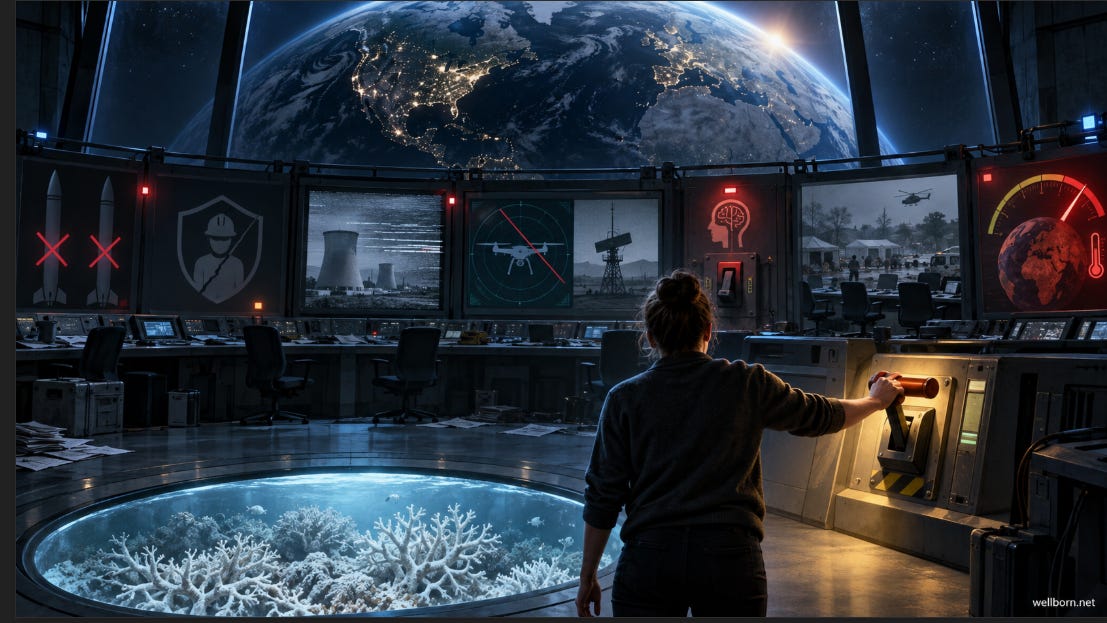
The argument that everything is converging at once is easy to make and easy to dismiss, because it arrives as a mood rather than as evidence. So here is the evidence, dated, in the order it happened, with the sources attached. Check any line of it.
February 5, 2026. Nuclear arms control ended.
The New Strategic Arms Reduction Treaty expired. For the first time since Richard Nixon met Leonid Brezhnev in Moscow, there is no treaty limiting the strategic nuclear arsenals of the United States and Russia. There are no inspections, no data exchanges, and no negotiations underway to replace it. None are planned.
The verification regime had already been dead for three years, since Russia suspended participation in 2023. In September 2025 the Kremlin offered to keep observing the numerical limits voluntarily for one year past expiration, without verification. Trump told a reporter the proposal sounded like a good idea to him and then, apparently, never responded to it before the deadline passed. His public position was that if it expires, it expires, and a better agreement would follow. UN Secretary-General Antonio Guterres called the lapse a grave moment for international peace and security, noting it came at a time when the risk of nuclear weapons use is the highest in decades.
Both countries built their entire nuclear modernization programs on the assumption that neither would exceed New START’s limits. That assumption now has nothing underneath it. The danger is not that either side wants a nuclear war. The danger is a future crisis in which neither knows what the other has deployed or where.
February 12, 2026. Federal labor protections.
The Office of Personnel Management directed agencies covered by Executive Orders 14251 and 14343 to proceed with terminating collective bargaining agreements, including at agencies where implementation had been delayed by litigation. Across both orders the exclusions reach roughly 950,000 workers, about 85 percent of the unionized federal workforce, at agencies including Veterans Affairs, the CDC, the FDA, NASA, and the National Weather Service. The IRS terminated its contract with the National Treasury Employees Union on February 27.
Spring 2026. Nuclear plant security inspections.
The Nuclear Regulatory Commission cut security baseline inspection resources roughly in half. Eight of eleven security inspection procedures were retired and folded into two. Material control and accounting inspections moved from every three years to as-needed. Cybersecurity inspections moved from every two years to every three. Total reactor oversight inspection hours fell 38 percent, from 2,018 to 1,245. The agency’s rationale, which belongs in the record, is that fleet performance has been consistently strong since 2000 and some inspections consumed heavy resources while producing few findings.
July 1, 2026. Counter-drone rulemaking.
The interim final rule implementing the SAFER SKIES Act took effect without ordinary notice and comment, on good cause grounds. The comment period closed September 4, two months after the rule was already binding. This followed a stretch from October 1 to December 18, 2025 when federal counter-drone authority had lapsed entirely, leaving DHS and DOJ with no legal authority to mitigate drone threats near airports, federal facilities, or mass gatherings for roughly two and a half months.
July 2026. The AI industry deleted its own brakes.
The Future of Life Institute’s latest AI Safety Index found that Anthropic, OpenAI, Google DeepMind, and Meta have all weakened or eliminated earlier commitments to pause development if their systems approached specified danger thresholds. The best grade any company earned was a C-plus. xAI, DeepSeek, and Mistral failed outright.
The entire architecture of AI safety rested on one promise, which was that when a system became dangerous enough, the people building it would stop. Four of the largest builders on the planet have now walked that promise back, and no binding alternative exists to replace it.
August 4, 2026. Disaster response.
The Government Accountability Office found that about 17 percent of FEMA’s workforce, more than 4,300 employees, separated in fiscal 2025. GAO found no evidence that DHS or FEMA had assessed what any of this would do to the agency’s ability to respond to a disaster. FEMA’s disaster workforce had already been added to GAO’s High Risk List in February 2025.
September 2, 2026. The 1.5 degree limit.
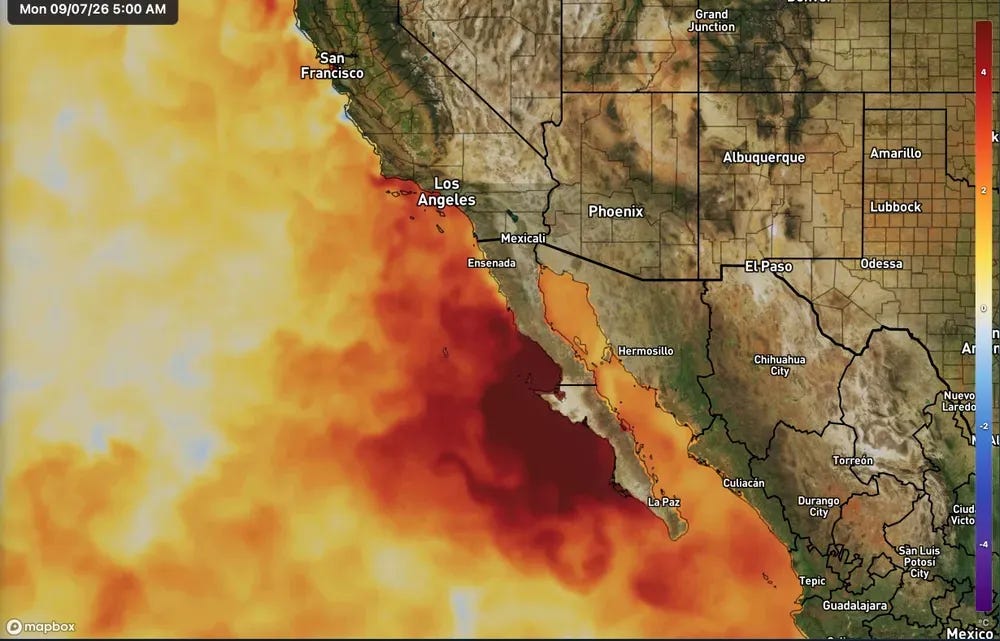
Nature reported that the United Nations has finally conceded global warming will overshoot 1.5 degrees Celsius, the threshold that has organized every international climate negotiation since Paris. Ocean temperatures are on the verge of an all-time record, which weakens the ocean’s ability to absorb carbon and accelerates everything downstream of that.
And the one that is already permanent.
In October 2025, scientists identified the widespread death of warm-water coral reefs as the first Earth-system tipping point humanity has actually crossed. Not projected. Crossed. Roughly a billion people depend on reefs for food, work, or coastal protection, and the recovery window for the most resilient species has closed.
What has not tipped, and why that matters
Here is the distinction that most writing on this subject collapses, and collapsing it is how people talk themselves into doing nothing.
The Atlantic Meridional Overturning Circulation has not collapsed. It is at its slowest in 1,600 years, and a study in Science Advances projects a 51 percent slowdown by 2100 against the 32 percent that international bodies had been using. But research published in Nature Climate Change this August, from the Institute for Marine and Atmospheric Research at Utrecht, found something that changes the shape of the problem. Lead author René van Westen concluded there is no fixed temperature beyond which the AMOC inevitably collapses. Stability depends partly on how fast the climate changes. Under fast warming, collapse onset appeared around two degrees in their model. Under slow warming, it did not appear at all.
The rate is a variable, and the rate is something human decisions still control.
The same is true of nearly everything else on this list, and it is the reason to publish the list rather than despair at it. Coral is gone. Nuclear arms control is a document that can be renegotiated by two governments that want to. Inspector general vacancies are filled by nominations and confirmations. FEMA staffing is a budget line. AI pause commitments are corporate policy, which means a board or a regulator or a sufficiently frightened Congress can put them back. Reactor inspection hours are a schedule.
None of that is easy. All of it is possible, and the difference between impossible and merely very hard is the entire ballgame.
So what are we supposed to do
This is the part readers actually want, and most pieces like this one skip it or lie about it. What follows is neither optimism nor a plan for fixing the world, because no individual has one. It is what a person can actually do with an accurate picture.
Sort the grief from the work. Some of this is lost for good, and grief is the correct response to loss. The reefs are not coming back in any timeframe that matters to anyone reading this. Grieving that is honest. What is dishonest is letting grief for the lost thing spread across the things that are not lost yet, because that spread is how a person ends up mourning a nuclear treaty that could be signed next year by two people in a room.
Notice that speed is a variable. The Utrecht finding is not a technicality. In a system where the rate of change determines the outcome, every year of delay purchased has real value, even after a target has been missed. Overshooting 1.5 degrees does not make 1.6 the same as 2.5. Anyone who tells you the difference no longer matters is describing their own exhaustion rather than the physics.
Treat institutional damage as the reversible category and act there. Most of this list is staffing, budgets, treaties, and corporate policy rather than physics, all of which respond to elections, litigation, congressional pressure, and shareholder revolt on a timescale of years rather than centuries. The midterms are November 3. Whatever else is true, that is a lever attached to a real mechanism.
Work at the scale where you can see the result. National catastrophe is not something an individual acts on directly, and pretending otherwise produces the specific despair that comes from swinging at something too big to hit. Local election administration, your county’s emergency management, a state legislature, a mutual aid network, the actual people on your actual street. These are where resilience actually gets built when federal capacity is being cut, and they are the layer that catches people when the layer above fails.
Keep records. When repair is not available, documentation is the next thing, and it is not nothing. Dated, sourced, checkable accounts of what was dismantled and when are what make repair possible later, and they are what prevents the whole period from being relitigated as a matter of opinion. This is the entire premise of the Dismantling Tracker on this site, and it is why the changelog matters as much as the entries.
Refuse both easy exits. Denial and nihilism feel like opposites and produce identical behavior, which is nothing. One says there is no problem. The other says the problem is too large to touch. Both let a person set the whole thing down and go back to their life, which is exactly what they are for. The harder position, and the only useful one, is to keep an accurate picture in view and go on acting inside it anyway.
Protect your attention deliberately. The firehose is not an accident and exhaustion is not a personal failing. A person who reads everything, all day, every day, ends up no better informed than one who reads carefully three times a week, and considerably less capable of doing anything with it. Pick the two or three threads you will actually follow, follow them properly, and let the rest go by without treating that as a moral failure.
And keep the timeline. The reason to write down February 5 and July 1 and September 2 is that a year from now, someone will say nobody could have known, and they will be wrong, and the dates will be sitting right here.